



18 November 2026
The Palestine Action repression – the same old British state
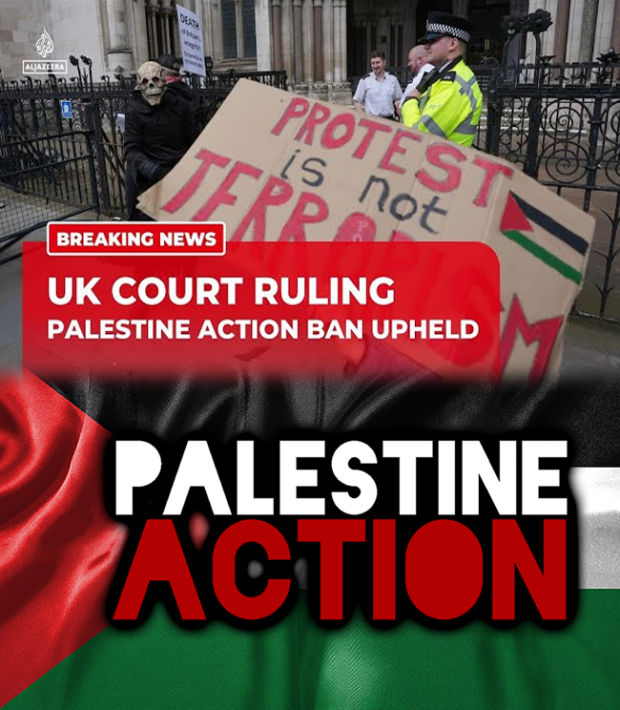
On 2 July 2025, 382 British MPs passed through the Aye division lobby to brand the direct-action group Palestine Action a terrorist organisation under the Terrorism Act 2000. Yet largely unnoticed amid the debate was an extraordinary piece of Westminster irony. Just hours earlier that same day, British MPs had gathered in Westminster Hall for a celebratory photocall marking 97 years since women won equal voting rights — a victory secured by the direct-action tactics of the suffragettes.
It is conveniently forgotten that the vote was won by women who chained themselves to railings, smashed windows, torched letter boxes, endured prison hunger strikes, threw a hatchet at the Prime Minister, and died beneath the hooves of the King’s horse. Their campaign of arson and bombings also struck large country houses, railway stations, the Bank of England, St Paul’s Cathedral, Edinburgh’s Royal Observatory, the Liverpool Cotton Exchange, the Glasgow Botanic Gardens, Westminster Abbey, Rosslyn Chapel, and an army barracks in Leeds.
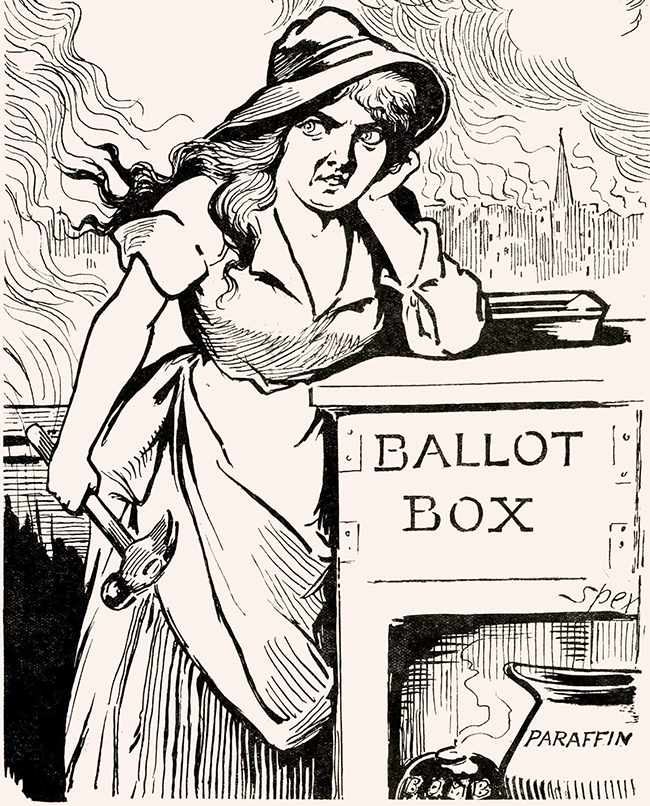
Indeed, the first bomb to be detonated in Ulster in the 20th century was planted not by Irish republicans nor loyalists, but by suffragettes, when Lisburn’s Christ Church Cathedral was targeted in August 1914. Today, such inconvenient history is neatly airbrushed away. In the popular imagination, the suffragettes have been defanged and co-opted. After all, Mrs Banks in Mary Poppins was a suffragette, and she was positively harmless!
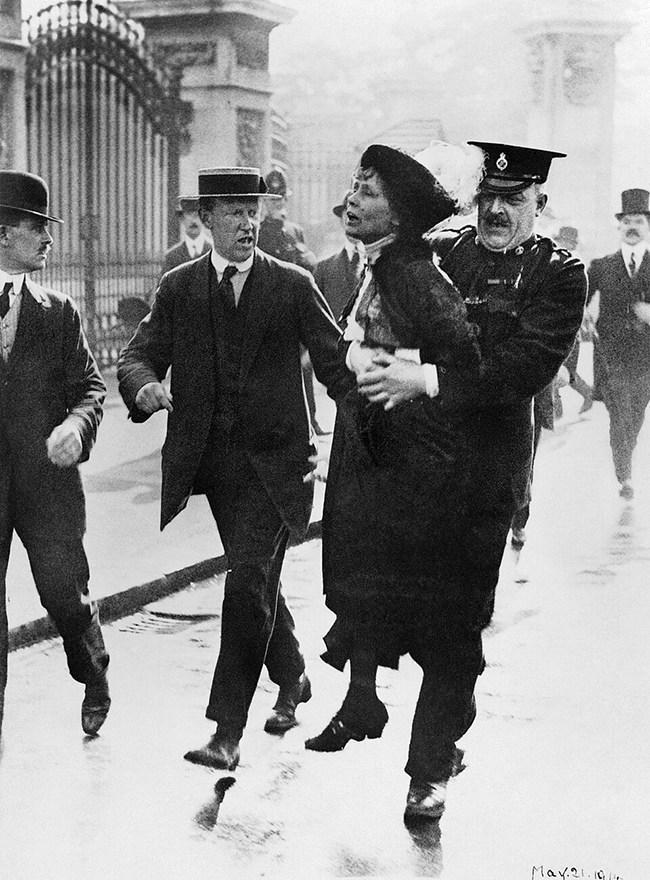
At a public meeting in the Albert Hall in October 1912, Emmeline Pankhurst instructed her followers: “Those of you who can break windows, break them. Those of you who can still further attack the sacred idol of property… do so.” More than a century later, her statue stands outside the Westminster Parliament, at the top of Victoria Tower Gardens, as a sacred idol of heritage-friendly history.
Just across the road in Parliament Square stands another bronze icon: Nelson Mandela, the anti-apartheid revolutionary who led the African National Congress before becoming South Africa’s president. Meanwhile, anyone with a memory longer than a news cycle will recall Margaret Thatcher denouncing the ANC in 1987 as “a typical terrorist organisation,” and declaring how “anyone who thinks that it is going to run the government in South Africa is living in cloud-cuckoo-land”.
A few paces from Mandela stands Mahatma Gandhi, a man whose strict non-violence did not spare him from Westminster’s ire. Even peaceful direct action was too dangerous for the British establishment. In November 1931, a peer in the House of Lords warned that there was barely a dividing line between Gandhi’s Congress movement and India’s “revolutionary and terrorist faction,” insisting that Gandhi’s speeches on civil disobedience were a direct incitement to bloodshed. In the fullness of time, we can anticipate that the proscription of Palestine Action will be judged just as harshly by history. In Westminster, today’s terrorists do have a habit of becoming tomorrow’s bronze statues.
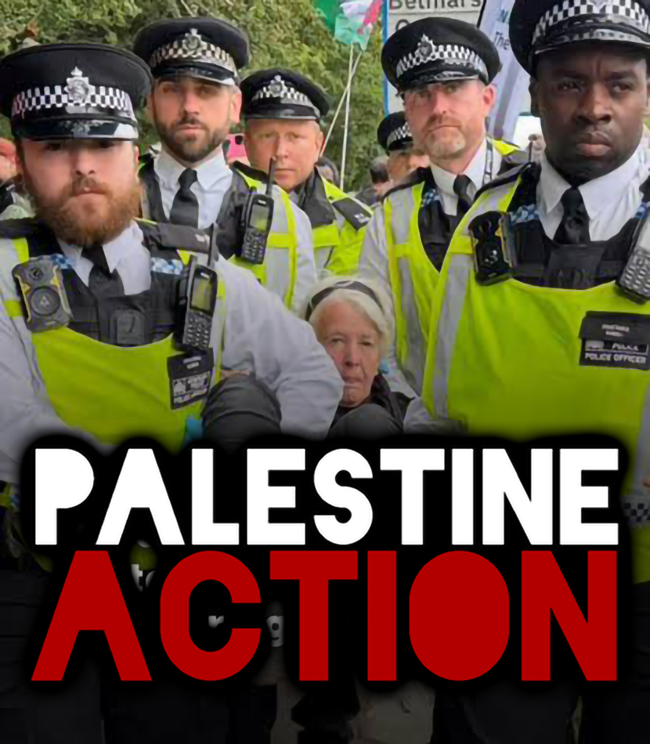
The proscription of Palestine Action has provoked widespread condemnation, raising urgent questions about the boundaries of free speech and legitimate protest. To be clear, the group has never targeted individuals; its direct-action campaign was directed solely at the industrial machinery producing instruments of war, amounting at worst to acts of property damage. Indeed, it is now known that the British government was secretly advised that Palestine Action was “highly unlikely” to advocate for violence. Government officials repeatedly struggled to produce evidence that the group posed a national security risk, and yet Westminster ploughed ahead with proscription anyway.
Since the ban came into force, thousands of ordinary citizens — young students and elderly pensioners alike — have been arrested under counter-terrorism laws simply for expressing solidarity with the proscribed group. Among those swept up in the crackdown are figures like Sir Jonathon Porritt, a former adviser to the English King Charles, and Margaret Owen, a 94-year-old Jewish human rights barrister who has been arrested four times since September for protesting the ban.
The chilling effect has now spilled over into the literary world. Best-selling author Sally Rooney — whose novels have been widely acclaimed and adapted by the BBC — now fears arrest should she even set foot in Britain. Acting on legal advice, her publisher has withdrawn her books from high-street bookshops following her pledge to donate her royalties to Palestine Action. In the wake of that decision, the author Sarah Helm also found herself in the state’s crosshairs for defending Rooney online, prompting the Metropolitan Police to scrutinise her social media account. That the police should be investigating the wife of the British government’s own National Security Adviser — Jonathan Powell — underscores how far this crackdown has strayed from the supposed intention of counter-terrorism legislation.
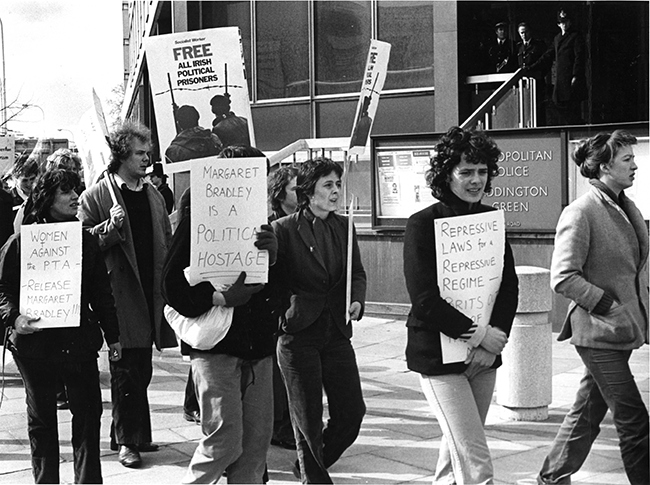
• Prevention of Terrorism Act protest in London
None of this, of course, comes as any surprise to Irish republicans. None of this — despite the disbelief of some younger comrades — is unprecedented. This is, after all, the very same British state that curtailed the right to silence in the Six Counties, silenced the voices of elected Sinn Féin representatives and other political parties through a broadcasting ban, imposed arbitrary exclusion orders, and routinely renewed the most draconian powers of the Emergency Provisions Act. Nor did such repression stop at the Irish Sea. With the introduction of the Prevention of Terrorism Act in 1974 — and its subsequent re-enactments in 1976, 1984, and 1989 — Westminster extended that same erosion of civil liberties directly to the Irish community living in Britain, treating an entire population as a suspect community.
Now, the well-worn authoritarian playbook of the British establishment has been dusted off for those who oppose Israel’s genocide of the Palestinian people — and Britain’s complicity in it. Peaceful protesters are now branded “terrorists” simply for holding cardboard signs. Make no mistake: this is what an attack on democracy looks like. History demonstrates time and again that democracy and civil liberties are far more imperilled by the overreach of the state than by any supposed “threat” it claims to confront.
For all the righteous protestations of its MPs, the British state remains, as it has always been, the greatest purveyor of violence. The suffragettes knew that much for sure.
Just as with the campaign for universal suffrage, the struggle against apartheid, and the fight for anti-colonial independence, history will vindicate the ordinary, decent people who stood up for Palestine by whatever means they believed to be necessary.