

16 November 2026
Growing momentum towards United Ireland
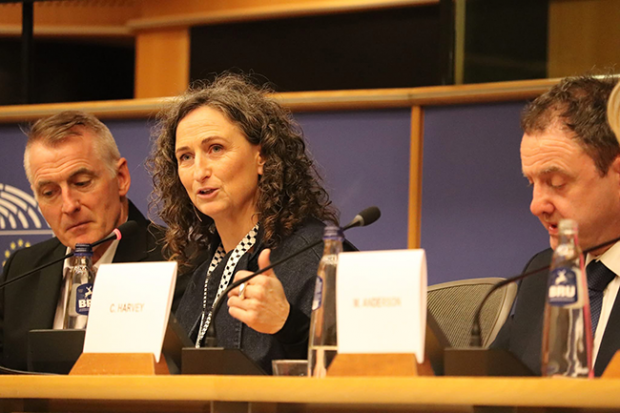
• Declan Kearney, Lynn Boylan MEP and Colin Harvey

Political momentum towards a United Ireland is growing. The latest opinion poll in the Six Counties confirms increased support for unity, especially among younger voters, while Fianna Fáil and Fine Gael have made long overdue but significant interventions in the Irish Unity debate.
The Lucid Talk November 2026 poll taken in the Six Counties shows just a 4% gap between support for a United Ireland at 42% and for remaining in the Union with Britain at 46%. When the same question was asked in February 2024 the gap was 10% (39% to 49%). Even more significant are the results among young people. Support for Irish Unity is ahead at 46% compared to 45% for the Union among the under-35s; 48% to 42% among 35-44 year-olds; and 45pc to 43pc among 45-54 year-olds. 55% of all those polled in the Six Counties either support a United Ireland now or would do so at some time in the future.
The ever widening interest, debate and support for Irish Unity, especially among younger voters, has finally compelled Fianna Fáil Taoiseach Mícheál Martin to move, however belatedly and cautiously. During the summer, in a petulant outburst to his party members, he said that “fellas talking about a Border poll” drove him “bananas”. Then at the start of November Martin announced to the Fianna Fáil Parliamentary Party a Futures Study Initiative that will “seek to provide an objective, independent knowledge base which can be used to inform specific proposals”.
The initiative will look at three constitutional options for Ireland about which political parties and other interest groups will be consulted and studies commissioned. These options are:
A single “unitary republic” which will be governed by institutions primarily based in Dublin which would be fully in place within five years of a referendum on a United Ireland, without a devolved government in Northern Ireland.
A United Ireland, or an “all-island state”, with a devolved government in Northern Ireland similar to the one in place now.
A continuation of the current arrangements in the Good Friday Agreement without constitutional change.
Commenting on Martin’s initiative, Sinn Féin Cathaoirleach Náisiúnta Declan Kearney said:
“The Taoiseach’s confirmation that he is to become involved in the discussion on Irish Unity is a welcome shift. His recognition that a comprehensive programme of work is required to plan for unity must now be matched by action.
“Sinn Féin is calling for an inclusive, all-island Citizens’ Assembly, which should bring together republican, unionist and other perspectives to plan for reunification. This must examine the implications for public services, jobs, pensions, citizens’ rights, and the economy.”
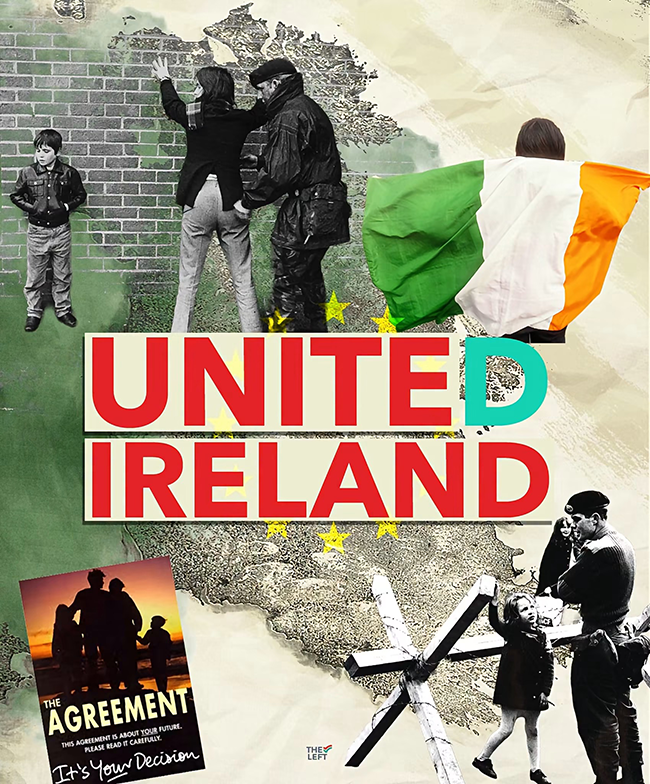
• Irish Unity Week in Brussels
Martin’s move was followed by the publication of a document by Fine Gael Tánaiste Simon Harris. He proposes to establish an “independent, government-supported, inter-party and consultative forum” as part of preparations for reunification of the island. The Fine Gael document states: “The Forum would commission research, examine constitutional and institutional options, identify areas of agreement and disagreement, and provide recommendations to help build the basis for a Unified Island.”
Harris also promised to appoint a junior minister in the Department of the Taoiseach to lead this process. Under the Fianna Fáil-Fine Gael ‘rotating’ arrangement, Harris is due to take over from Martin as Taoiseach in a year’s time.
Despite these initiatives by Martin and Harris they have failed to use the opportunity of their six-month EU presidency, which ends next month, to advance Irish Unity. Once again it was Sinn Féin which raised the Irish national democratic question at EU level. The party’s Ireland South MEP Kathleen Funchion said:
“Irish Unity has been completely absent as a topic at European-level during the Presidency. While Micheál Martin promotes EU enlargement for other countries, he has failed to use Ireland’s position to advance preparations needed for our own constitutional future.
“The European Union has already recognised that following reunification, the North would automatically rejoin the EU. We now need to see what practical preparations need to be undertaken, and the Irish government must lead that work.
Whilst we welcome recent discussion among government parties about plans for Irish unity, their words must be followed by concrete action.”
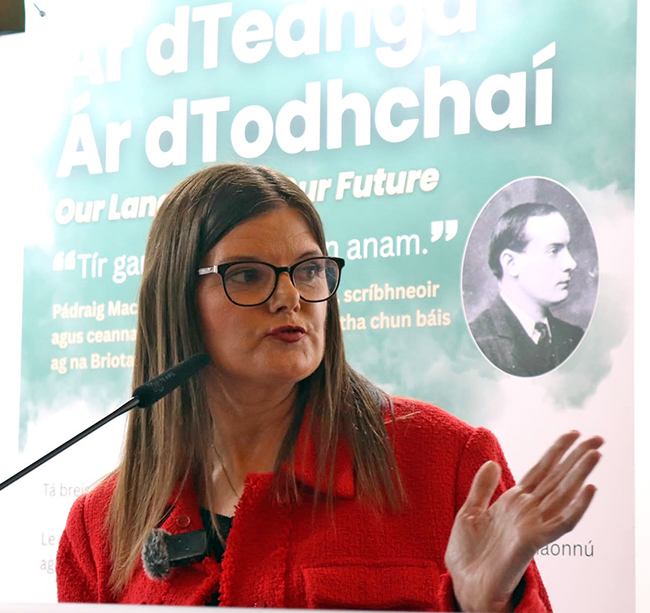
• Kathleen Funchion MEP
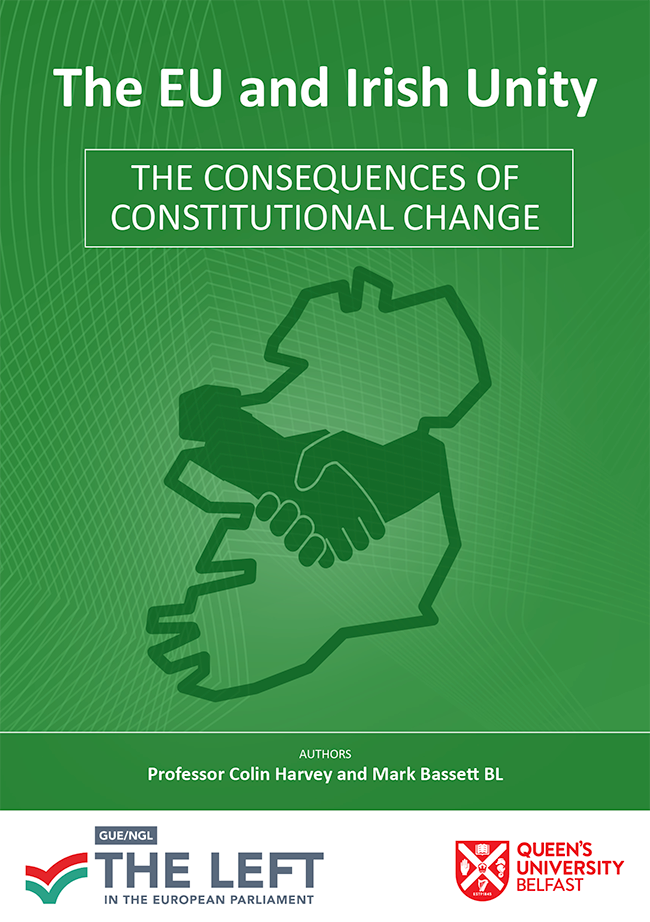
Kathleen Funchion was speaking at the opening of Irish Unity Week in Brussels, which she sponsored along with Sinn Féin Dublin MEP Lynn Boylan. This included meetings, presentations and an exhibition on Irish Unity in the EU Parliament building. The week featured the publication of a significant new report by Professor Colin Harvey and Mark Bassett on the concrete implications of Irish Unity for Ireland and the EU. The authors state:
“Our intention in this report is to stress that the EU institutions and member states would be well-advised to commence detailed consideration of Irish unity now. We outline the potential impact on the EU, and we include a series of recommendations to illustrate what practical planning would look like.” (HERE)
While the drive towards Irish Unity gathers pace, unionist parties in the North are more divided and disarrayed than for many years. The Drumcree debacle continues to send shockwaves through unionism as many in that camp realise that once again unionism has shot itself in the foot, while others want to deepen the damage by bringing down the Executive. After the DUP, UUP and TUV spending weeks knocking lumps off each other, came the poll results cited above, a further headache for the unionist parties.
When Simon Harris wrote to Ulster Unionist Party leader Jon Burrows he replied that Harris’s move was “a republican invitation to commit political suicide”. No-one expects any of the three main unionist parties to soften their opposition to Irish Unity but they are no longer the power they once were. The poll showed a rise in support of 6% for Sinn Féin to 28% and, crucially, the gap between those for and against Irish Unity has never been narrower. The days and weeks ahead in the run-up to the Assembly elections in May, and beyond, will be vital in pushing for the holding and the winning of the Irish Unity referendum.