

4 November 2026
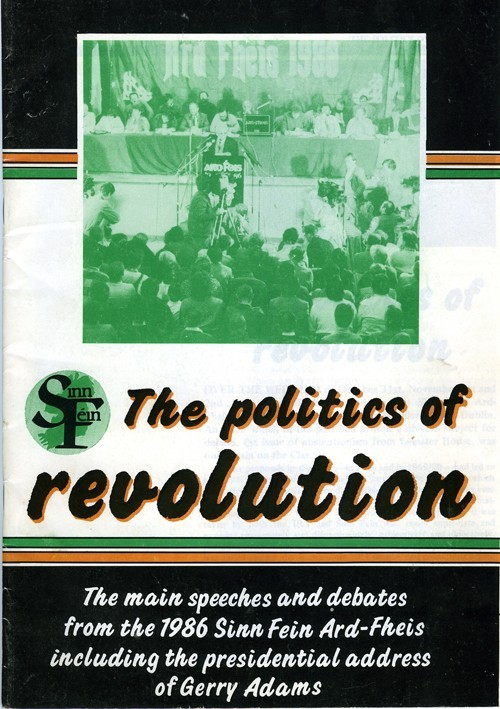
The politics of revolution
Remembering the Past – 40th anniversary of the 1986 Ard Fheis

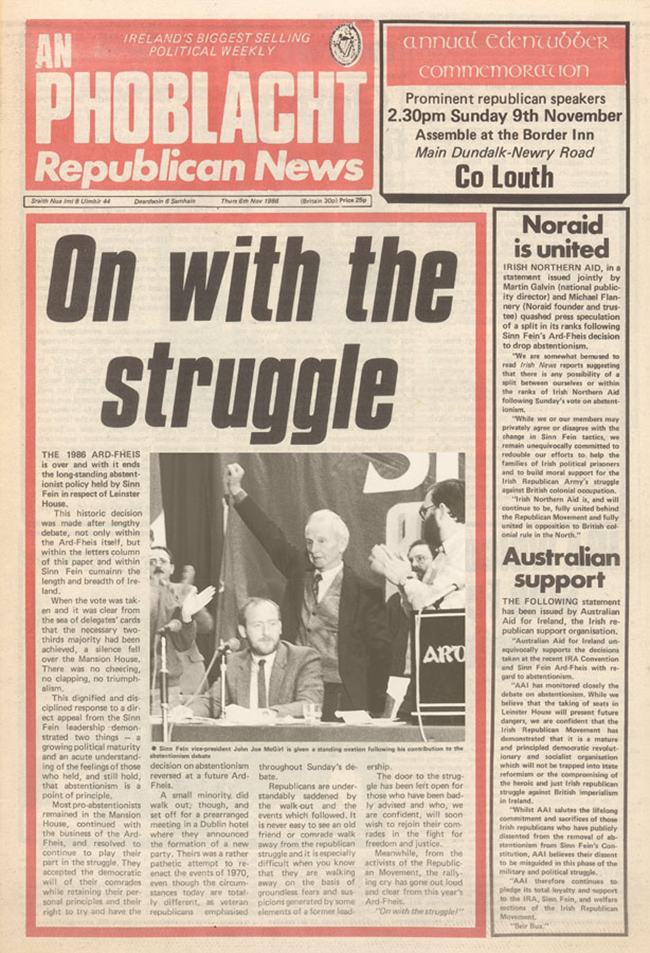
This week 40 years ago Sinn Féin was beginning a new phase of its political development in the wake of the 1986 Ard Fheis which ended the party’s long-standing policy of abstentionism from Leinster House.
The boycott of the Leinster House parliament dated back to the establishment of the Free State and the Civil War in 1922. The Second Dáil Éireann elected in 1921 continued to sit after it endorsed the Treaty by a margin of seven votes in January 1922, with anti-Treaty members remaining in it. However, the pro-Treaty members constituted the parliament of the Free State which came fully into existence on 6 December 1922, a year after the Treaty was signed. They took the Treaty’s Oath of Allegiance to the British monarch but continued to call the parliament Dáil Éireann. TDs representing constituencies in the Six Counties were refused entry after the Unionist parliament in Belfast formally rejected the option to join the Free State.
Anti-Treaty republicans refused to recognise the Free State parliament as Dáil Éireann. This position was reinforced in the ferocity of the Free State military repression of republicans, including executions inside and outside the jails. Sinn Féin regarded the anti-Treaty members of the Second Dáil Éireann as the only legitimate Dáil and government of the now suppressed Republic. This remained the position from 1922 until 1926 when Sinn Féin president Éamon de Valera advocated entering the Free State parliament in Leinster House. He lost the vote at the Sinn Féin Ard Fheis and left to form Fianna Fáil, taking most of the TDs with him.
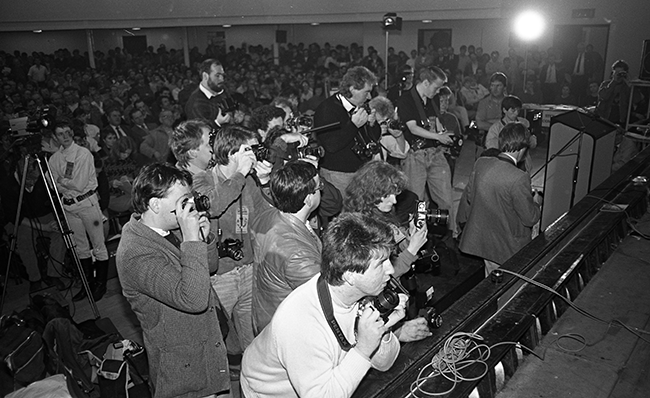
• 1986 Ard Fheis – The Irish government’s broadcasting ban on Sinn Féin prevented RTÉ from letting its viewers and listeners hear the historic event
The situation in the IRA was more complex with a wider range of views on what strategy should be. Volunteers were allowed to assist Fianna Fáil in the 1932 election in order to throw out the Cumann na nGaedhal government. Fianna Fáil support was further consolidated when the Oath was abolished, weakening the argument for boycotting Leinster House. Sinn Féin became ever more isolated in the 1930s and ‘40s. The abstentionist position remained in place when the party was reorganised in the 1950s but would become contentious again in the late 1960s. The split in the IRA and Sinn Féin in 1969 and ’70 was driven primarily by events in the Six Counties but the proposal to drop abstentionism, not only from Leinster House but from Stormont and Westminster as well, was very divisive.
Abstention from Leinster House remained in place in the reorganised Sinn Féin from January 1970. The election of three IRA prisoners during the 1981 Hunger Strike was transformative, stressing the need and the possibility to broaden the republican base and win wider public support, both in the immediate prison crisis and in longer term strategy. Sinn Féin electoral success in the Six Counties in 1982 and ‘83 contrasted with political weakness in the 26 Counties, a point stressed by Gerry Adams when he replaced Ruairi Ó Brádaigh as president in October 1983. This was the background to the debate on abstentionism when the Sinn Féin Ard Fheis assembled in Dublin’s Mansion House on the weekend of 31 October to 2 November 1986.
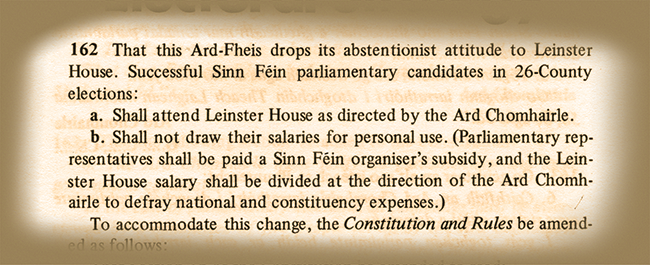
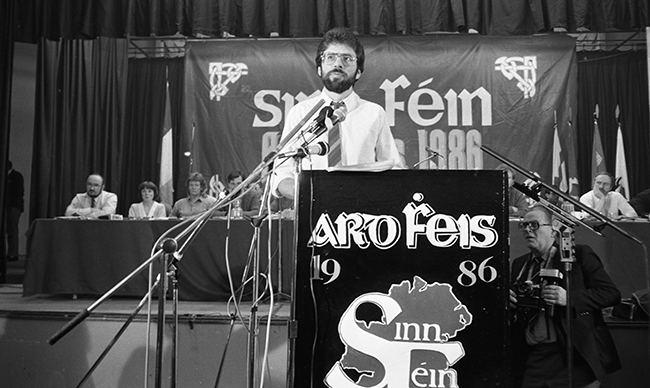
The motion to change the Sinn Féin constitution to end the ban on entry to Leinster House was passed by more than the required two thirds majority. The Irish government’s broadcasting ban on Sinn Féin prevented RTÉ from letting its viewers and listeners hear the historic event, one of the most intense and fascinating debates ever held by an Irish political party. While the debate has been covered by broadcasters and historians since, little attention has been paid to the presidential address by Gerry Adams, one of the most important speeches he ever made, setting a political course for Sinn Féin that would help shape events to come.
Gerry Adams urged unity and appealed to those against the motion to remain in the party, as he would if the party leadership lost the vote. Then he addressed the issue:
“This question of electoralism as a means of revolutionary struggle has affected all struggles in areas where parliaments with universal suffrage exist. As with all such questions, the answer lies in the people’s attitudes to those institutions.
“Our experience has taught us that our struggle – and this affects every aspect of the struggle for national liberation – cannot be built merely on the republican perception of things. We have had to consistently pitch our struggle at the level of people’s understanding and we have had to develop it from this common denominator, taking into account, in an objective way, all the forces and factors involved.
“It would be much easier, of course, if all the Irish people, or a large section of them, were born with our perception and our view of things, but this is not the case. If it was, there would be little need for a republican struggle. But there is such a need and if we want to win then there is a fundamental need to make it a people’s struggle. Of course, if we have no concept of winning we can remain as we are – a party apart from the people, proud of our past but with little involvement in the present and only dreams for the future…
“It is a massive mistake to presume that our republican attitude to Leinster House is shared by any more than a very small section of our people, especially the citizens of this state, who might otherwise be open to our policies on all other issues. It must also be clear that the reconquest of Ireland, much less a British withdrawal, cannot be completed without the support of more of these people…”
Stating that republicans needed to be strategic and flexible, Adams continued:
“The central issue is not abstentionism. It is merely a problematic, deeply rooted and emotive symbol of the lack of republican politics and the failure of successive generations of republicans to grasp the centrality, the primacy and the fundamental need for republican politics. This truth must be grasped. It is a difficult one for many to accept given the conspiratorial and repressive nature of our past, our distrust for ‘politics and politicians’ and a belief that ‘politics’ is inherently corrupt. But once it is grasped then everything else follows logically, especially the need to develop our struggle at the level of people’s understanding.”
Turning to what must be done he said:
“We must develop a 32-County wide political struggle. This is the most important task facing us at present. While consolidating our base in the Six Counties, we must develop a popular struggle here in the 26 Counties to complement the struggle in the Six-County area. Of necessity this means, in order to advance at the level of people’s consciousness, the removal of abstentionism in regard to Leinster House…
“We must all share the daunting and massive task of interpreting and applying republicanism to changing and changed political conditions. Our failure to do this is one of the tragic failures of our past…We have at all times been more committed to rebellion than to revolution. The cement which held us together was physical force and, until recent times, physical force was applied in isolation, unsupported by organised political sentiment in the country. I have spoken and written on this theme many times and I have preached the gospel of republican politics – the need for republican politics, that is the need for republican involvement with the people – up and down this island.
“The only feasible way to break out of our isolation, to make political gains, to win support for our policies, to develop our organisation and our struggle is by approaching people at the level they understand…This means Sinn Féin getting among people in the basic ways which people accept.”
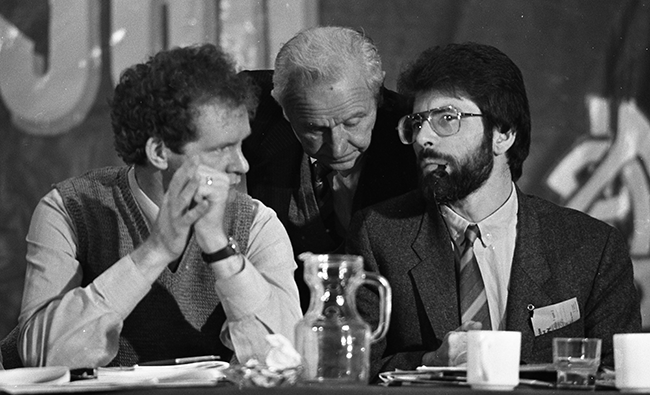
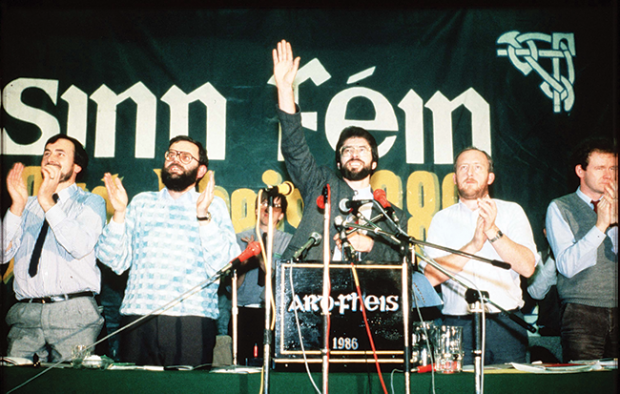
• Martin McGuinness, John Joe McGirl and Gerry Adams
Adams said the removal of abstentionism would not provide a magic wand solution to all Sinn Féin’s problems: “Indeed, in this state it merely clears the decks and it makes the burden of struggle heavier upon us all. We have to cease being spectators of a struggle in the Six Counties and become pioneers of republicanism in the 26 Counties, putting our policies before the people, confident of the logic of the alternative which Irish republicanism offers.”
As Gerry Adams predicted, there was a long hard road ahead in building Sinn Féin, but already the party’s opponents were worried. Garret FitzGerald was Taoiseach in the Fine Gael-Labour government and, after the Ard Fheis vote, he issued a call to Fianna Fáil to join in a campaign against Sinn Féin to ensure that no Sinn Féin TD would be elected or, if elected, that no government would be formed with the party’s support. Fianna Fáil leader Charlie Haughey used Sinn Féin’s decision to urge support for his party so that “fringe groups” would not “disproportionately influence the conduct of our affairs”. And there was much amusement among republicans when the leader of the right-wing Progressive Democrats, Dessie O’Malley, said he would be accepting no support from Sinn Féin!