

29 October 2026
Garvaghy Road: a manufactured political crisis by unionist and British opponents of progress

"The days of second-class citizenship and denial of rights for any section of our society are in the past"
The attempt to force an unwanted sectarian Orange Order parade from Drumcree through the Garvaghy Road for the first time in 28 years has precipitated a serious political crisis in the north of Ireland.
In time, more detail will emerge as to why and how this happened: Why the Parades Commission gave approval for its catastrophic decision, with PSNI complicity.
The history of the Drumcree Orange parade is steeped in sectarian violence and murder. It was ended in 1998 after three young Catholic brothers were burned alive in their home in Ballymoney, when unionist paramilitaries firebombed their home.
During that period, 21 murders occurred in support of the unionist and orange demand for this parade being forced through the Catholic neighbourhoods of Garvaghy Road.
So when the Parades Commission inexplicably made a determination that this unwanted sectarian parade should again be imposed upon the local community, it was immediately re-traumatised and gripped with fear.
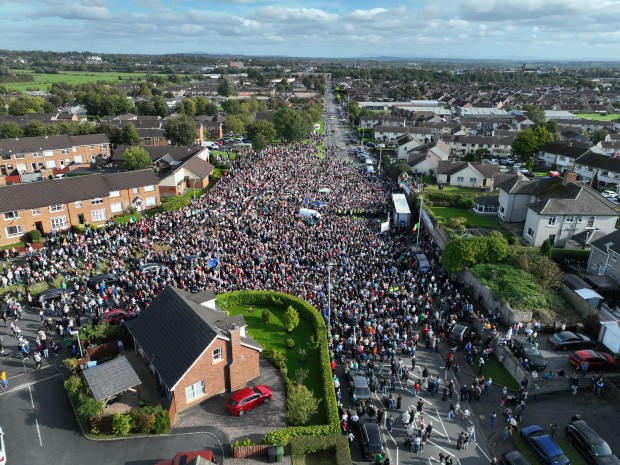
All right minded people met the decision with outrage. Nationalists and democrats from all over Ireland mobilised in a popular demonstration of peaceful civil disobedience. As a result, the march, scheduled for 27 September, was prevented from being pushed through Garvaghy Road by the PSNI.
For the next week, thousands held the Garvaghy Road, opposing the threat from those in unionism who wanted to turn back the clock. The standoff culminated in a mass rally of 15,000 which gathered in solidarity with the Garvaghy Road residents and their right to live free from sectarian harassment and intimidation. Twenty-four hours beforehand, over 1,500 people from various Protestant backgrounds courageously published an open letter calling on the Orange Order to withdraw its parade and look to the bigger picture in the interests of wider society.
That same weekend, I addressed the 90th anniversary of the Battle of Cable Street in London, when Mosley’s fascists were prevented from marching into Jewish neighbourhoods by the working class of London’s East End. It was an iconic moment.
The historical parallels with the impasse at Garvaghy Road were unmistakable. My message to the commemoration was that just as the fascists had not passed in Cable Street in 1936; the Orange Order would not pass on the Garvaghy Road. I said the community resistance at Garvaghy Road was also another watershed.
These have been critical weeks in the north of Ireland.
A judge hearing legal actions against the Orange Order parade said that an abyss had been reached.
Once again, politics and society are confronted with serious challenges.
The current British Secretary of State totally mishandled this dangerous situation. It took him 13 days before using his powers to finally ban the orange parade. The British government’s indifference and disengagement towards this crisis has been disgraceful. So too the public and political position of Taoiseach Micheál Martin.
It has been a stark reminder that the peace and political processes can never be taken for granted.
However, the intention was about much more than sectarian provocation.
What happened at Garvaghy Road is a manufactured political crisis, which has been over two years in the making.
It represents an attack on the peace and progress which has been secured. Driven by a mindset that croppies must be made to lie down, by those who want to return to the era of the orange state.
An outright assault against the Good Friday Agreement has been mounted.
Ensuing events have brought to the fore divisions within and between unionist parties, over who will dominate political unionism.
The extremists have taken the whip hand within unionism and are trying to push the DUP further to the right. They want to undermine the political institutions and destroy power-sharing.
The subtext to what is happening is next year’s Assembly and council elections, and the objective of removing Sinn Féin as the largest party in the north and Michelle O’Neill from the position of First Minister.
All of this aligns with the wreckers’ agenda, which the DUP has been wielding within the Assembly and Executive for over 18 months. This is reflected in that party’s outright hostility to all manifestations of equality; including use of public money to fund legal action against Irish language signage; and, blocking the most progressive employment rights legislation in the history of the northern state.
The approach of political unionism is defined by race to the bottom politics.
The current perfect storm of whipped up sectarian polarisation and political instability is a pre-meditated counter reaction to the growing momentum for Irish unity. This is being driven by those sections of the British state, which are determined to prevent the right to national self-determination, and holding a unity referendum.
Powerful influences within Britain’s security and intelligence establishment have never reconciled themselves with the Good Friday Agreement peace settlement. They remain psychologically and politically at war with the Sinn Féin leadership and northern nationalism.
Partition is in their strategic interest.
This section of the British state has assessed that a security foothold has to be maintained in Ireland as a defensive flank on Britain’s western seaboard.
The growth in electoral and political support for Sinn Féin and momentum for Irish unity are anathema to the ‘deep state’ in Britain.
Therefore, the Garvaghy Road ‘standoff’ has been about more than preventing an attempt to trample over the rights of local residents. The consequences are far-reaching.
It throws up fundamental questions relating to the future, protection of the peace process, and the nature of continued political transformation on the island.
That is why this watershed is unprecedented.
It explains why unionist extremists have sought to promote a narrative that the peaceful opposition to reassert sectarian domination means that a future new Ireland will be a hostile place for orange culture, the unionist tradition or British identity.
It is a false assertion and a deliberate distraction. The future cannot and will not be one of supremacy, subjugation or division.
The days of second-class citizenship and denial of rights for any section of our society are in the past.
We refuse to be pushed backwards. Not now, not ever. No section of society will again be marginalised.
Constitutional change is on the political horizon, hence the carnival of reaction, which has begun.
Those opposed to political progress from within the British state and the extremes of political unionism are intent on causing deeper instability, insecurity and fear throughout society.
The need for progressive, positive, future-focused leadership in this period is paramount.
We who are committed to democratic change must not be deflected, or drawn into sectarian cul-de-sacs.
Fleadh Cheoil na hÉireann, which took place in Belfast for the first time during August, gave us all a glimpse of what a shared future, in a shared island, can look like.
The new Ireland will be a place to celebrate diversity, parity of esteem and respect.
This is what all decent people want for themselves and their children.
We must be ambitious for the future – for an inclusive, progressive society.
For a new Republic, where there will be no place for extremism, domination, demonisation or sectarianism.
A new phase of politics has opened up. There will be many challenges, but the opportunities are also immense.
We must all keep focused on the prize.
Follow us on Facebook
An Phoblacht on Twitter
An Phoblacht Podcast
Uncomfortable Conversations
An initiative for dialogue
for reconciliation
— — — — — — —
Contributions from key figures in the churches, academia and wider civic society as well as senior republican figures