



7 October 2026
The long trail of bigotry to Garvaghy Road
Orange supremacy in Portadown since 1795
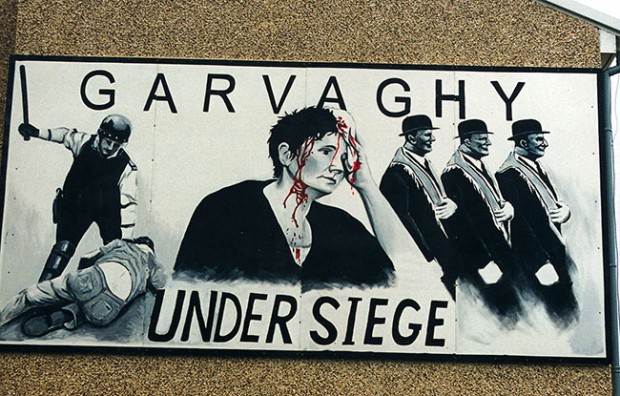

It is impossible to fully understand the current impasse on Garvaghy Road without knowing what that community went through in the 1990s and what nationalists in Portadown endured for two centuries before that.
The north of County Armagh was where the Orange Order began in 1795 as an exclusively Protestant and anti-Catholic organisation. From the beginning it was provoking violence by Protestants against their Catholic neighbours. It was seen as a useful tool by the British government in its efforts to prevent the unity of Catholic, Protestant and Dissenter in pursuit of Irish independence as championed by the United Irishmen. But even then, such was the violence and disruption caused by the Order, that at one stage it was banned by the British government and on other occasions its marches were restricted.
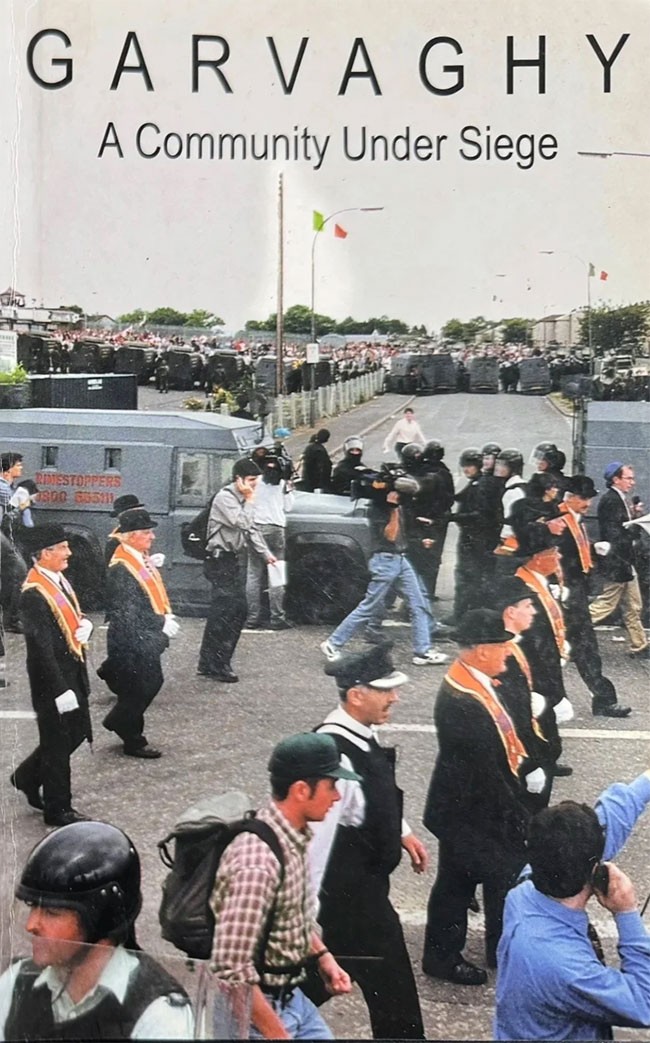
The following chronology is based on a chapter in ‘Garvaghy - a Community Under Siege’ published in 1999 and now available free to download from Beyond the Pale Publications here: Garvaghy: A Community Under Siege — beyond the pale books – books on Irish society and politics
1795: Inflammatory sermons by a clergyman in Portadown led to attacks on Catholics. Two men were killed. This was followed by the ‘Battle of the Diamond’ near Loughgall, Co. Armagh, in which up to 30 Catholics were killed. The Orange Order was founded in Loughgall in the aftermath.
1796: By the end of this year an estimated 3,500 Catholics were driven from their homes in Co. Armagh.
1812: The entire Armagh Yeomanry (local militia) was disbanded due to insubordination by members who refused to serve under an officer who signed a petition in support of Catholic Emancipation.
1825: Due to the sectarian turmoil caused by its parades, the Orange Order was suppressed by the British parliament, but Portadown Orangemen went ahead with their parade through Portadown.
1829: Almost 2,000 Orangemen defied the ban and marched through Portadown, followed by widespread rioting and shooting across Ulster, with up to 20 people killed. The Armagh City Orange Grand Master was charged with causing riots.
1833: 20,000 Orangemen paraded illegally through Portadown.
1835: “For some time past the peaceable inhabitants of the parish of Drumcree have been insulted and outraged by large bodies of Orangemen parading the highways, playing party tunes, firing shots, and using the most opprobrious epithets they could invent…” - William Hancock, Co. Armagh magistrate.
1836: Concern at the activities of the Orange Order was so widespread that its Grand Master, who was the King of England’s brother, and its Grand Lodge, agreed to disband it. Portadown Orangemen again defied the ban.
1860: At Derrymacash between Portadown and Lurgan, Orange parade participants shot 16 Catholics, one of whom died. Catholic homes and a chapel were attacked.
1867: Orangemen with bands assembled outside St Patrick’s Catholic Church in Portadown during a religious service and attacked people on their way to and from the chapel.
1873: Orangemen paraded through the Catholic Obins Street area of Portadown, provoking what a senior RIC man described as the worst riots he had witnessed anywhere in 20 years.
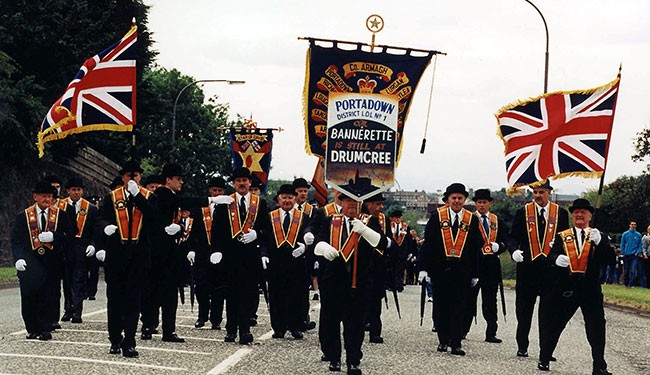
1877: An Orange parade through a Catholic area of Lurgan was banned but the one through Obins Street, Portadown, was allowed.
1879-1882: Rioting as Orange marches were forced through Obins Street.
1893: Intense rioting as Orangemen descended on Obins Street. The RIC used fixed bayonets to disperse them. However, during the rest of the 1890s the area’s residents were placed under siege as the RIC escorted Orange marches through.
1905: Orange parade through Obins Street resulted in a Catholic man being shot dead.
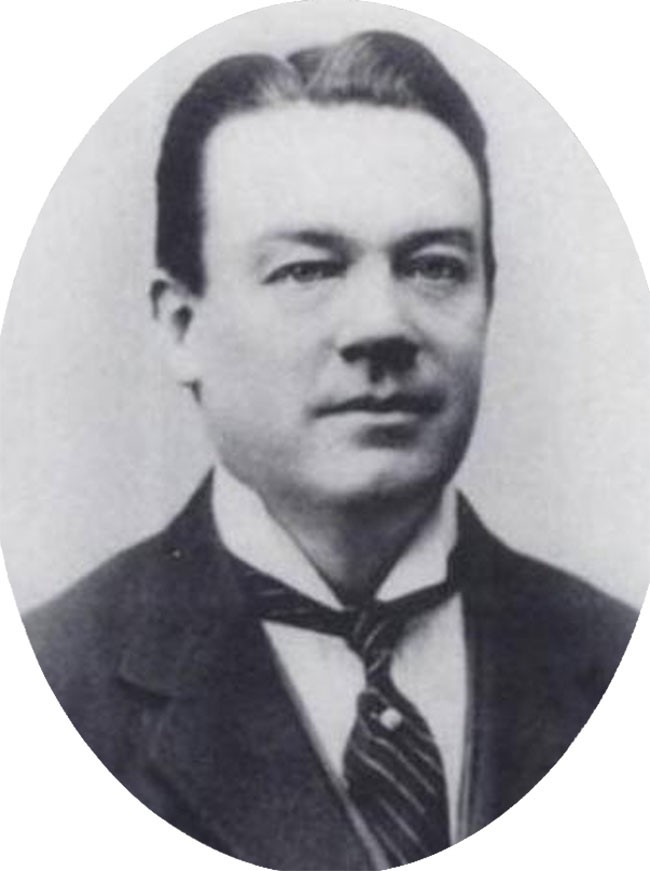
• Joe Devlin MP
1909: The Orange marches through Obins Street were raised in the House of Commons by Joe Devlin MP who said shots were fired by marchers.
1913: A meeting of the Portadown Unionist Club was told of the arming of the Ulster Volunteer Force (UVF) to stop Home Rule, and the Orange Order was thanked for allowing the UVF to use their halls for training.
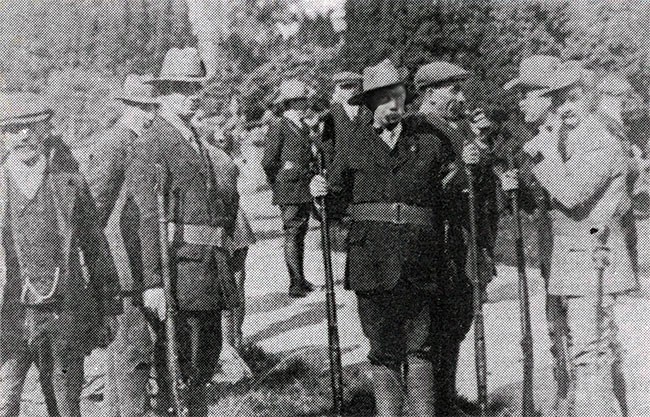
1921: Opening of the Northern Ireland Parliament which began the era of the Orange Order’s supreme power in the new Six-County statelet, with membership virtually compulsory for all Unionist MPs and ministers and those in many levels of administration.
1931: Portadown Loyalists attacked nationalists returning on buses from an event in Armagh and destroyed property owned by Catholics in the town.
1932: As Catholics returned from the Eucharistic Congress in Dublin, trains were stoned in Portadown and Obins Street was attacked.
1935: A Catholic resident of Obins Street, standing at his bedroom window, was shot dead by an RUC volley of shots. This followed rioting provoked by loyalist and RUC harassment of local Catholics.
1939-1945: Orange parades were suspended during the Second World War. Portadown was relatively free from civil and sectarian strife.
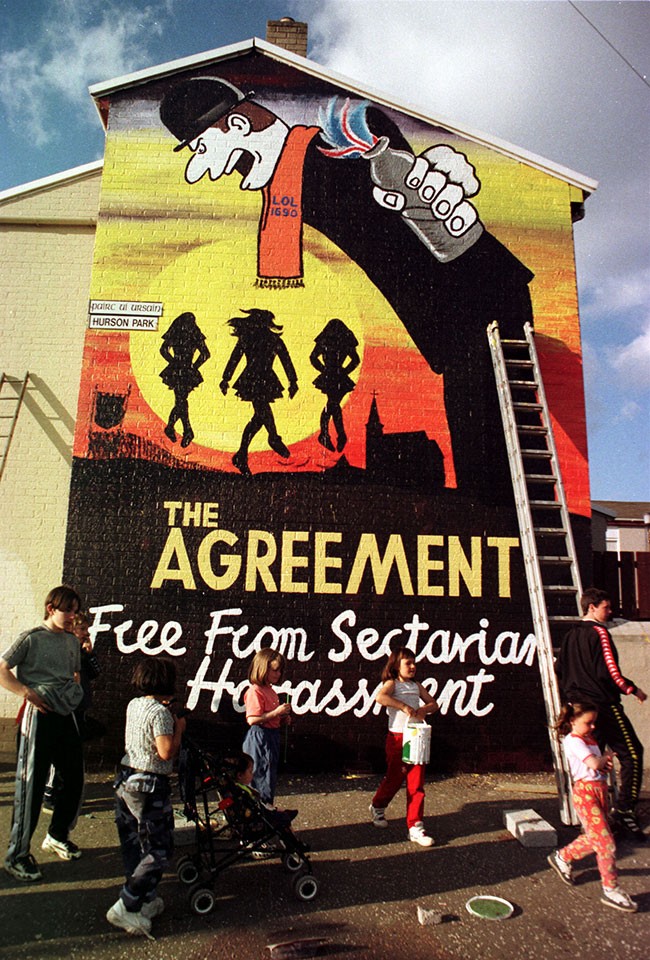
1950: Eight nationalists were prosecuted for staging a peaceful protest during the Orange parade through Obins Street. Asked in court if he thought the Orange parade should be re-routed, RUC Head Constable Stansfield said: “It is not given to me to think…I am here to obey orders.”
1951-1969: Orange marches every year through the nationalist areas of Portadown.
1969: Many nationalists from the Obins Street area had moved to new housing estates along Garvaghy Road. 400-500 members of the Black Preceptory (sister organisation to the Orange Order) paraded through Objns Street where there was fighting.
1971: RUC and British Army occupied nationalist areas of Portadown as a large number of the recently disbanded B Specials led over 1,000 Orangemen through Obins Street.
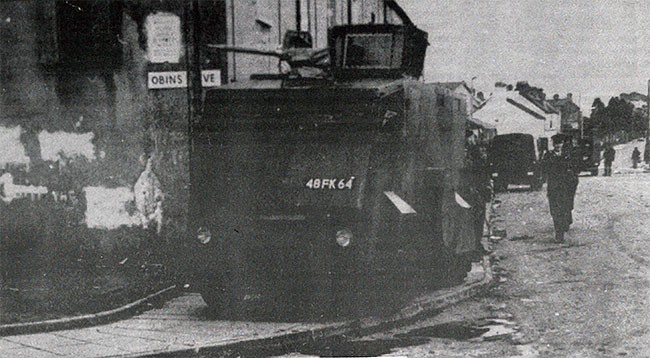
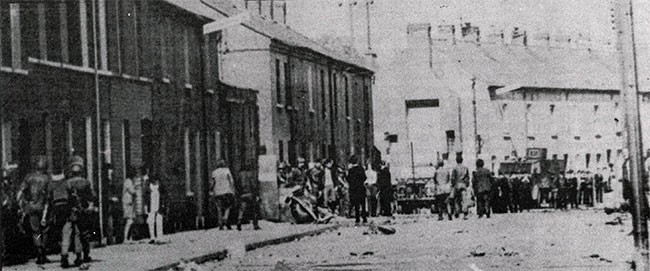
1972: In March, after the fall of the Stormont parliament, there were widespread attacks on Portadown nationalists, one of whom was tortured and murdered. Families were forced out of their homes and property wrecked and looted. Then in July, after nationalists appealed in vain for the march to be re-routed, they erected barricades along Obins Street. The British Army and RUC invaded the area, using CS gas and rubber bullets, smashing into homes and assaulting residents. They then permitted masked and uniformed UDA and UVF men to drill on Obins Street before lining the route as several hundred Orangemen marched through the area. The same UDA/UVF display greeted the Orangemen returning along Garvaghy Road, again guarded by the British Army and RUC. Further marches that month were followed by the shooting dead of two Catholics and a Protestant.
1973-1981: Nationalist areas of Portadown were placed under siege for days every year as the British government facilitated the Orange marches. “A visitor to the town could have been excused if he had been under the impression that a fair proportion of the British army stationed in Ulster had been drafted into the town…” Portadown News, July 1975.
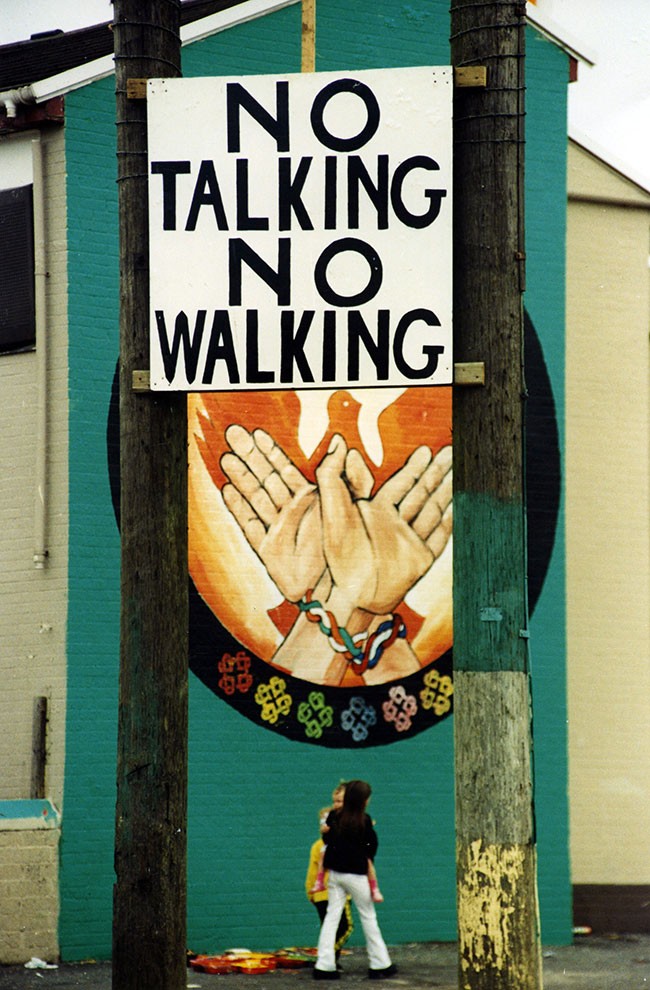
1981: At the trial of a number of young nationalists arrested after riots caused by the forcing of Orange marches through Obins Street, Resident Magistrate Sarah Creanor stated in court that she agreed with the defence that the parades should not be allowed into the area.
1983: Orange marchers broke ranks and attacked Obins Drive residents with ceremonial swords and pikes.
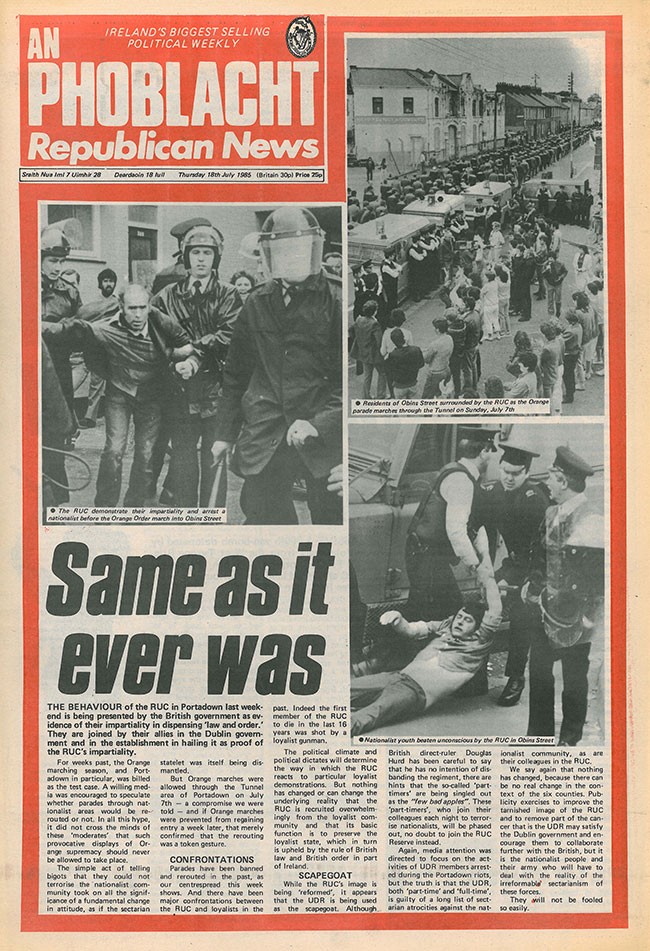
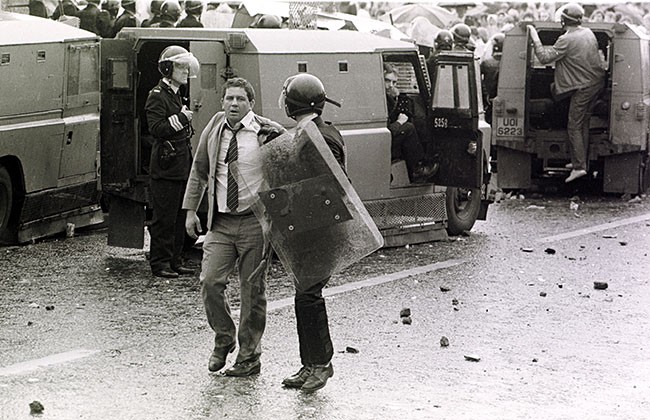
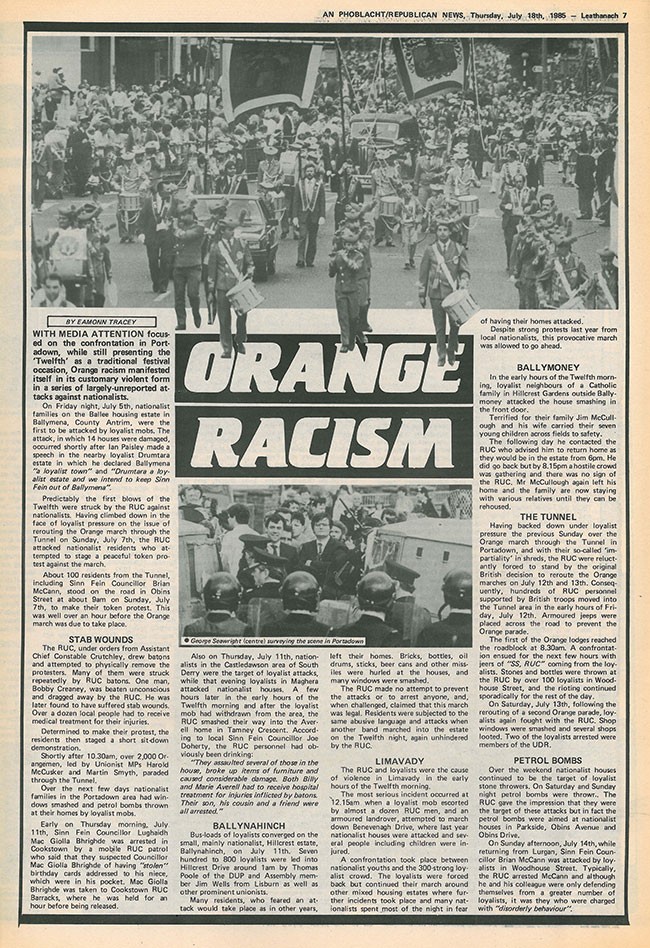
1985: In the guise of a ‘prayer meeting’, Unionist politicians and followers gathered to oppose a St Patrick’s Day parade by a nationalist band from Obins Street to Garvaghy Road. On 7 July the RUC attacked with batons a peaceful sit-down protest by nationalists, clearing the way for 2,000 Orangemen led by MPs Harold McCusker and Martin Smyth.
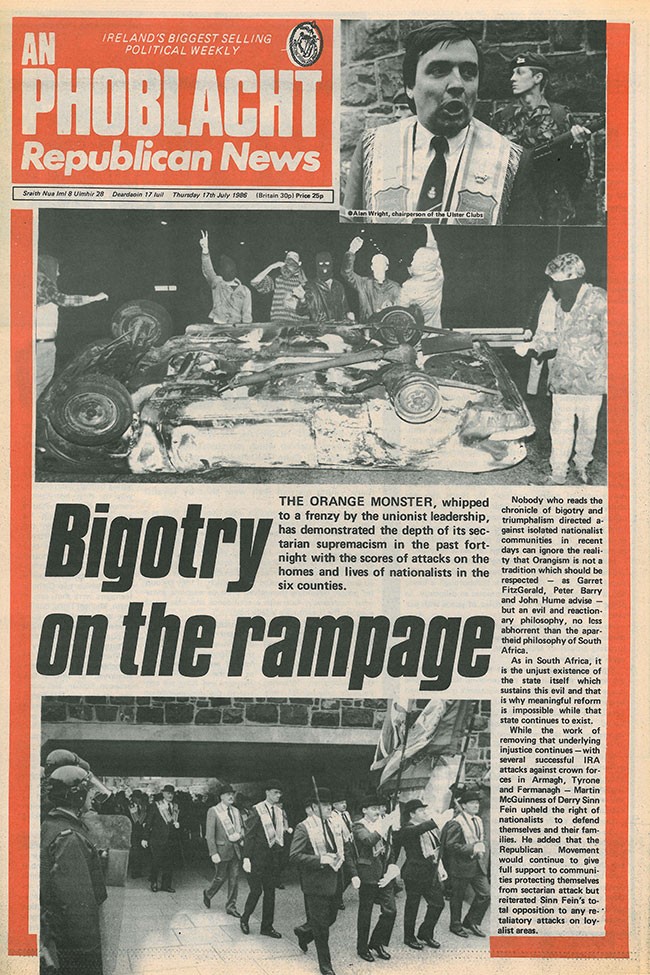
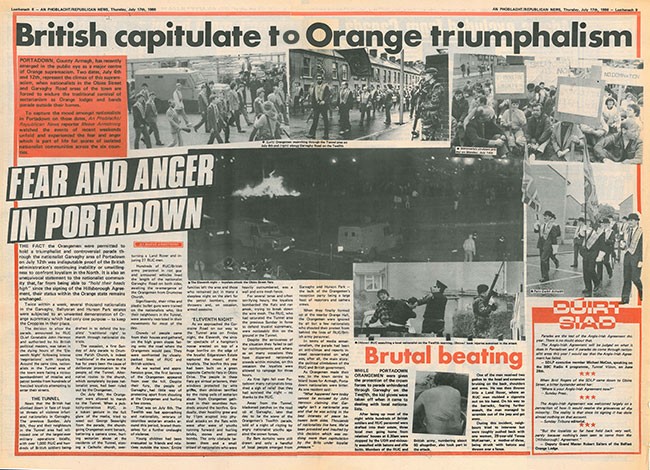
1986: As Unionists furiously opposed the Hillsborough Agreement, an Easter Monday march by the Apprentice Boys down Garvaghy Road was banned. However, on Easter Sunday night, the British Army and RUC returned to barracks and Ian Paisley and other Unionist politicians led around 4,000 loyalists, some openly carrying arms according to witnesses, in a midnight march down Garvaghy Road, despite the ban. Loyalists rampaged in the town on Monday and a loyalist youth was fatally wounded by an RUC plastic bullet. Then in July, Orange marchers were re-routed from Obins Street but permitted down Garvaghy Road. Obins Street came under attack from loyalists.
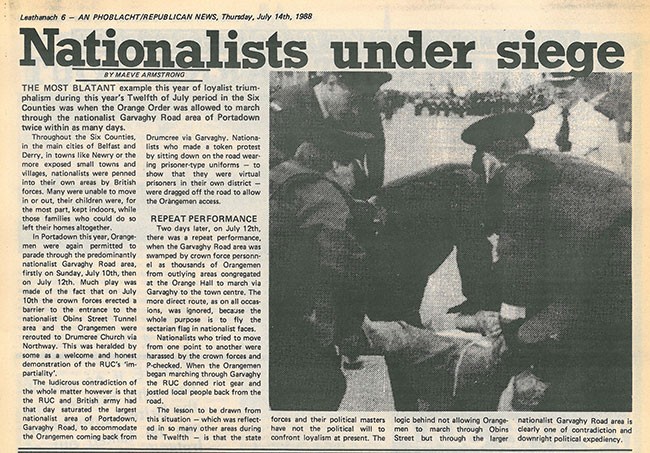
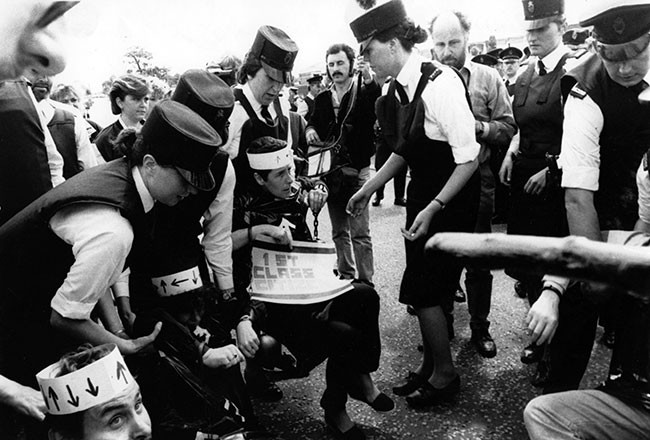
1987-1992: Drumcree parades were re-routed from Obins Street but allowed down Garvaghy Road, with residents hemmed in by the British Army and RUC and peaceful protests suppressed.
1992: During the Drumcree parade led by David Trimble, marchers broke ranks and attacked local people.
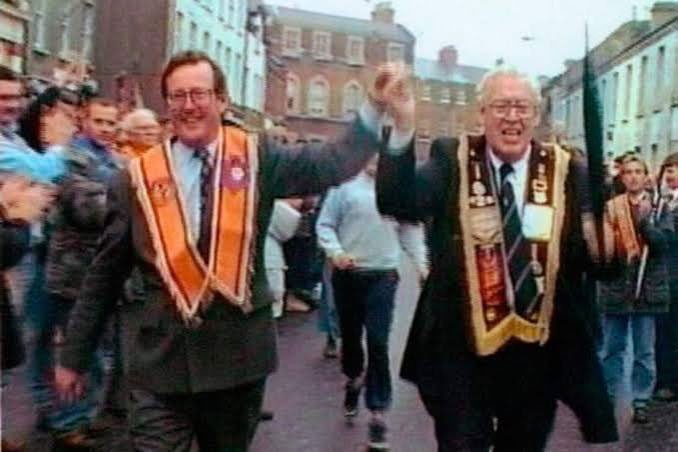
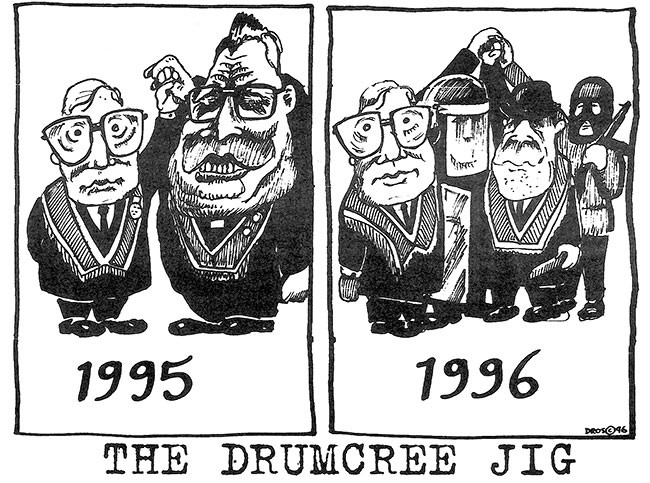
1995: In the bicentenary year of the Orange Order, Unionists and loyalists orchestrated a massive confrontation in Portadown after the 9 July Orange parade on Garvaghy Road was prevented by the RUC. The next day there were 10,000 Orangemen and supporters at Drumcree and clashes between them and the RUC. Loyalists attempted to invade nationalist areas. On 11 July an agreement was reached between Garvaghy Road representatives and the RUC that only local members of the Portadown Lodge would parade on Garvaghy Road without bands or banners. This proceeded, with nationalists staging a peaceful roadside protest, but it was evident that many more than local Orangemen participated. When the parade entered the centre of the town David Trimble and Ian Paisley joined hands and strutted along the street to the cheers of loyalists, with Trimble gloating: “There was no compromise. We have come down our traditional route in normal fashion with our flags flying.”
• RUC Chief Constable Hugh Annesley
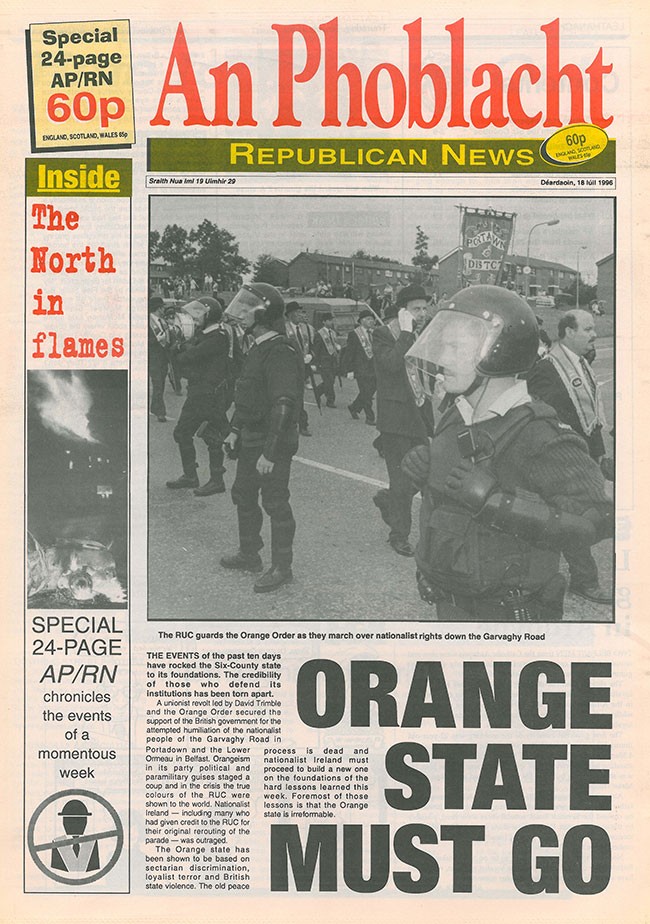
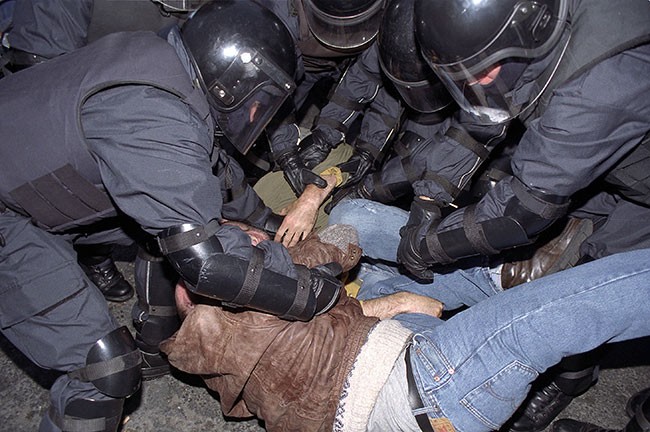
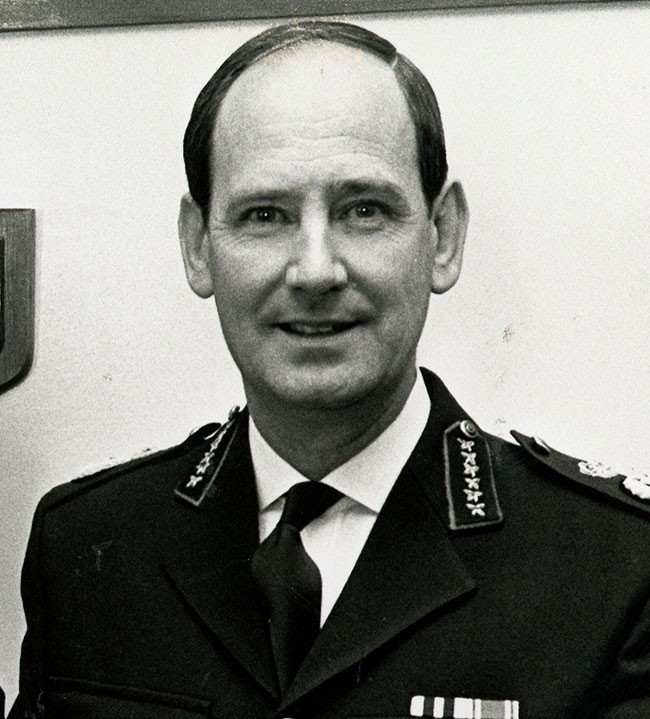
1996. On 7 July RUC Chief Constable Hugh Annesley prohibited the Garvaghy Road parade. Once more there was a furious Unionist reaction across the North. Outside the town of Lurgan, Michael McGoldrick, a 31-year-old Catholic, was shot dead by loyalists associated with leading paramilitary Billy Wright. Over the next three days loyalists blockaded roads and towns, including Portadown, and committed numerous acts of violence. There were many clashes with the RUC and 662 plastic bullets were fired. 16 families in Obins Street/Craigwell Avenue had their homes invaded and wrecked by loyalists led by Billy Wright, with whom David Trimble held a secret meeting in the town. Garvaghy Road representatives and church leaders were deceived by the Orange Order who pretended to negotiate by proxy while elsewhere pressure was brought to bear on the British government and RUC to change their minds and allow the Orange parade down Garvaghy Road. Hugh Annesley duly announced the u-turn on 11 July and the parade was back on. Peacefully protesting nationalists were beaten and battered off the road with RUC batons and plastic bullets flying and many people injured. Fine Gael Taoiseach John Bruton condemned the British for giving in to force and the threat of force.
• Robert Hamill
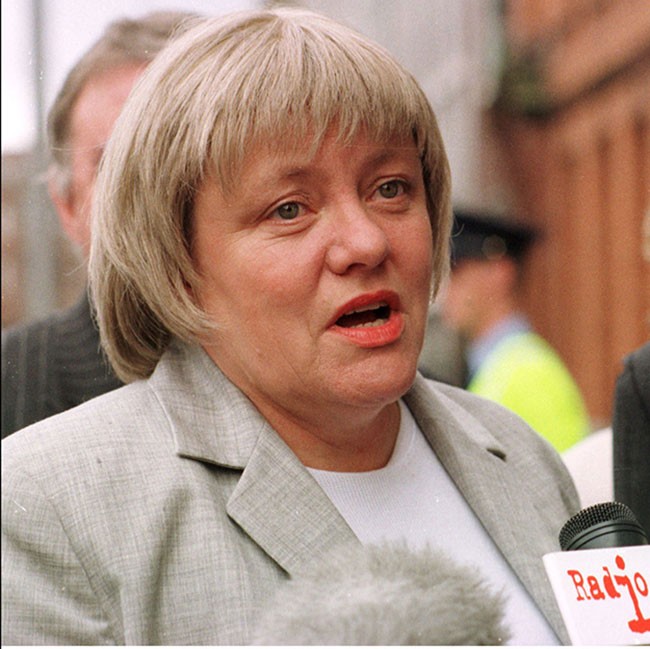
• Secretary of State Mo Mowlam
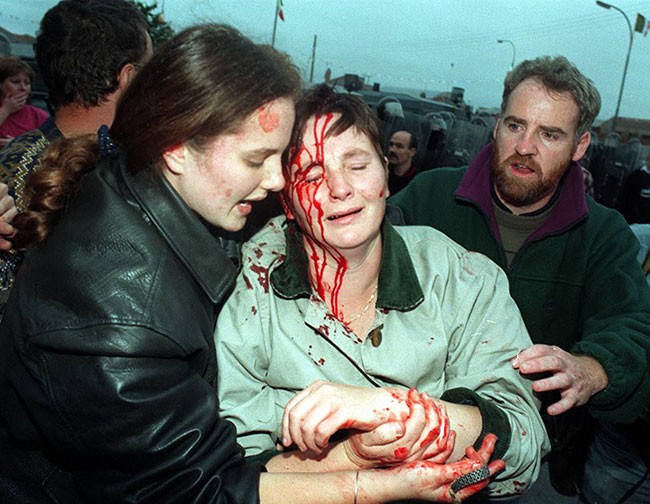
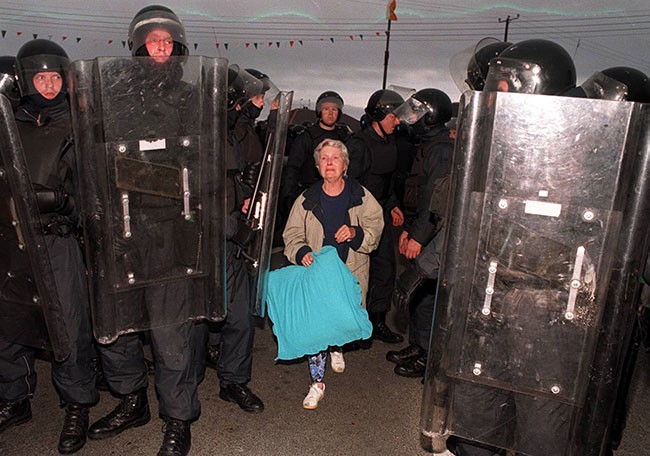
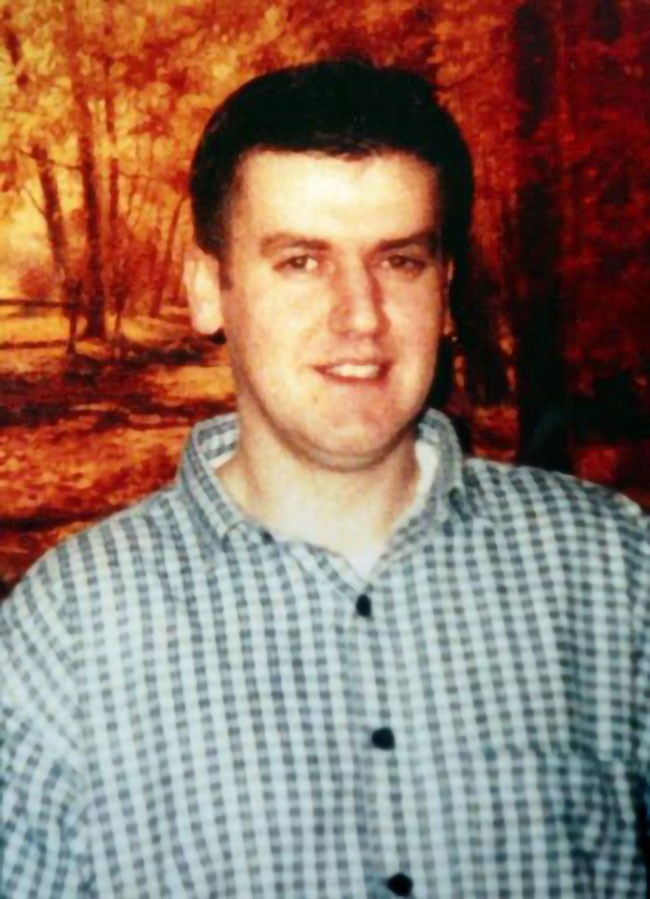
1997. Portadown resident Robert Hamill was savagely beaten by loyalists in the town and died in hospital on 8 May. A week before his death the British Labour Party won the Westminster election and Tony Blair became Prime Minister. Mo Mowlam was appointed Secretary of State in the Six Counties. As they had done through all the annual crises over marches, the Orange Order refused to speak directly to the Garvaghy Road Residents Coalition. Mo Mowlam gave the green light to the Garvaghy Road march on 6 July and once more nationalists were beaten off the road by the RUC. Two days later a leaked British government document said a “controlled march” was the “least worst option”.
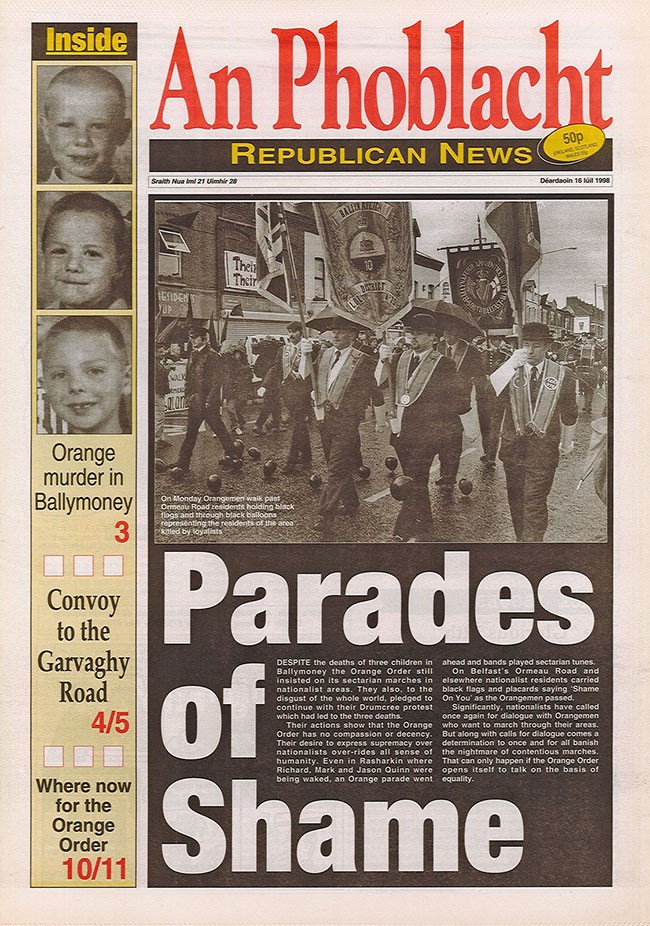
1998: On 29 June the Parades Commission ordered the rerouting of Orange parades away from the Garvaghy Road. Unionist and loyalist protests erupted again. Brothers Jason (9), Mark (10) and Richard (11) Quinn were murdered by loyalists in a sectarian arson attack on their home in Ballymoney, Co. Antrim. Despite a call by the Armagh chaplain of the Orange Order and many others to end the Drumcree stand-off, the Portadown Orange Order and its supporters maintained its presence and persisted in filing applications for marches.
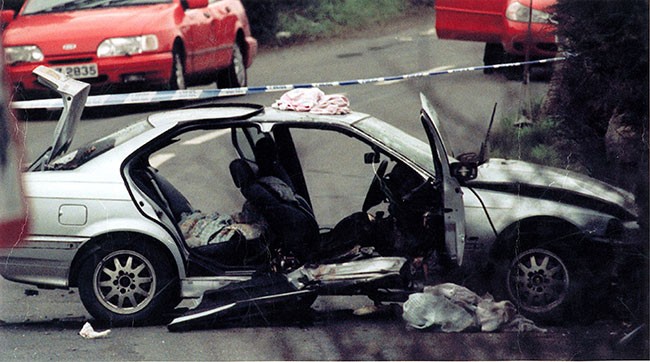
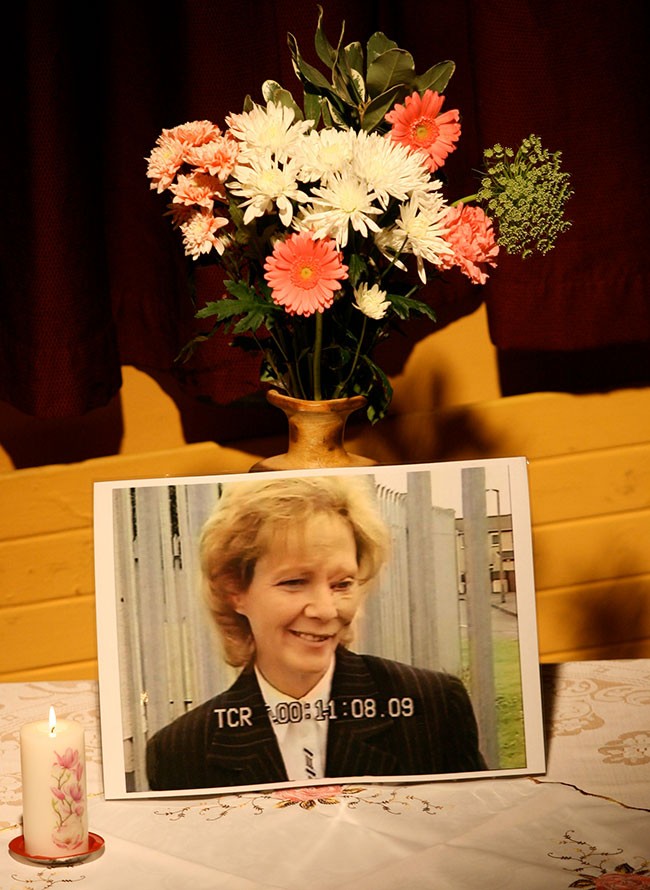
1999: Rosemary Nelson, lawyer for the Garvaghy Road residents and for the family of Robert Hamill, among much other human rights work, was murdered in a loyalist car bomb attack on 15 March.