


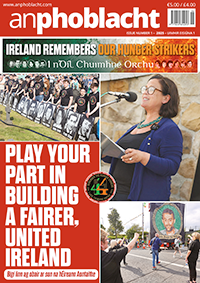
31 July 2026
50 Years on, Derek Highsted remembered on both sides of the Irish Sea
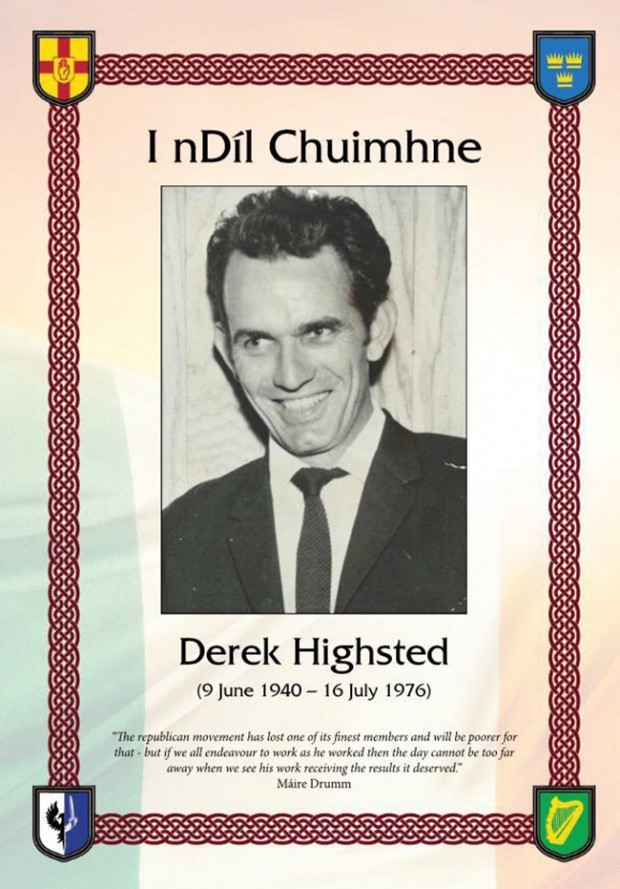

The 50th anniversary of the passing of Derek Highsted was marked with two unique tribute nights, in both London’s Camden Town and his native Maghera in South Derry.
Highsted, a 36-year-old Sinn Féin Political Organiser for Britain, died under suspicious circumstances on 16 July 1976. Operating at the heart of the British state during the height of the conflict, he faced immense risks. As Sinn Féin MLA Gerry Kelly once noted, “The hardest place to be an Irish Republican at that time was in Britain.”
Driven into the Republican Movement as a young man following local police harassment, Highsted was an active IRA volunteer during the 1956–1962 Border Campaign and was interned in 1958. After his release in 1960, he moved to London for work, navigating an era of widespread anti-Irish discrimination.
He built a life in Cricklewood, marrying Philomena and raising two children, Brendan and Bríd. However, the outbreak of the conflict in the North pulled him back into activism. When the Battle of the Bogside erupted in August 1969, Highsted immediately brought a lorry full of medical supplies across the Irish Sea for the besieged people of the Bogside.
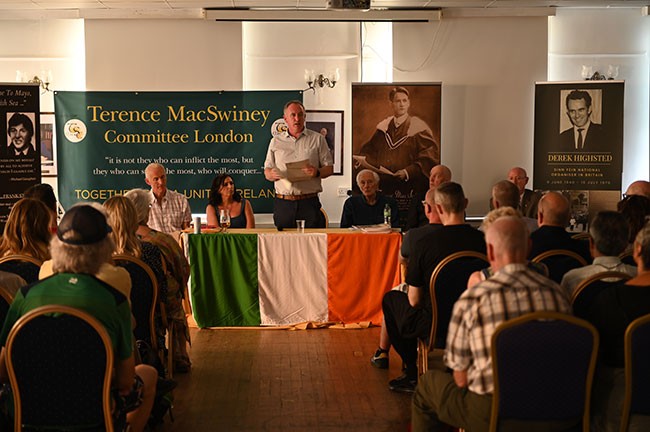
• Cathal Mallaghan delivers the keynote speech at the Derek Highsted Commemoration hosted by the London Terence MacSwiney Committee
Back in London, he stepped into leadership roles with the Anti-Internment League and North London Sinn Féin Cumann. Despite the dangers of being a visible republican in Britain, throughout this period Highsted provided essential financial, political, and logistical support to the republican movement, while personally assisting Irish political prisoners and their families with housing, transport, and prison visits.
Highsted was a leader who never asked others to take risks he would not face himself. When republican prisoners — Michael Gaughan, Gerry Kelly, Hugh Feeney, Frank Stagg, Paul Holme, and the Price sisters — launched a hunger strike in 1974, Highsted supported them daily, horrified by the brutality of prison force-feeding.
On 3 June 1974, Michael Gaughan died on his 65th day of hunger strike after a prison doctor fatally punctured his lung during a forced feeding. For Gaughan’s funeral procession on 8 June, 3,000 mourners filled Kilburn High Road. As Highsted personally pinned the Irish tricolour onto Gaughan’s coffin; the very same flag that had once draped the coffin of Terence MacSwiney in Brixton in October 1920.
It was a clear show of strength and revealed the widespread sympathy and solidarity of the Irish community and progressive allies in London. To prevent similar displays reoccurring, the British Home Secretary quickly moved to use the 1936 Public Order Act to ban future republican funeral processions in Britain.
Despite such repression and marginalisation, British authorities estimated that Highsted and his comrades raised between £15,000 and £17,000 annually across the pubs and clubs of Kilburn, Cricklewood, Harlesden, and Camden. As Highsted proudly told Daily Mail journalists in December 1975, this funding did not arrive in £20 bank notes but was built almost entirely on ten-pence pieces from working-class people. Tangibly demonstrating the level of support that existed.
Tragically, Derek Highsted’s life was cut short on 16 July 1976, when the hydraulic hoist of his tipper lorry collapsed, trapping and killing him instantly. A subsequent inquest in Cardiff proved inconclusive. Although Department of the Environment examiner Sydney James Roberts found no mechanical faults with the vehicle and twice failed to replicate the error alleged to have caused the collapse in front of police officers.
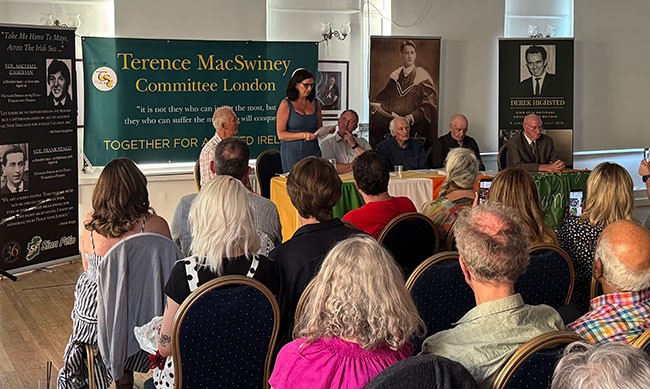
• Derek Highsted's niece, Siobhán McDaid who shared a heartfelt account of her family’s profound loss
Acknowledging the suspicious nature of the incident, the South Glamorgan coroner remarked that “there may be the appearance that there was some interference by a third-party,” but ultimately concluded that there was no evidence of third-party involvement. The jury would return an open verdict by a majority of ten to one.
With each passing year and with each revelation of British state collusion, suspicion about what took place that fateful day only gathers more credibility. As Derek’s comrade Maureen Maguire later stated, “Derek’s death left an irreplaceable hole in the republican movement in England.”
A measure of the respect and reverence that Highsted’s memory still carries in London was marked by the high level of attendance at a memorial event in Camden’s London Irish Centre last Thursday, 16 July.
The evening was hosted by the Terence MacSwiney Committee [London] and was opened by the Committee Chairperson Frank Glynn. Chair of Sinn Féin’s Six County Cúige and abstentionist MP for Mid Ulster, Cathal Mallaghan delivered a keynote political address.
Personal reflections followed, beginning with Derek’s niece, Siobhán McDaid, who shared a heartfelt account of her family’s profound loss. George Stagg, brother of hunger striker Frank Stagg, also sent a video message of solidarity praising Derek’s enduring strength and fortitude throughout the 1976 hunger-strike. Jim Curran, a close friend of Highsted and Chair of the Irish Civil Rights Association (Britain), detailed Derek’s early work with Cumann Cabrach. He highlighted their efforts, following the 1970 split, to ensure all 24 Sinn Féin Cumainn in England aligned with the Provisional leadership over the Officials.
Curran also noted Highsted’s vital support during the October 1974 British Westminster elections, when seven civil rights candidates ran in constituencies with sizeable Irish populations on a British withdrawal ticket. He noted that Derek Highsted could see even then the value of electoral interventions to highlight the cause of Ireland.
The evening concluded with Troops Out Movement co-founder Aly Renwick, who discussed the British left’s solidarity towards Ireland and the British left’s collaboration with Sinn Féin in Britain, highlighting the severe dangers faced by republican representatives in the English capital.
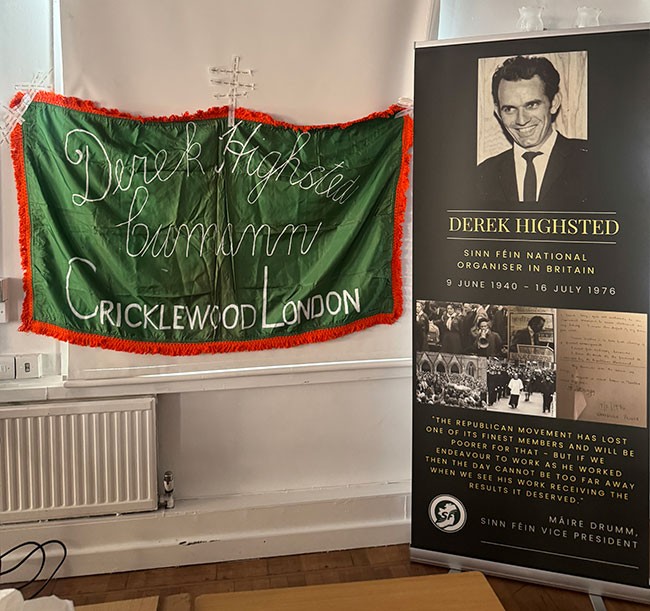
• Derek Highsted commemoration poster and flag
This was followed by veteran activist Pat Reynolds who analysed how the Prevention of Terrorism Act and high-profile miscarriages of justice, like the Guildford Four and Birmingham Six, hampered Irish political activism in Britain. Following this, presentations were made to the Highsted and McDaid families who had travelled to attend the meeting.
Two days later in Maghera, republicans gathered at Derek Highsted’s grave in Glen Cemetery, Maghera. Following a procession by the South Derry Martyrs colour party, Cllr. Paddy Kelly paid tribute to Highsted as wreaths were laid by republican representatives and family members.
Attendees included local representatives Emma Sheerin MLA, Cllr. Ian Milne, and Cllr. Cora Corry, alongside Sinn Féin National Chairperson Declan Kearney MLA and Philip McGuigan MLA. Following this, Paul Bryson opened an event at Brackagh Hall, discussing local republican politics throughout the decades and Highsted’s enduring legacy. Gabhan McFalone then shared how recent Undercover Policing Inquiry revelations clearly demonstrate how Highsted successfully outmanoeuvred British security personnel who attempted the infiltrate Sinn Féin in Britain. To close, Ian Milne recalled Highsted’s funeral service from fifty years previous, and Emma Sheerin MLA read a commemorative poem.
Both events paid a worthy tribute to the memory and legacy of Derek Highsted, a leader who did all he could in the time he had to advance the cause of Irish freedom.
As the Irish rebel Thomas Davis once wrote:
“Whether, then, oh Reader you spend a season,
or a life abroad, do not forget for a day,
How much should be done for Ireland.”
There can be little doubt that Derek Highsted’s life stands a testament to this challenge. Whether home or away, he will remain an inspiration for generations of Irish republicans.
Follow us on Facebook
An Phoblacht on Twitter
An Phoblacht Podcast

Uncomfortable Conversations
An initiative for dialogue
for reconciliation
— — — — — — —
Contributions from key figures in the churches, academia and wider civic society as well as senior republican figures