


26 May 2026
Workers' rights delayed or blocked are rights denied
Sinn Féin National Chairperson Declan Kearney MLA
"Whatever decision is made in the Executive on 28 May, workers and families should not be made to wait any longer"
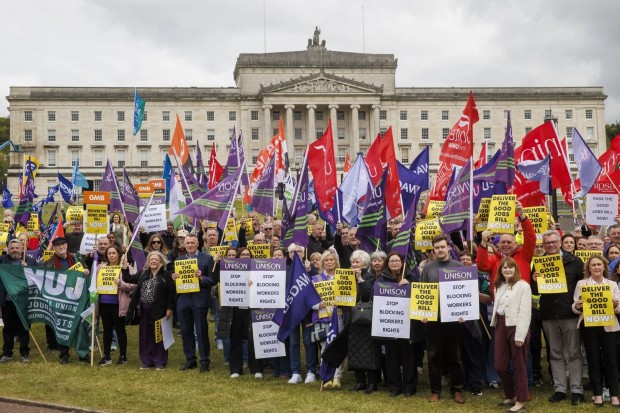
Last week a large number of local trade unionists, various MLAs, and Party workers rallied together outside Parliament Buildings in Belfast to call for progress on implementation of the ‘Good Jobs Employment Rights Bill’, which is being spearheaded by the Sinn Féin Economy Minister, Caoimhe Archibald. Representatives from all political parties at Stormont addressed the rally.
While all spoke, they did not speak with one voice.
The Bill is currently with our power-sharing Executive for consideration.
It will meet again on Thursday 28 May. This meeting provides an opportunity for the Executive to agree that the Bill immediately proceeds into the Assembly and Economy Committee for the start of the legislative scrutiny process before the Assembly summer recess.
The ‘Good Jobs Bill’ represents the most progressive piece of employment law ever introduced in the north. Its provisions exceed the existing legislative arrangements in the 26 counties.
Employer and business organisations recently published concerns suggesting there would be insufficient time to scrutinise & amend the bill.
That is not the case. If the Executive agrees on 28 May that the Bill may proceed for scrutiny there will be plenty of time.
Inevitably some organisations and economic interests will express disagreements. But democratic debate is positive.
Of more concern is the potential for the DUP to try and stall the Bill within the Executive in an attempt to run the clock down for purely cynical and partisan ideological reasons.
A toxic political context exists within the Assembly and Executive.
Throughout the last 18 months the DUP has brought a wreckers agenda in its approach to the workings of both the Assembly and Executive. It has set its face against legislative initiatives to support some of the most vulnerable in our society. It is opposed to the very concept of equality. It actively rejects measures aimed at tackling climate change.
Its hostility to the Irish national identity, culture and language has intensified. King Charles has more respect for Irishness than the DUP and other sections of political unionism.
There is a saying which cautions against ‘cutting off your nose to spite your face’. In other words, avoid doing things that are counter to one’s own interest.
The ‘Good Jobs Bill’ is a case in point. It has been drafted to benefit every working family in the north regardless of religious, ethnic or political background.
However, the as yet unanswered question is whether the DUP will try to prevent passage of this Bill into law, and consequently deny workers and families, including those who vote for the party, improved employment rights, enhanced workplace conditions and representation, and decent pay.
Or, whether it will in fact work with all other parties to deliver the fundamental improvements envisaged with this legislation for every single working family in the north. That is obviously the best possible outcome.
In February 2026, the Law Centre NI and Joseph Rowntree Foundation reported that up to 60% of people in the north that are living in poverty are in working families.
Across various sectors of our economy, including retail, hospitality, health and social care, workers are not making enough money to sustain decent living standards for their families.
Low pay jobs and insecure employment have become a lived reality.
This damning statistic underscores the need to overhaul employment practices through a legislative measure which gets the balance right between employers’ profitability and the right of workers to a fair wage and decent living standards.
Now we have an opportunity to get that balance right.
The primary objective of the ‘Good Jobs’ Employment Rights legislation is to address low pay and insecure employment through decent jobs, improved trade union access to workplaces, and collective bargaining.
Passage of this progressive legislation is also about encouraging development of an economy that is both productive and rewarding for all.
Scaremongering about trade union access to workplaces, and collective bargaining rights for workers is misplaced.
Workplace relations between employers and employees do not have to be contentious. Social dialogue provides the mechanism with which to meet the challenges facing the regional and national economies.
The Cambridge Center for Business Research finds that strengthened workers’ rights and higher union density increase the productivity and profitability of a company while at the same time delivering well paid jobs.
The Nordic experience shows that strong unions and enhanced collective bargaining rights contribute to improved levels of economic productivity, higher wages, strong workers’ rights, and a better quality of life benefits for workers and families.
This model succeeds because it practices social dialogue.
There does not have to be a contradiction between union density and the sustainability of business enterprise models.
Data from the United States illustrates the positive role which unions play in that economy.
Workers in higher union density states, such as Washington, Hawaii, New York and California, earn higher median wages than their counterparts in states with lower union membership.
According to the US Department of Labour, in 2023, annual household income in higher union density states was approximately $12,000 higher, on average, than in lower union density states.
The Bureau of Labour Statistics also finds that high union density states enjoy higher levels of productivity. Washington leads all states in long term productivity and growth.
These same states enjoy higher living standards, lower levels of inequality, better health outcomes, and levels of educational attainment.
The US Economic Policy Institute concludes that union density and collective bargaining rights improves wages and living standards for both union and non-unionisedworkers alike.
The presence of unions lifts all boats.
The north’s regional economy is increasingly attracting Foreign Direct Investment.
Major investors operate here because of the well educated workforce, our cost competitiveness, and dual market access.
Investments in engineering, manufacturing, and financial services have increased wages and benefits for thousands of workers across the north.
Some employers have a negative reflex towards empowered workers’ and collective bargaining.
A more considered response to the evidence from Nordic economies and the contrast in union density in US states should give pause for thought.
Large investors want profitability for their companies and their shareholders. And, that’s fair enough.
However, a balance must be struck between gains for shareholders and the importance of raising living standards of all our workers in the north and indeed across the island.
One of the most effective counters to the worsening cost of living crisis is to ensure that workers have fair pay and decent conditions of employment.
At the same time, empowering our workforce with effective representation is the key to building a stronger economy, and more, and better paid jobs.
The ‘Good Jobs Bill’ is the vehicle to help rebalance the regional economy in the interests of businesses, investors and workers.
It must not be delayed. It should be brought forward for democratic scrutiny through the Assembly’s processes to provide sufficient time for all views to be heard.
Attempts to frustrate and or slow down progress of the Bill will be a serious denial of expanded employment rights for all workers in the north.
Whatever decision is made in the Executive on 28 May, workers and families should not be made to wait any longer.
In the coming period it is essential that unions, political parties, wider civic society, and political and trade union activists resolve to work collectively to campaign vigorously for implementation of these important workplace reforms.
Workers' rights delayed or blocked, are rights denied.
Follow us on Facebook
An Phoblacht on Twitter
An Phoblacht Podcast

Uncomfortable Conversations

An initiative for dialogue
for reconciliation
— — — — — — —
Contributions from key figures in the churches, academia and wider civic society as well as senior republican figures