


8 May 2026
The Triple Lock - the truth
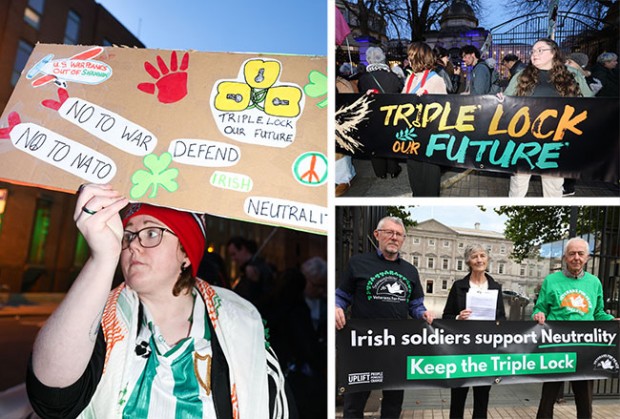

There was huge interest among delegates to the presentation on the Triple Lock at last summer’s ICTU Global Solidarity School. As a result Dublin Council of Trade Unions organised a similar presentation for its delegates and a call for the Trade Union movement to lead their defence of the Triple Lock and Irish Neutrality. This led to the formation of Trade Unionist for the Triple Lock. Since then they have been building a grassroots campaign in unions and Trades Councils across Ireland.

The Triple Lock governs the deployment of Irish troops on overseas missions. It sets out that for more than 12 Irish troops to be dispatched on overseas missions there must be:
(1) Cabinet/government approval
(2) Dáil Éireann approval
(3) The mission must have a United Nations (UN) mandate from the Security Council or General Assembly. The Triple Lock is a safeguard;
Ireland can only deploy troops on UN mandated missions established in accordance with the international legal principles set out in the UN Charter.
Ireland joined the UN in 1955 and began deploying troops on UN peace-keeping missions in 1958.
In 1960, the government introduced the Defence (Amendment) Act and the Defence (Amendment) (Act 2) which set out that Ireland would only dispatch troops overseas on UN mandated missions.
The Triple Lock and the Nice and Lisbon Treaties
In 2001, the Irish electorate voted No to Nice 1 because of fears that it would jeopardise Irish neutrality. In 2002, during a European Council meeting in Seville, a National Declaration was made stating that:
‘the participation of … the Irish Defence Forces in overseas operations, including those carried out under the European security and defence policy, requires: the authorisation of the operation by the Security Council or the General Assembly of the United Nations; the agreement of the Irish Government and the approval of Dáil Éireann, in accordance with Irish law’.
This Seville (Solemn) Declaration became known as the Triple Lock. It was basically a repackaging of the 1960 Act. On the basis of the Seville Declaration, the electorate voted in favour of Nice II.
After the rejection of Lisbon I in 2008, Ireland’s commitment to the Seville Declaration was reaffirmed in a protocol attached to the Treaty and later registered with the UN as a legally binding international treaty, in order to get Lisbon II over the line. This was included in the Lisbon Treaty referendum booklet and on this basis the Irish electorate approved Lisbon II.
The authorisation of UN missions
The UN Security Council is responsible for international peace and security. It has 15 members, five of whom (P5) are permanent and hold veto powers. UN missions are authorised by the Security Council, though the UN General Assembly may approve missions under the Uniting for Peace framework.
The government claims that UN P5 members have a veto over where Ireland can deploy its troops.
This is false. Government framing of this question is intentionally misleading and inaccurate. It would have us believe that P5 members specifically veto Irish participation in peacekeeping missions. This is what happens: If a P5 member vetoes a mission then it is the mission as a whole that is vetoed and not specifically Ireland’s participation in it. If a mission is vetoed, then it either doesn’t begin or if it is operational, then it is wound down.
There have been remarkably few vetoes. In 1999 China vetoed the continuation of a UN mission in Macedonia in a dispute regarding recognition of Taiwan. There are no other examples where a peacekeeping mission has been vetoed. Britain, France, the Russian Federation and the US have never vetoed a mission. Resolution 2790, which extended UNIFIL’s mandate for one final year with a view to being wound down thereafter, has been inaccurately described as a US veto of a peacekeeping mission.
The government claims that it is necessary to dismantle the Triple Lock to ‘take back our sovereignty’. Is this true?
No. There is no relationship between the veto powers of P5 members and Irish sovereignty. Under Bunreacht na hÉireann sovereignty is vested in the Irish people. When we exercised our sovereign right to vote in favour of Nice and Lisbon we did so on the basis that the Triple Lock would be maintained, understanding it to be a positive restriction that the Irish people – the sovereign – place on ourselves in order to guarantee that our troop deployments would be in line with international law.
Moreover, the decision to deploy troops rests with the Irish government alone and not with the Security Council. The Triple Lock simply commits the government to deploying those troops only on UN mandated missions in line with international law.
The Triple Lock and neutrality
In 2013, Micheál Martin described the Triple Lock as being ‘at the core’ of Irish neutrality. The Triple Lock and neutrality are intrinsically linked. Missions without UN mandates, such as NATO or EU missions, are driven, not by a desire to build peace, but to secure and maintain US – EU – NATO interests at all costs, including waging war. Irish participation in such missions would violate our neutrality.
The Triple Lock does not impede Ireland from evacuating Irish citizens.
Article 3 (1)(f) of the Defence Amendment Act 2006 permits the deployment of troops overseas to undertake ’humanitarian tasks in response to an actual or potential disaster or emergency’
Would the Triple Lock stop Ireland from responding an attack on undersea infrastructure?
If there were an attack on undersea infrastructure in Irish waters the Triple Lock would not be engaged because it refers to overseas deployments ONLY. There is a vast body of maritime law that deals with undersea infrastructure. Any attack must be dealt with in line with international law. In any case the likelihood of such an attack is massively increased if we ditch the Triple Lock and are instead associated with a nascent or established EU military alliance.
Should we buy fighter jets and military equipment that is interoperable with that of NATO?
Ireland is not a military power and we could never match the military might of other states. Our best and only defence is our neutrality, to not become embroiled in wars and military alliances that have nothing to do with us and only serve to make us a target. If Ireland invests in fighter jets and other military equipment this is money that won’t be invested in hospitals, health care, housing, education, public infrastructure.
What will happen if the Triple Lock goes?
This would be the most significant shift in Irish foreign policy since the foundation of the state. It would permit Irish troops to engage in foreign wars and expose the country to attack. Currently Irish troops participate in EU battlegroup and NATO-led training exercises but they cannot deploy on EU or NATO missions unless these missions have a UN mandate.
If the Triple Lock is dismantled there will be no impediment to deploying Irish troops to EU battlegroup and NATO-led missions. The most likely outcome is that Irish troops would be deployed to future war and conflict zones and possibly to illegal wars.
Get in touch, get involved:
[email protected]
Follow us on Facebook
An Phoblacht on Twitter
An Phoblacht Podcast

Uncomfortable Conversations

An initiative for dialogue
for reconciliation
— — — — — — —
Contributions from key figures in the churches, academia and wider civic society as well as senior republican figures