

14 March 2026
DUP wreckers’ charter will not succeed
Sinn Féin National Chairperson Declan Kearney MLA
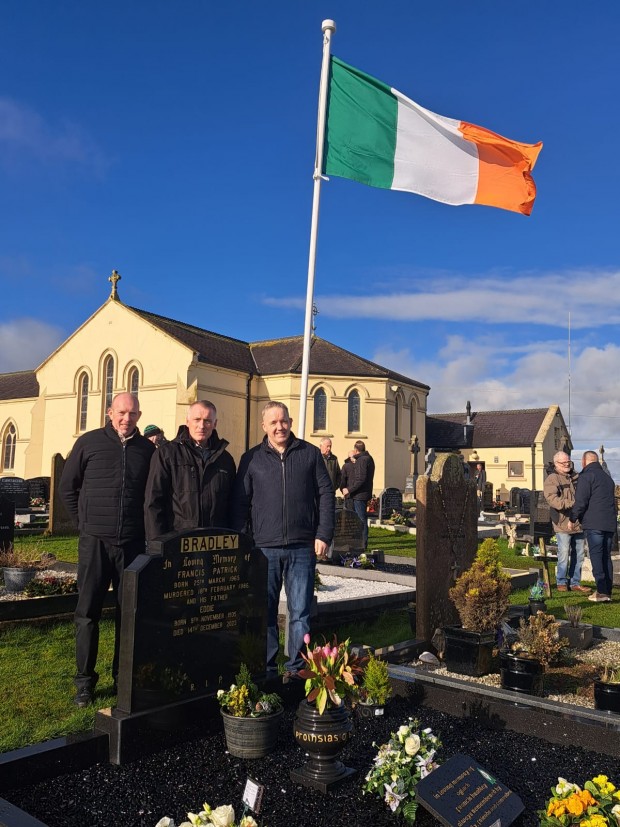
A couple of weeks ago I walked with a friend from the car park at Cargin Chapel towards the graveyard to attend the 50th anniversary commemoration for Volunteer Anne McCoy.
We spoke about the 40 and 50 years’ anniversaries which are being marked at this time within the republican struggle. Fifty years no longer seems such a significant passage of time. We are all getting older. But memories remain strong.
That was reflected in the big crowd which gathered for the simple and dignified ceremony which was organised to commemorate Anne’s life and contribution to the Irish freedom struggle.
Anne was a family friend and was killed in a tragic car accident returning from Long Kesh. Although just under 21 years old, she was already a significant activist; as O/C of Cumann na mBan in south west Antrim.
One week previously, I was honoured to speak at a commemoration in nearby Newbridge, to mark the execution of a young IRA volunteer, Francis Bradley, by a British undercover unit.
For the last 40 years, Francis’s family has campaigned relentlessly to expose the circumstances surrounding his killing.
There is a timeless photograph of Francis with a lovely beaming smile. His laughter in that image evokes joy and happiness. It resonates the hopes and aspirations of a young man.
In his home area of Newbridge, Francis was popular and friendly; described as a bit of a rascal.
He was rural working class; a farmer’s son who kept his own animals. He played Gaelic football for Ballymaguigan. At 20 years of age he was the eldest of three brothers and a sister.
Four years earlier, the 1981 hunger strike had taken place. This was a dark but defining period in Irish history. Two of the republican hunger strikers who died, Francis Hughes and Thomas McElwee, were from Tamlaghtduff, about six miles from Francis’s home.
Sixty-five years after the 1916 Rising, the hunger strike became the latter day 1916 watershed moment in modern Ireland.
It was a transformational phase for the republican struggle.
As a result, during 1981, and succeeding years, thousands of young people joined the IRA’s armed struggle, and became members of Sinn Féin.
Francis was one of them. By the end of 1984 he too had become a IRA volunteer.
The immediate aftermath of the hunger strike was a period of resurgence in the national liberation struggle. The republican POWs in the H-Blocks defeated Britain’s criminalisation strategy. They went on to plan and execute the mass escape of 1983, when 38 prisoners broke out of Long Kesh.
There were significant developments taking place within republicanism. An electoral strategy was initiated by Sinn Féin. The party made an historic breakthrough in the north’s local council elections of 1985.
A new phase of political struggle was crystallising.
Francis Bradley had options at this stage in his life. He didn’t have to join the IRA; he had a lot going for him – a job in nearby McElhone’s, and maybe thoughts of settling down. But he made his decision based upon what he saw happening around him.
In the mid-1980s the northern state was heavily militarised. Occupation forces engaged in widespread repression, including house raids, arrests, brutal interrogations, and frequent checkpoints. Sectarian discrimination in employment was endemic. The Irish national identity was demonised and treated with hostility by the state system. This was the modern reality of partition, 60 years after its imposition by the British.
Francis joined the IRA to change things. Democratic reform of the state was impossible.
During this period, the British responded to the intensified armed struggle and Sinn Féin’s emerging political and electoral momentum with a new counter-insurgency strategy.
Thatcher’s war cabinet launched a new offensive. A ‘Tasking and Coordination Group’ was established to oversee military and security operations. A shoot to kill policy was mounted against republicans in Lurgan, Armagh city, east Tyrone, Derry city, and south Derry, where Francis was killed.
The British deployed a ‘paid perjurer’ tactic to arrest, detain and charge large numbers of republicans on the word of individual, perjured witnesses, who had been recruited as agents of the state.
From the mid-1980s British security agencies reorganised unionist death squads. They were provided with multiple intelligence files and rearmed with weapons and munitions imported into the north from South Africa by state agents.
Yet despite being confronted with seemingly overwhelming military and intelligence resources, the IRA could not be defeated due to the resilience of its political support base. A military and political stalemate took hold.
As the tentative foundations of what became the Irish peace process began to develop, those most hostile to change within the British military and security system tried to derail the emergent process.
They knew that a successful peace process would undermine their colonial control and occupation in the north.
They were right. An unstoppable transformation was unleashed.
Today the peace process has opened a peaceful and political road to achieve self-determination and Irish unity.
That change is in evidence all around us.
The north has been demilitarised.The RUC and Ulster Defence Regiment militia have been disbanded. Sectarian discrimination in employment has been ended. The Irish national identity has parity of esteem and the Irish language enjoys official status. Political unionism’s dominance has crumbled.
Yet powerful sections within the British security and intelligence agencies remain politically and psychologically at war with the Sinn Féin leadership. That’s the subtext to the current civil case against Gerry Adams in London at this time.
These are the same people who have blocked Francis Bradley’s family’s campaign for truth. They are using the so-called Legacy Act as a new effort to cover up Britain’s dirty war in Ireland.
So, the challenges are many, however, those of us who champion a new vision for Ireland have momentum.
But, still there is much more to be done.
The DUP in particular, and political unionism generally, is attempting to subvert the capacity of the power-sharing Executive and regional Assembly to work effectively.
The state of public finances and ability to deliver sustainable and decent public services has arguably never been more difficult. That, combined with inflationary pressures and extremity of the cost of living crisis, are creating unprecedented challenges for the northern Executive. The British Labour government has not reversed the chronic underfunding of the north by the Tories since 2010.
As a result, schools in the north of Ireland are crumbling; children with special educational needs, and adults with additional and complex needs are being failed; the health service itself is in crisis; the wastewater infrastructure system is in a state of collapse; our environmental and agricultural challenges are immense.
Westminster rule has systemically undermined the political process in the north. It will never act in our interests, and that pattern will continue in the absence of constitutional change.
However, the prospect of achieving Irish unity is now firmly on the political horizon.
It’s this reality which is driving the increasing arrogance, negativity and confrontational approach of the DUP, and others in political unionism. Of course, intra-unionist electoral rivalry is a factor, but DUP tactics are totally focused upon causing political demoralisation. The DUP is hellbent on pursuing a wreckers’ agenda within the Assembly and Executive, no matter what the consequence.
However, there is a change occurring within the protestant section of the community in the north. Protestant people, including those who have been traditionally unionist, are questioning the benefits of being part of a decaying union, and where their best interests lie in the future.
They are watching political and economic developments in Britain and feel increasingly distant from decisions being made in London, by a government which neither understands nor cares. Sinn Féin activists know this because they tell us in discussions at their doors. And, it is a particularly strong sentiment being expressed by young people.
The British Labour austerity approach to the north is mutually reinforcing with the stance of political unionism. That is unsurprising, English politicians do not care about citizens in the north. British indifference provides cover for the DUP in its efforts to block and frustrate positive progress within the north’s political institutions.
All this underlines the fact that the Good Friday Agreement is a peace settlement, but not a political settlement.
The political institutions established by the agreement are important mechanisms to try and make change on behalf of all citizens, but they are not an end in themselves.
As I drew my remarks to a close in Newbridge graveyard, I told the assembled crowd that the road to a better future and Irish unity is clear. In moving forward we need to remain cohesive, to continue increasing popular support, and leveraging our political strength to secure a unity referendum by 2030, and then win the popular debate for national reunification.
Republicans need to take every opportunity to engage collectively and discuss the challenges and opportunities within this political phase.
The Assembly and council elections in 2027 will be another key beachhead from which we can advance the project of national and social change.
Thankfully, today young people in Ireland no longer need to take the decision made by Francis Bradley.
They are at the fore of an exciting, democratic movement aimed at decolonising Irish society, through language, music, cultural expression, and international solidarity with peoples denied their rights across the world: A recent Ard Fheis of Conradh na Gaeilge exemplified that dynamic.
Today’s youth are shaping our future in spite of the conservative forces in the north and south.
They are the new change makers – setting the pace for the march of the Irish nation towards a new, modern progressive republic.
With their energy and ambition, they will surely realise the legacy of Francis Bradley, Anne McCoy, and the many others who went before.
Follow us on Facebook
An Phoblacht on Twitter
An Phoblacht Podcast

Uncomfortable Conversations
An initiative for dialogue
for reconciliation
— — — — — — —
Contributions from key figures in the churches, academia and wider civic society as well as senior republican figures