


9 March 2026
Women’s bodies are still battlegrounds
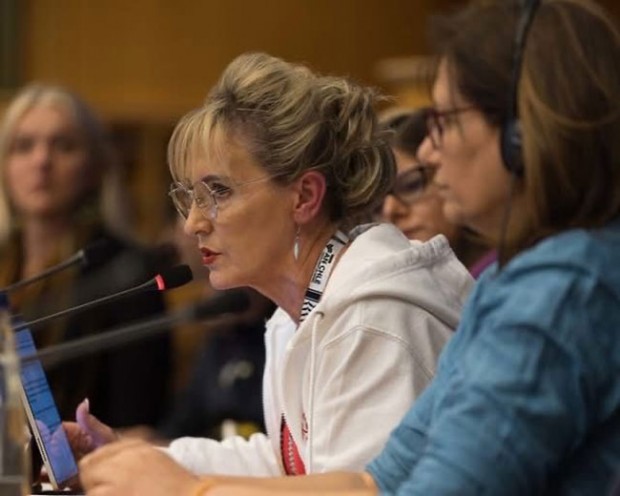

This article for International Women’s Day is based on a talk given in Brussels last week.
Before Ireland was partitioned, the law that governed us did not arrive with consent.
It arrived with empire. It drew borders not only around our land, but around our lives, our bodies, our language, our faith, our futures.
Britain sought to destroy Irish culture, to erase our language, criminalise our traditions, and even ban the practice of the Catholic faith. Colonialism is never abstract. It is intimate. It enters the home. It enters the body. They called An Gorta Mór – the Irish famine. It wasn’t. It was starvation.
One million Irish people starved to death, another million displaced. And those who survived built other places.
Colonial power always rewrites its crimes as accidents, as inevitabilities, as history. But we remember. We remember the Easter Rising of 1916. We remember the War of Independence. We remember that those Irish Republicans now officially commemorated in Ireland were once denounced by the Irish establishment as criminals suffering from “criminal madness.”
We remember Ballyseedy, where Irish republican prisoners were taken from jail, tied to a rock and blown apart. Empire doesn’t disappear, it reshapes itself. And we remember Irish Republican Prisoners Terence MacSwiney. Playwright. Author. Lord Mayor of Cork. Who died in Brixton Prison in England after 74 days on hunger strike in 1920.
Britain partitioned Ireland in 1921, GIFTING unionists in the north of Ireland their own statelet, just as empire did elsewhere: white settlers in South Africa, Israeli settlers in Palestine. Divide. Control. Rule. I was born into that state. A state that did not want us. That did not welcome us. That policed us.
I was seven years old in 1969, a child of the Battle of the Bogside in my hometown - Derry. My family took to the streets demanding nothing more radical than civil rights. They were beaten for it. Heads smashed. Homes attacked. Fourteen unionist bombs. Six Catholics shot dead before the IRA fired its first shot.
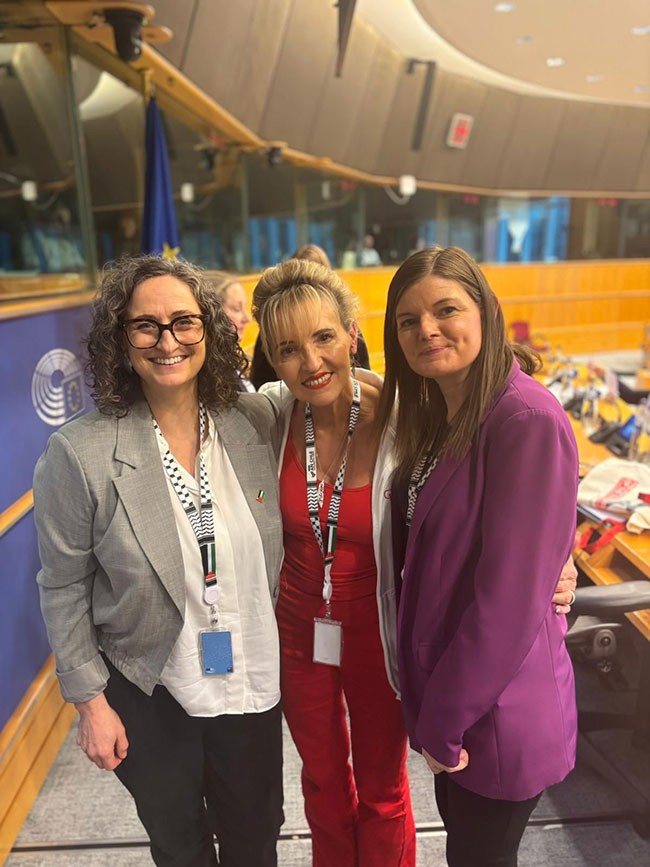
• With Sinn Féin MEPs Lynn Boylan (Dublin) and Kathleen Funchion (Ireland South)
Sinn Féin was banned until I was 12 years old. Discrimination was Law - Housing, jobs, voting rights, denied. And then Bloody Sunday in Derry when British soldiers shot 26 Marchers, 14 died. And Annette McGavigan, still wearing her St Cecilia’s school uniform, murdered at the end of our street by a British soldier. She was the real Derry Girl.
THIS is the context in which women entered a war that was never meant to include us. A war imagined as the sole terrain of men. But colonial violence never spares women, it recruits our bodies as sites of punishment, warning, control.
I was arrested in 1981 and imprisoned in Armagh jail. Upon getting bail, I attended our hunger strikers’ funerals which included Bobby Sands. In 1985, I was arrested in Glasgow with four comrades, including the late, great Dr Ella O’Dwyer from Tipperary.
We were remanded not to Holloway women’s prison, but to Brixton Prison - a men’s jail. Six hundred men and only two women – Ella and I. Brixton Prison - where Terence MacSwiney died.
From the moment we arrived, sexual verbal abuse was relentless. Men exposing themselves from their cell windows. Day and night. Outlining how they would rape us if they got near us. The prison regime knew exactly what it was doing. And then the strip searching. Let me be clear: this was not security. It was ritualised domination.
Six prison officers “screws” standing in a circle. We were ordered to strip naked. Turn. Lift body parts. Mouths inspected. Ears probed. Hair searched. Six times a day. It was a choreography of humiliation. A form of sexualised state violence carried out under uniform and authority.
At first, we tried to count how many strip searches. Then we stopped. Counting made it feel normal. And it wasn’t. It was punishment. It was about power. About reducing women’s bodies to objects, believing that if the body was broken, the spirit would follow. It didn’t. We treated it like a siege. You dig deep into yourself, to a place no one can search. It was cruel. It was degrading. And I won’t pretend it didn’t take its toll. Prison always does.
Ella never hid what it did to her. She said plainly that the daily struggles she faced on the outside were rooted in what we endured inside. There was no romance in it. No heroic varnish. They wanted us compliant. Silent. Submissive. Instead, they got two stubborn Irish republican women.
We were sentenced to life in prison. Spent years in English prisons. Slopping out. Cockroach-infested cells. No toilets. The stench unbearable, especially for women during our monthly periods. That too is how gendered punishment works. We served almost ten years in England. Married in prison. Were among the first prisoners repatriated shortly before the first IRA cessation. Released after the Good Friday Agreement, 14 years later.
And like so many former political prisoners, I asked - not what next for me? But how do I contribute? Stormont. The Assembly. Europe. Palestine. Brexit – and now SF’s National Training and Political Development Coordinator.
ONE continuous struggle, against borders, against militarisation, against imperial logic dressed up as security. Our Struggle for national liberation in Ireland is interwoven with the struggle for Women’s liberation. Colonialism and Patriarchy are two sides of the same coin.
Wherever empire needs to assert control - it begins with the body. So, I as I speak here in the European Parliament of struggle; I do so not only in terms of military resistance, but as a broader resistance to Colonialism, Patriarchy and Poverty.
Because women’s bodies are still battlegrounds and that is not metaphor.
It is material.
It is political.
It is deliberate.
Resistance, too, is deliberate.
And from Ireland to Palestine, from prison to parliament, women have never been passive terrain.
We have been – and remain – agents of resistance. And from Ireland to Palestine, from prisons to parliaments, women have never been passive terrain. We have been, and remain, agents of resistance.
Follow us on Facebook
An Phoblacht on Twitter
An Phoblacht Podcast

Uncomfortable Conversations
An initiative for dialogue
for reconciliation
— — — — — — —
Contributions from key figures in the churches, academia and wider civic society as well as senior republican figures