


27 February 2026
The Prison Struggle 1976-1981
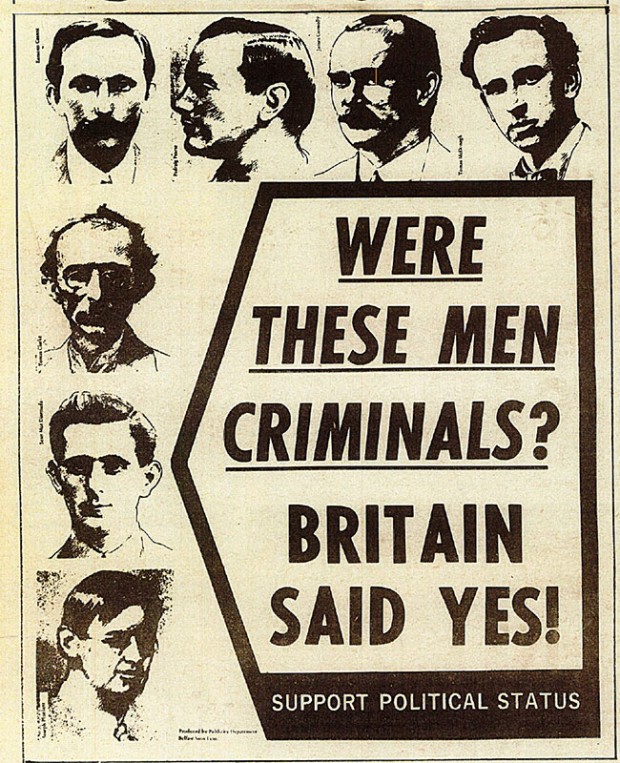
• Republican News carried a poster linking it to the 60th anniversary of the 1916 Rising

Introduction
Between 1976 and 1981 the prisons in the Six Counties became front lines in the struggle for Irish freedom with an intensity and for a duration never seen before in Irish history. This stemmed from the attempt begun 50 years ago by the British government to brand Irish Republicans prisoners as criminals.
From August 1971, internment had been imposed. It ended in December 1975 and during that period 1,981 people were locked up without any charge or trial; of that number, only 107 were unionists/loyalists. But the end of internment merely signalled a new phase of British repression. The British Government decided to end Special Category Status, which was effectively the recognition of republicans convicted in the courts as political prisoners – in other words, prisoners of war. This status had been achieved in May 1972 after a 35-day hunger strike by IRA prisoners in Crumlin Road Jail.
The British Labour Government announced that those convicted after 1 March 1976 would be denied Special Category Status. They would no longer be held in the Cages of Long Kesh, where convicted and sentenced republicans had been locked in compounds adjacent to those interned without trial. Instead, the sentenced republicans would be moved to the newly-built H-Blocks of Long Kesh, the ‘Cellular Maze’ in official jargon. This was supposed to be a conventional criminal jail – “the most modern prison in Europe” as British Government spokespersons called it.
The purpose of the H-Blocks was to implement the policy of criminalisation which attempted to treat republican political prisoners as common criminals and, more importantly, to have the wider world see them as criminals. Internment and the ill-treatment of prisoners had done serious damage to Britain’s international reputation and a major propaganda counter-offensive, as part of a wider counter-insurgency strategy, was required.
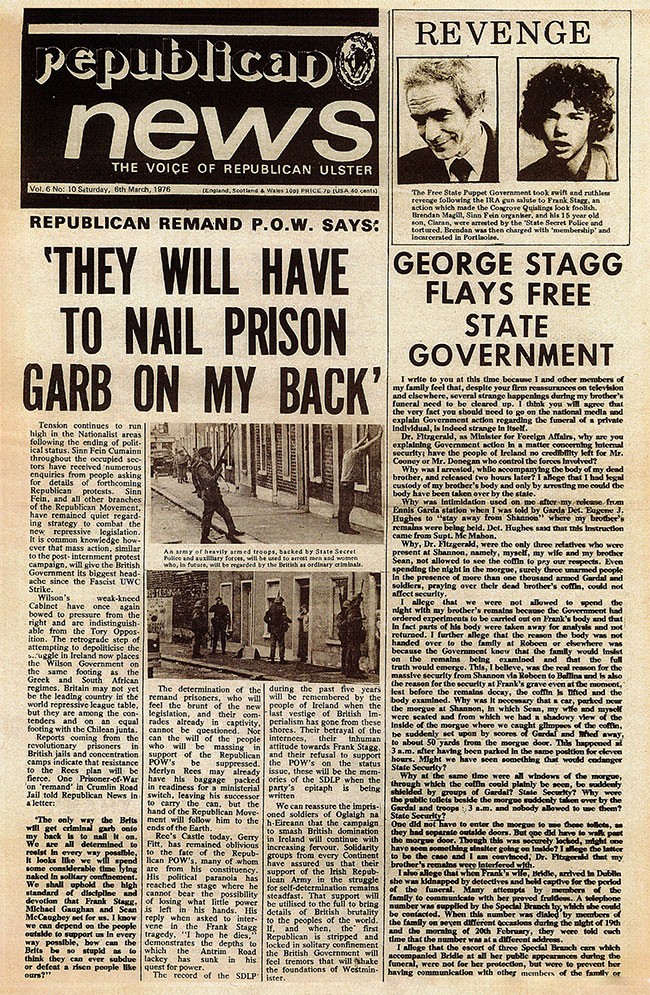
Here we begin a series of re-publications of articles from An Phoblacht and Republican News reporting the battle against criminalisation as it happened. 50 years ago Republican News carried a response to the imposition of criminalisation from 1 March 1976. The following month the paper carried a poster linking it to the 60th anniversary of the 1916 Rising.

Republican remand POW says: "They will have to nail prison garb on my back."
Tension continues to run high in the Nationalist areas following the ending of political status. Sinn Féin Cumainn throughout the occupied sectors have received numerous enquiries from people asking for details of forthcoming Republican protests. Sinn Féin, and all other branches of the Republican Movement, have remained quiet regarding strategy to combat the new repressive legislation. It is common knowledge however that mass action, similar to the post-internment protest campaign, will give the British Government its biggest headache since the fascist UWC Strike.
Wilson’s weak-kneed Cabinet has once again bowed to pressure from the right and are indistinguishable from tbe Tory Opposition. The retrograde step of attempting to depoliticise the struggle in Ireland now places the Wilson Government on the same footing as the Greek and South African regimes. Britain may not yet be the leading country in the world repressive league table, but they are among the contenders and on an equal footing with the Chile junta.
Reports coming from the revolutionary prisoners in British jails and concentration camps indicate that resistance to the Rees plan will be fierce. One Prisoner-of-War on ‘remand’ in,Crumlin Road Jail told Republican News in a letter:
"The only way the Brits will get criminal garb onto my back is to nail it on. We are all determined to resist in every way possible, it looks like we will spend some considerable time lying naked in solitary confinement. We shall uphold the high standard of discipline and devotion that Frank Stagg, Michael Gaughan and Seán McCaughey set for us. I know we can depend on the people outside to support us in every way possible. How can the Brits be so stupid as to think they can subdue of defeat a risen people like ours?"
The determination of the remand prisoners, who will feel the brunt of the new legislation, and their comrades already in captivity, cannot be questioned. Nor can the will of the people who will be massing in support of the Republlcan POWs be suppressed. Merlyn Rees may already have his baggage packed in readiness for a ministerial switch, leaving his successor to carry the can, but the hand of the Republican Movement will follow him to the ends of the earth.
Ree’s Castle toady, Gerry Fitt, has remained oblivious to the fate of the Republican POWs, many of whom are from his constituency. His political paranoia has reached the stage where he cannot bear the possibility of losing what little power is left in his hands. His reply when asked to intervene in the Frank Stagg tragedy, “I hope he dies,” demonstrates the depths to which the Antrim Road lackey has sunk in his quest for power.
The record of the SDLP during the past five years will be remembered by the people of Ireland when the last vestige of British imperialism has gone from these shores. Their betrayal of the internees, their inhuman attitude towards Frank Stagg, and their refusal to support the POWs on thc status issue, these will be the memories of the SDLP when the party’s epitaph is being written.
We can reassure the imprisoned soldiers of Óglaigh na h-Éireann that the campaign to smash British domination in Ireland will continue with increasing fervour. Solidarity groups from every Continent have assured us that their support of the Irish Republican Army in the struggle for self-determination remains steadfast. That support will be utilised to the full to bring details of British brutality to the peoples of the world. If and when the first Republican is stripped and locked in solitary confinement the British government will feel tremors that will shake the foundations of Westminister.
Follow us on Facebook
An Phoblacht on Twitter
An Phoblacht Podcast

Uncomfortable Conversations

An initiative for dialogue
for reconciliation
— — — — — — —
Contributions from key figures in the churches, academia and wider civic society as well as senior republican figures