

23 February 2026
Mícheál Martin is an obstacle to Irish Unity in Fianna Fáil’s centenary year
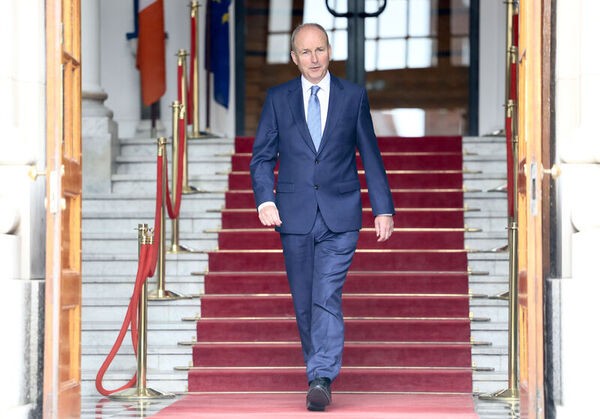

Fianna Fáil Taoiseach Mícheál Martin has gone from delaying progress towards Irish Unity to actually becoming an obstacle to that objective which is enshrined in the Irish Constitution. And this is in the centenary year of Fianna Fáil, ‘the Republican Party’ which regards itself as the champion of the constitutional pursuit of national reunification.
Throughout the conflict in the Six Counties from 1969 onwards, successive Fianna Fáil Taoisigh and Ministers urged the IRA and those who supported it to turn to the constitutional, unarmed pursuit of Irish Unity. Countless appeals were made on this basis but their credibility was undermined by two factors.
First was the reality of the situation in the Six Counties. Decades of participation by nationalists in the totally Unionist-dominated Stormont parliament had yielded nothing and as the world changed in the 1960s, the Northern Ireland state remained a political slum of one-party rule in which nationalists were second-class citizens. The extra-parliamentary Civil Rights movement challenged this on the streets. The Orange State and its loyalist paramilitary auxiliaries reacted with fury and violence. The British government sent its Army in to shore up the Union, its guns being quickly turned against the nationalist community.
The second factor undermining Fianna Fáil appeals for constitutionalism was its own past record and its reaction to the crisis in the North. Founded in 1926 in the wake of the Boundary Commission fiasco and the abandonment of Northern nationalists by the first Free State government, Fianna Fáil made ending Partition their central aim. As they dismantled the Treaty from within government from 1932 on, there was every reason to believe their rhetoric about reunification. But as the years passed it became clear that the republicanism of Fianna Fáil governments stopped at the border. This was symbolised when, more than once, nationalist public representatives from the Six Counties who sought speaking rights in the Dáil were turned away by de Valera.
When the crisis broke in 1969 the initial Fianna Fáil rhetoric was familiar and they had to respond to widespread public sympathy for beleaguered nationalists. The Jack Lynch government even arranged for arms to go North for defence, a scheme that collapsed in another fiasco that saw Lynch disown his own ministers and deny all knowledge. Nationalists in the North looked on in disbelief at the party political hysteria in the South about the ‘Arms Crisis’ when for them the real crisis was the lack of arms to defend themselves.
Little wonder then that nationalists turned to the IRA for defence and that republicans in the Six Counties saw no viable alternative to armed struggle to defend nationalist communities, get the British Army out, end second-class citizenship and reunite Ireland. The situation was further polarised and politics paralysed by the imposition of censorship by successive Irish governments, as well as attempted isolation of Irish Republicans and refusal to engage with Sinn Féin public representatives. The refusal of two successive Irish governments to resolutely and publicly press the British for the just settlement of the prison crisis in the North in 1980 and ‘81, as a result of which 10 hunger strikers died, was yet another factor that undermined the credibility of Fianna Fáil’s ‘constitutional republicanism’.
The armed conflict took many lives among civilians and combatant groups and entered a phase where no end seemed in sight and no hope of peace in prospect. But through determined work by, initially, a relatively small number of people, including Irish Republicans, a peace process was built and strengthened. Dialogue was begun, negotiations were finally undertaken, based on recognition of all mandates, and the 1998 Good Friday Agreement was the outcome.
It took a long time to get the political institutions of the Agreement up and running and they have never run smoothly. But a core part of the Agreement is the provision for a referendum on Irish Unity, a key reason that Sinn Féin supported it in the first place. Here was the peaceful democratic path to Irish Unity that Fianna Fáil had previously but spuriously claimed was always available. So Sinn Féin and others have increasingly urged movement on Irish Unity, fostered dialogue and debate, engaged with all strands of opinion and encouraged planning for the referendum and for the New Ireland that can and will emerge.
It might have been expected that a Fianna Fáil Taoiseach, true to the tradition he claims, following up on the so-often-promised constitutional path to unity and on the work of his predecessors in the peace process and the Good Friday Agreement, would be leading this effort. But not Mícheál Martin. This Taoiseach can barely bring himself to utter the words Irish Unity, let alone lead on the subject.
Mícheál Martin is now actively working against others who work for unity. In a recent interview he said:
“What Sinn Féin and other parties are talking about is politics and a kind of campaign but there is not much behind it, there is not much substance in my opinion.”
Martin said “there’s no prospect of a referendum before 2030 and a vote in favour of unification”, a prediction he is clearly working to see fulfilled.
In his increasingly venomous attacks on Sinn Féin Leinster House, far from reassuring unionist communities in the North, Martin echoes the rhetoric of the unionist political parties. He tries to put Sinn Féin ‘beyond the Pale’ for government in Dublin, based on the legacy of the conflict, and thus he reinforces unionist parties’ intransigence and obstructionism in the Assembly and Executive.
Martin sets the aim of reconciliation, as he defines it, against the aim of Irish Unity. He sets the laudable projects and cross-border developments of the Shared Island Initiative against preparation for a referendum and planning for unity. In both cases it is a false exercise. Reconciliation and constitutional change can and will happen in parallel. The first cannot be a pre-condition to the second. Ongoing all-Ireland developments serve to emphasise the potential benefits of unity for all who share our island, not to stifle debate and discourage action for unity.
Responding to Mícheál Martin, Sinn Féin President Mary Lou McDonald said:
“The Taoiseach’s claim that there is ‘not much substance’ behind the growing demand for a referendum on Irish unity is both wrong and revealing. It shows a government that is content to drift, rather than lead, on the most important constitutional question facing our country.
“Irish unity is not just a ‘campaign’. It is a democratic objective enshrined in the Good Friday Agreement. It is grounded in the lived experience of people across this island who want better public services, economic opportunity, political stability and a future free from division.
“The responsibility to prepare for constitutional change rests squarely with the Irish Government. On that front, this government has failed.
“The Good Friday Agreement provides a clear democratic pathway. It is not for any Taoiseach to dismiss that pathway because it is politically inconvenient.”
Follow us on Facebook
An Phoblacht on Twitter
An Phoblacht Podcast

Uncomfortable Conversations

An initiative for dialogue
for reconciliation
— — — — — — —
Contributions from key figures in the churches, academia and wider civic society as well as senior republican figures