


10 February 2026
Frank Stagg – two governments could not silence him
Remembering the Past - 50th anniversary
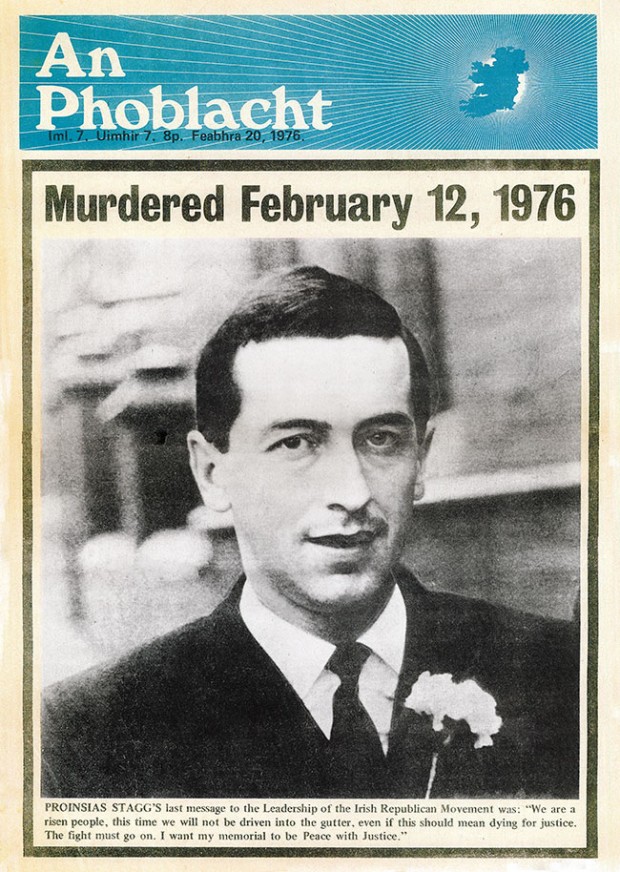

Irish Republican Frank Stagg was in a battle for his rights and against brutal English prison conditions from the day of his arrest in Coventry in 1973 until the hour he died in Wakefield Prison on 12th February 1976. His death after 62 days on hunger strike had been preceded by efforts in Ireland and Britain by campaigners, including his family, to win his demands and to save his life.
The campaign included marches, demonstrations, pickets, petitions and political lobbying in many centres. Two weeks before his death hundreds of workers on the site of the ESB’s generating station in Tarbert, Co. Kerry, marched off the site in a solidarity protest. That is just one example. At the same time, Gerry Adams, then a prisoner in Long Kesh, under the pen-name ‘Brownie’ was writing:
“Within the next week or two, support for Frank Stagg will build among the freedom-loving people of Ireland. This may be too late. It must be stressed that Frank Stagg will die if pressure is not brought to bear on the Brits immediately….The Dublin government has abandoned its responsibility to its own citizens. It actively undermines their rights. Only the Irish people can guarantee these rights. They can do this by opposing the British presence in Ireland and the injustices and torture meted out to Irish prisoners.”
The prediction proved all too true. The British Labour government would tolerate no concessions to Frank Stagg. And the Fine Gael/Labour Cabinet in Dublin acted in a manner that told political prisoners, and all those oppressed by British rule in Ireland, that they were not only abandoned but treated with contempt by an Irish government.
The crisis in the Six Counties, the violent attacks on the Civil Rights movement, the pogrom of 1969, British Army occupation, internment without trial, Bloody Sunday – this was the context in which Frank Stagg, like so many of his generation, joined the Republican struggle. He had come from a Republican family background in Hollymount, Co. Mayo, the seventh of 13 children. He took the boat to England for work and found it as a bus conductor and then a driver. Seeing the events unfolding in Ireland and wishing to play his part, he joined Sinn Féin in Luton in 1972. He then volunteered to join the IRA. Frank was arrested in Coventry in April 1973 and charged under catch-all conspiracy laws, convicted on flimsy evidence and sentenced to ten years in jail.
From the outset of his imprisonment, Frank Stagg insisted on being treated as a political prisoner and refused to carry out prison work. This led to repeated punishment, including long periods in solitary confinement. He was held in several prisons, including Albany on the Isle of Wight and Parkhurst, where conditions were particularly severe.
In March 1974, Stagg joined a hunger strike alongside fellow Mayo man Michael Gaughan and other Irish prisoners, demanding transfer to a prison in Ireland. The protest coincided with a wider hunger strike involving the Price sisters, Hugh Feeney and Gerry Kelly. All were subjected to force-feeding, a practice that was increasingly condemned at the time by human rights organisations.
Frank Stagg endured force-feeding for more than two months. Michael Gaughan died on 3 June 1974 as a direct result of this brutal procedure. Following his death, negotiations were opened and the hunger strike was ended, but the promises made were not honoured. Instead, Stagg was returned to solitary confinement and held under near-constant lockdown, deprived of normal contact and basic comforts, including uninterrupted sleep.
By December 1975, after repeated broken assurances and deteriorating conditions, Stagg began his fourth hunger strike in two years. His demands were limited - an end to solitary confinement, access to education without compulsory prison labour, and a realistic date for transfer to a prison in Ireland.
As the strike progressed, his health declined rapidly. During this period, Stagg persuaded another prisoner to abandon his own hunger strike for the sake of his family. Even while on his fast, the prison authorities continued to torment him. A coffin was placed in a cell across the landing, within sight of Frank’s cell. And on the 51st day of his hunger strike the Catholic Bishop of Leeds Dr Wheeler ordered a priest to refuse Stagg mass in the hospital wing of Wakefield Prison.
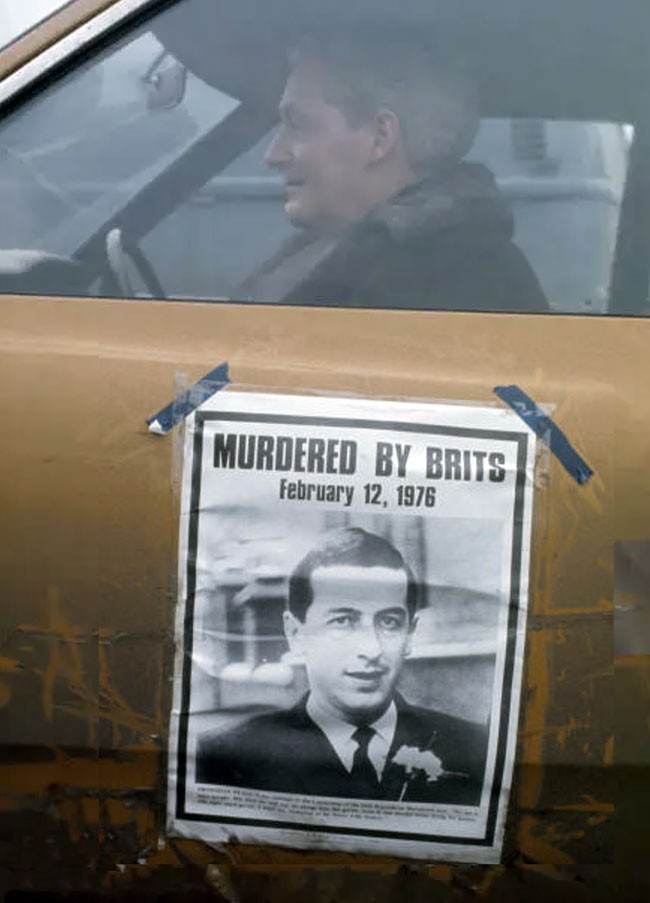
On 12th February, after 62 days without food, Frank Stagg died. In his last message to the Republican Movement he could not have been clearer:
“We are a risen people, this time we will not be driven into the gutter, even if this should mean dying for justice. The fight must go on. I want my memorial to be Peace with Justice.”
He was equally clear that he wanted a Republican funeral and to be laid to rest beside his comrade Michael Gaughan in the Republican Plot in Leigue Cemetery, Ballina. It was now that the Irish government intervened, having refused repeatedly to intervene to try to save Frank’s life.
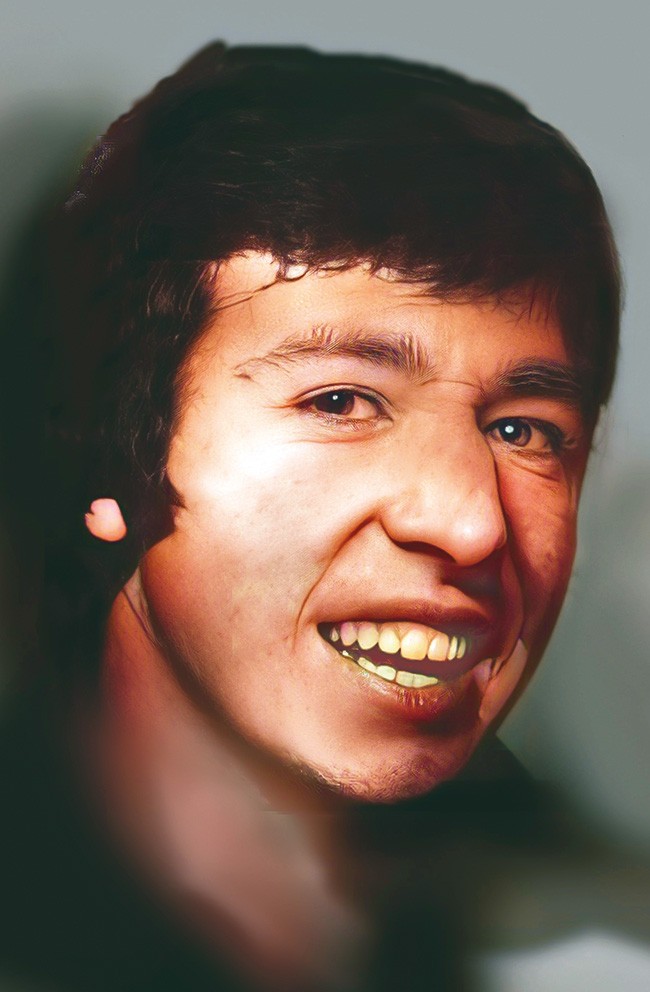
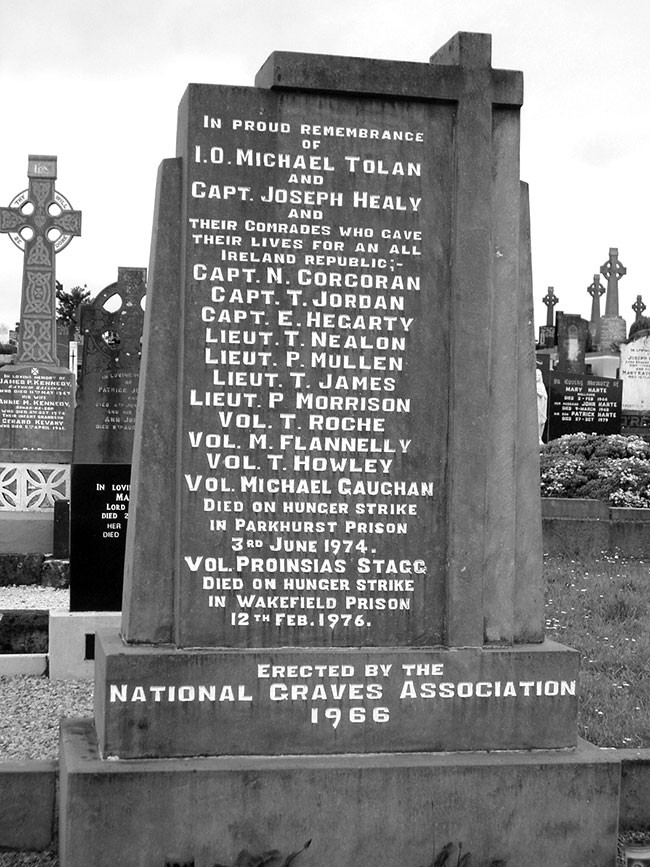
• Michael Gaughan
The Fine Gael/Labour Coalition led by Taoiseach Liam Cosgrave had been affronted by the many thousands of people who had turned out to pay tribute to Michael Gaughan at his Republican funeral through Dublin and across the country to Ballina in June 1974. Cosgrave, and in particular his Foreign Affairs Minister Garret FitzGerald and his Justice Minister Patrick Cooney, were determined that no such tribute would be paid to Frank Stagg.
The British Home Secretary Roy Jenkins, while he had refused Stagg’s demand and allowed him to die on hunger strike, was prepared to accede to his wish that his body be handed over to Sinn Féin representative Derek Highstead to proceed with the funeral. However, Garret FitzGerald threatened to make this public and the arrangements were changed. On 19 February police in London transferred the coffin directly to Gardaí in Heathrow Airport. While members of Frank’s family and leading Republicans waited for the arrival at Dublin Airport, the Irish Government had ordered the plane to go directly to Shannon Airport.
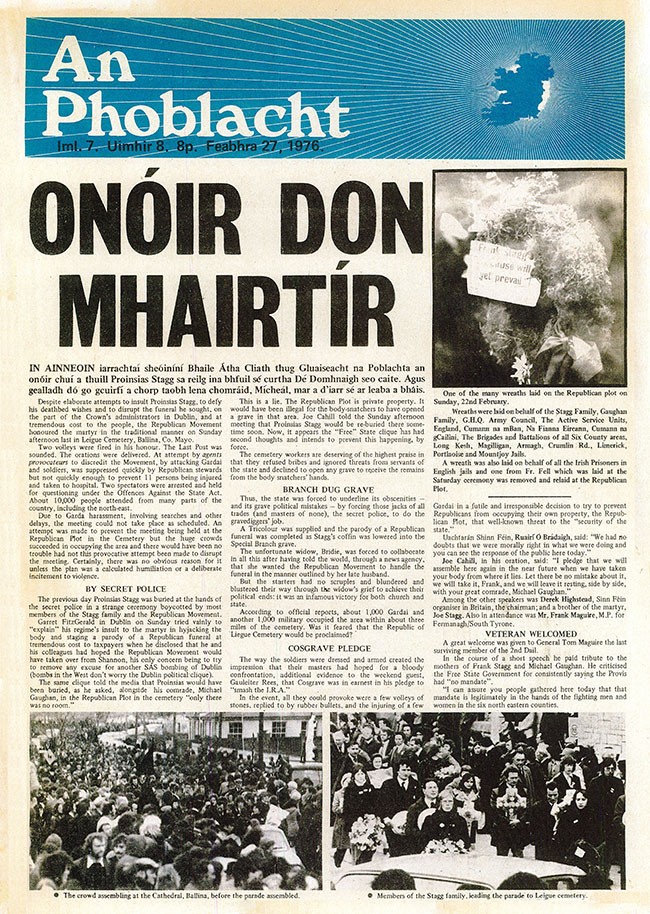
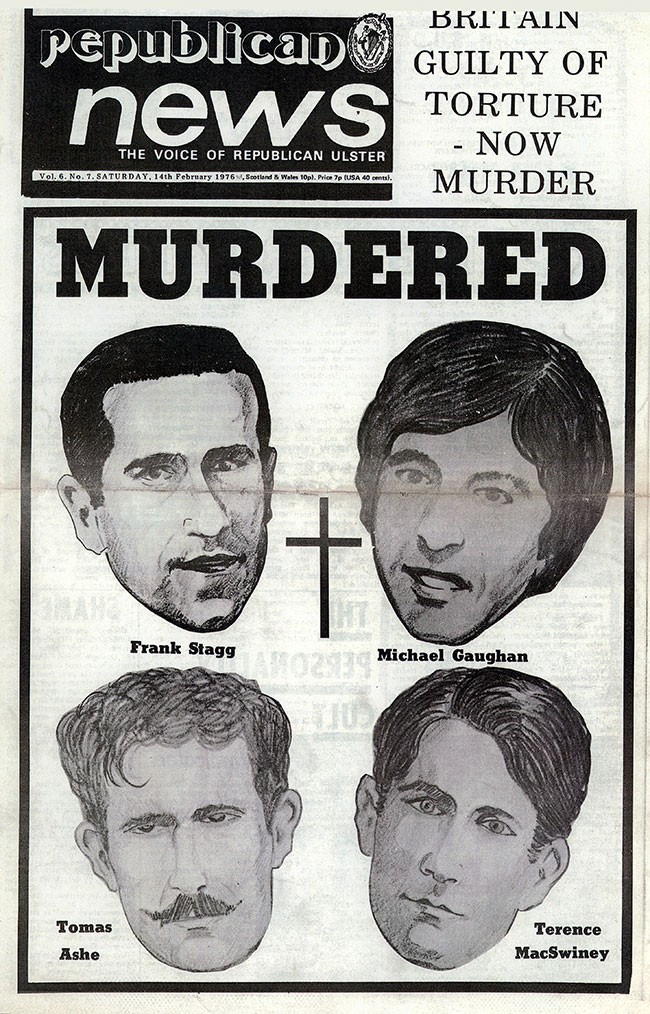
The Coalition claimed that they did not allow a Republican funeral for Stagg through Dublin because they feared loyalist retaliation. But any suggestion that they would have allowed a Republican funeral from Shannon to Ballina was refuted when they kept Stagg’s body in a locked building in Shannon, refusing access to the family. The grotesque hijacking of the hunger-striker’s body took on an even grimmer aspect the next day, 20th February, when it was flown by helicopter from Shannon to Robeen church, Hollymount. Under guard of hundreds of gardai and troops, a funeral mass was said on 21st February and then the body was taken by road to Ballina. Frank Stagg was buried in a grave bought by the gardai, away from the Republican Plot. Cemetery workers refused to carry out the burial which was done by gardai themselves.
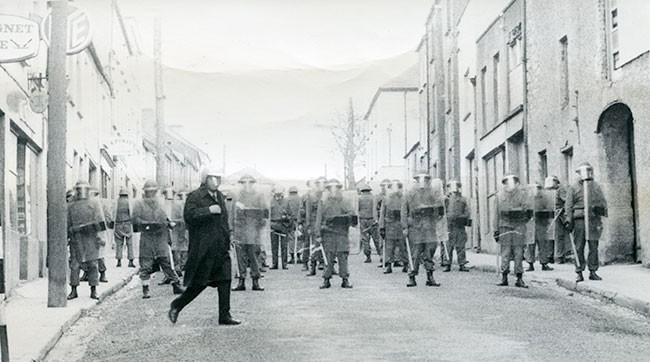
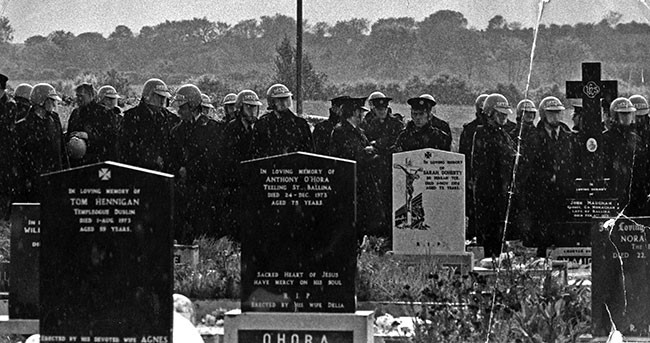
• Military and police presence in Ballina
On Sunday 22nd February thousands of people from all over Ireland assembled in Ballina for a Republican Movement ceremony to honour Frank Stagg. Again many hundreds of gardai and troops were deployed by the Coalition government, including armoured cars and soldiers with riot shields and drawn batons. An attempt was made to prevent access to Leigue Cemetery but this was thwarted by the large crowd and the Republican ceremony proceeded. The main speaker was Belfast Republican Joe Cahill who told the crowd:
“I pledge that we will assemble here again the near future when we have taken your body from where it lies. Let there be no mistake about it we will take it, Frank, and we will leave it resting, side by side, with your great comrade Michael Gaughan.”
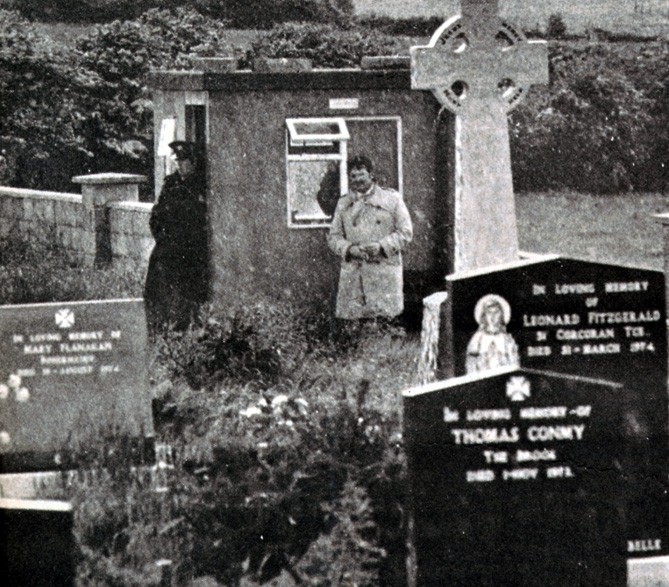
In the following weeks a constant guard was kept on Frank Stagg’s grave by the State. The final desecration was when they poured concrete into the grave on top of the coffin to prevent reburial. But they were unaware that the cemetery caretaker, appalled by the conduct of the State, had advised Frank’s brother George to purchase the plot next to Frank’s. This was done and on a rainy night in November 1977 George and a small group of comrades opened the grave and retrieved Frank’s coffin from under the concrete and reburied him with Michael Gaughan in the Republican Plot.
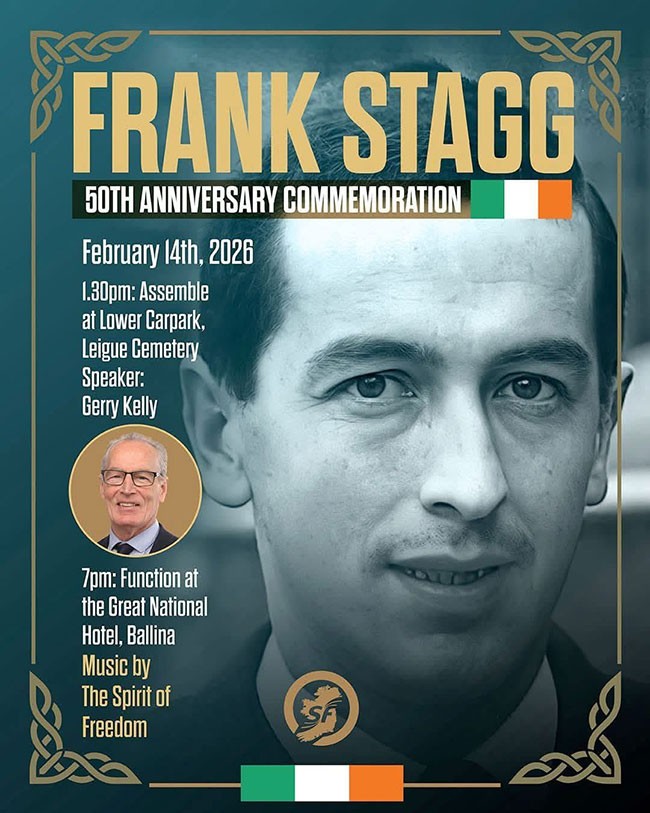
Frank Stagg, whom two governments tried but failed to silence, died 50 years ago on 12th February 1976.
Follow us on Facebook
An Phoblacht on Twitter
An Phoblacht Podcast

Uncomfortable Conversations

An initiative for dialogue
for reconciliation
— — — — — — —
Contributions from key figures in the churches, academia and wider civic society as well as senior republican figures