

29 November 2025
Why isn’t the West wakening up?
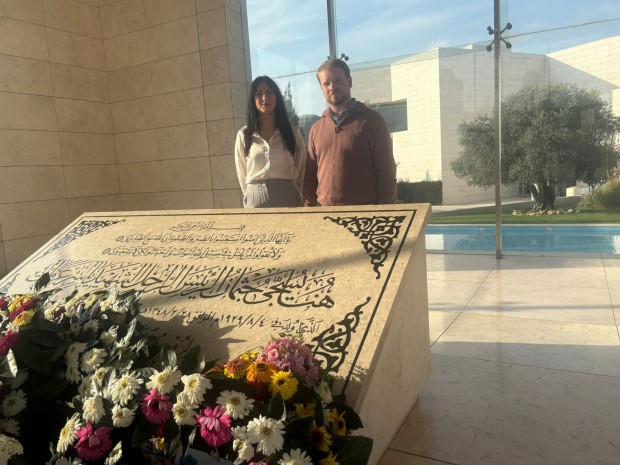

A few weeks ago I had the opportunity, with my colleague Donnchadh O’Laoghaire TD, to visit the West Bank, Palestine, as part of a delegation organised by Progressive International to discuss the Decolonisation of Palestine.
Before even hearing the details of what would be involved I agreed to attend, jumping at the chance to visit the tragically beautiful country I’ve had an interest in for all of my politically awakened life, and whose current troubles are never far from my mind. Anyone familiar with Sinn Féin and our politics will know how heavily we align ourselves with the Palestinian people and their struggle against oppression and occupation. As a millennial woman from the six counties I, somewhat naively, see my own history in their story.
Friends and family who heard of the plan were anxious, but I allayed their fears by assuring them that I was visiting ‘the safe part’ of Palestine. How my privilege plays out in these conversations still makes me cringe, even if that description of where I was is the most accurate I can muster following my trip. Sadly, things have changed immeasurably in the West Bank even in the two weeks since I was there.
Travelling in to the country via the airport in Tel Aviv was not advised, given that most of those on the delegation had publicly called the Israeli regime out for their slaughter of tens of thousands, so we had to cross into Palestine by land, at the Jordanian border. This is something I had been told about before, but until you experience it, it’s really hard to comprehend.
Standing in the dry heat in what felt like an airport security department, controlled by the Israeli government, my mind raced. Just that morning, after an overnight flight into Amman, I’d been informed that my ‘cover story’ was that I was visiting Jerusalem on a religious pilgrimage. Suddenly the miraculous medal I’d worn to placate those at home felt like a good idea. I was not to mention visiting Ramallah, and any reference to my role within Sinn Féin would more than likely refuse my entry. As I selfishly mulled over all of this, I watched as hordes of people, men, women and children, many of them holding Palestinian Authority passports, queued for hours alongside us to cross into a country they cannot freely wander. Their country.
After what felt like hours of queuing, and multiple security scans, we got to the decision maker.
‘What is your father’s full name?’ the Israeli official at the passport control desk stared through the glass with hostility on her breath.
‘Where are you going?’
‘What do you work as?’
‘And does your father have any other names?’
As an Israeli civil servant barked questions at me, I tried to remain calm, with the appearance of someone excited about a holiday around the Holy lands, even though the very notion of ‘Israel’ as a holiday destination literally makes my stomach churn.
As someone who benefitted from the foresight, bravery, and political strategy of the generation of Irish republicans who came before me, I grew up in peace. I don’t remember border infrastructure or UDR checkpoints, I didn’t walk past soldiers going to school, and I’ve had the privilege of serving Sinn Féin without having to encounter any serious security concerns as a consequence.
At that border crossing, I felt like I’d morphed back in time, to what life might have been for me. What it was for my parents and thousands others like them. Daily life hampered and interrupted by a foreign force; plans changed or derailed by soldiers wielding weapons; inconvenience, annoying as it was, often the least worse outcome.
‘The safe part’ rolled around in my head. I felt safe for the duration of my time in Ramallah, the city itself still almost exclusively controlled by Palestinians, (although more and more illegal Israeli settlements have been established and were pointed out to us) and we witnessed no explicit violence on the trip.
I did, however, speak to students who’d been detained without trial just for attending university, heard about the months-long closures of the university at the Israelis’ behest, seen the water tanks on the roofs where Palestinians store their water because it’s only turned on once a week and has to be rationed, and met countless people who’d never even tried to leave the West Bank- because they’re not allowed to.
Even before travelling into Ramallah, we in the bus gasped at the two heavily armed IDF soldiers at the checkpoint on the outskirts of the city, one pointing in each direction, with a huge warning not to take photographs attached to the side of their shelter. The land they were standing on is recognised as Palestinian by international agreement, but the Palestinians travelling along the road have rifles pointed at them by the most militarised army in the world.
Early on the first morning of the visit, I met a Palestinian lady in Jordan who casually mentioned that she couldn’t give me any advice about the border crossing because she’s never been and isn’t allowed in. As someone with an interest in the issue, I knew that there are literally millions of displaced Palestinians worldwide, but hearing someone say it, with resigned acceptance, over coffee, still shocked me.
As the Israelis encroach on more and more Palestinian territory, we heard stories of the farmers who are continuing to grow crops to feed their family, effectively an act of resistance as the IDF burn olive trees and literally take the land from under them. The account of agriculture in the West Bank was so moving it brought me to tears in the lecture hall, such was the resonance.
All of what I heard and seen, life under occupation, made me uneasy. Even where life is safe in Palestine, it is not free. It is life with limits.
And yet this has gone largely unspoken about, with the endorsement of the West, for decades. It has taken images of mutilated bodies on Instagram to provoke reaction from most, and even then, the reaction has been insufficient.
Why is the threshold for ‘real suffering’ dead children? Why is that still not a threshold for guaranteed action? When will the West waken up?
We talk about solidarity all the time, and at times over the course of the past 2 years, when life has particularly brutal for the people of Gaza, I’ve felt frustrated with what our solidarity amounts to.
Objecting to a genocide is, and should be, a natural human reaction. Most of us are calling it out because we cannot bear not to, we cannot bear to see it happening and our gut instinct is to complain. But in a scenario where all our protesting has not stopped it, where a government minister in the north congratulates the IDF and sneers when he is ciriticised, it feels almost futile. Like protesting is for the privileged, and we’re lucky that we’re safe to call it out.
Having spoken to young Palestinians, I’ve seen the worth in our speaking out. The effect of the Irish people’s solidarity with Palestine felt valuable, it meant something real to those living under Israeli occupation. The warmth with which we were treated, the hospitality, the kindness, the spirit. The resilience of these people was overwhelming. As we know from our own context, support from other countries is vital when dealing with occupation.
The people of Ireland were colonised, controlled, starved to death and forced to flee. Our one time refugees became decision makers in other parts of the world and their descendants helped us to build peace at a time when international pressure was integral to the Good Friday Agreement.
We know that public opinion can shape international policy, and we need to take those lessons and act on them today for Palestine. As a global left movement, we need to unite where we have common ground, and work together. Events this week have demonstrated how quickly Israel can escalate their terrorism, and how fragile the small amount of normality I witnessed in Ramallah actually is.
Collaboration is needed for the Palestinians, and it is needed urgently.
• Emma Sheerin is Sinn Féin MLA for Mid Ulster
Follow us on Facebook
An Phoblacht on Twitter
An Phoblacht Podcast

Uncomfortable Conversations
An initiative for dialogue
for reconciliation
— — — — — — —
Contributions from key figures in the churches, academia and wider civic society as well as senior republican figures