


10 November 2025
Martin Collins – A true friend of Ireland
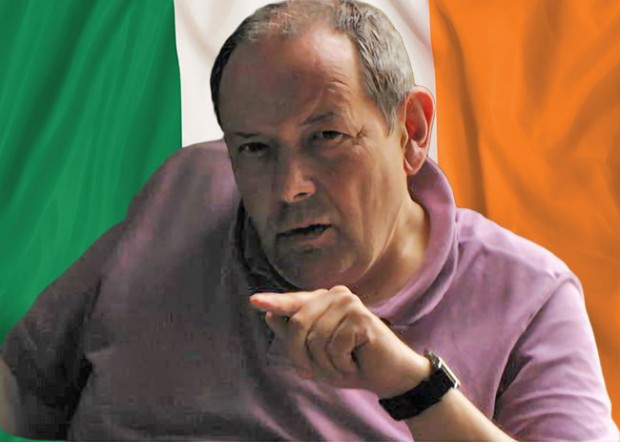
• Martin Collins

United Irelanders across London, and further afield, were saddened on Friday to hear about the passing of Martin Collins. A political organiser, across a range of Irish organisations and campaigns, Martin was a staple of the solidarity movement in Britain for decades.
Martin was brought up in Bristol. As a philosophy graduate and factory worker, he was politically active from the early 1970s and joined the British Labour Party in 1976.
Although he had been involved in the early mobilisations of the Troops Out Movement and had co-organised a NCCL/AUEW-TASS Conference on the Prevention of Terrorism Act in 1977; Martin always cited the 1981 hunger-strikes as having a transformative effect on his thinking, bringing him further into the centre of the Irish solidarity movement in Britain.
Martin was a key organiser behind the Labour Committee on Ireland and edited its quarterly magazine ‘Labour and Ireland’. He organised conferences on the use of plastic bullets and championed the adoption of the MacBride Principles for Fair Employment. He wrote a regular column, ‘Ireland Unfree’, in the weekly Socialist Action newspaper and, in 1987, became the campaign director of the ‘Time To Go!’ Campaign. Later, in 1990, Martin became director of the Britain & Ireland Human Rights Projectand did sterling work on supporting the victims of British state violence in Ireland.
In 1985, Martin edited the remarkable book: ‘Ireland After Britain’. The work is a collection of essays reflecting on the merits of unification and the pitfalls of the British occupation. It includes a range of perspectives and different voices; including, among others, Gerry Adams, Seán MacBride, Mary Robinson, Rita O’Hare, Ken Livingstone, and Tony Benn.
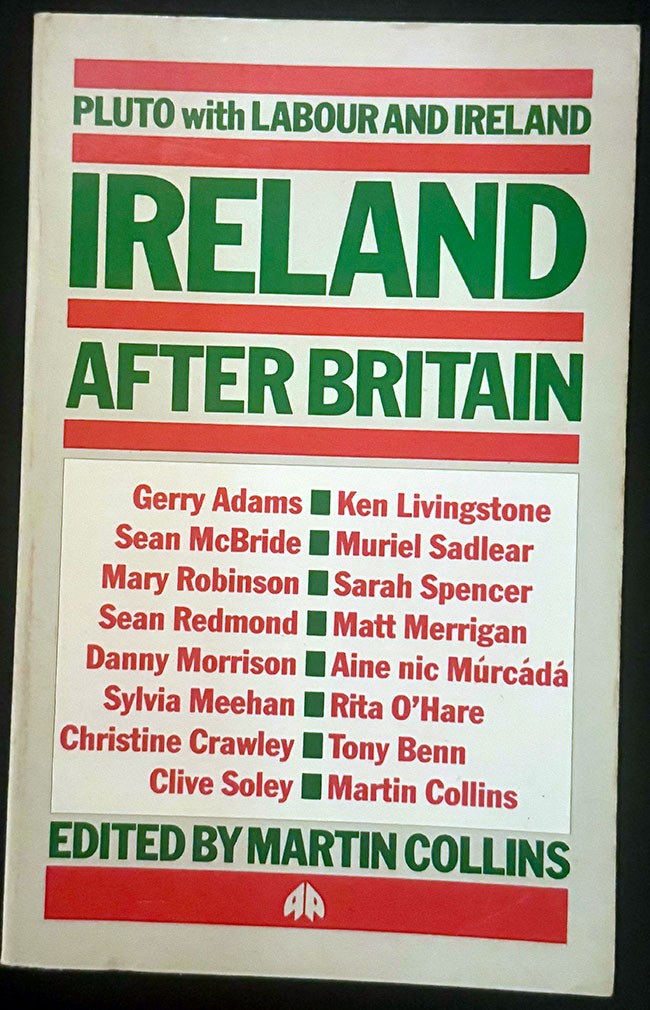
• Cover of 'Ireland after Britain'
The book, dedicated to the ten hunger-strikers of 1981, remains a valuable text; notably, making the case for all-party talks and pan-nationalist cooperation at a time when many were still attempting to construct a process that included every party besides Sinn Féin.
As I read back over Martin’s own essay in the collection, I was struck by his depth of analysis and clearsighted advocacy for a united Ireland. To give just a flavour, he powerfully identifies and reproaches the national chauvinism of the British labour movement, writing:
“To deny the possibility that the Irish working class might be able to impose its image upon a new Ireland rests frequently on the rather self-congratulatory tunnel vision of the British labour movement. The chauvinist view of the problem in the North which has trivialized and mystified the roots of the conflict tends to see the Irish labour movement and women’s movement overhung by the legacy of history and hidebound by the backwardness of a religious and rural past. Yet the tradition of radicalism and internationalism of the Irish movement makes the British look stodgy and parochial by comparison.”
It is a tendency that many British comrades still struggle to shake off.
I can remember the first time I met Martin. It was October 2013; Gerry Adams was in town to address the ‘Towards a New Ireland’ Conference, in Camden. My Dad and I were stewards for the day’s proceedings. After the conference, a dinner was organised for those who had helped to bring the day together. I remember the two of us were sat opposite Martin and his partner Ginnie. The conversation flowed, and a shared appreciation of tiramisu was discovered. From that day on, Martin was always a friendly face at many a political conference, meeting, and rally on all things Irish.
For Martin was a man of committee meetings and organising committees. During meetings he would scribble frantic notes and could always seem to produce photocopied newspaper clippings from his pockets to refer back to a particular quote or instant. When the floor of a meeting was opened to questions, Martin would be among the first to have his hand up. He was also the only person I knew who would text me asking where the weekly ‘Sinn Féin London Office News Bulletin’ was, whenever I was running late on sending it out!
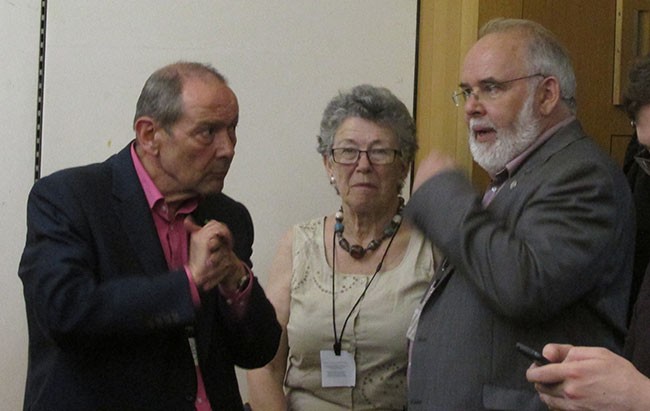
• Martin Collins, his partner Ginnie and Francie Molloy
When I began to work with the Sinn Féin MP team, Martin was kind enough to reach out and see if he could be of any help or counsel. Still finding my feet in the role, we used to meet up for fairly regular coffees and catch-ups, usually in the Tate Britain Café down on Millbank. He was a great man to bounce ideas off or run things past, enjoying a wealth of experience, knowledge, and general life lessons that he was always ready to share.
He knew Westminster inside-out and was a master of navigating its antiquated procedures and convoluted processes. From 1994, he had worked as a political adviser to Kevin McNamara MP, a politician whom Martin always felt never received his due recognition from the British Labour Party. Following this, Martin worked as Director of the Irish Traveller Movement,before going on to work for Chris Ruane MP, advising him on his work as chair of the All Party Parliamentary Group on Irish in Britain.
He would also spend five years as the Political Affairs and Global Irish Diaspora adviser for the Irish in Britain(formerly the Federation of Irish Societies), from 2010-15. With the campaign for voting rights for the Irish abroad becoming a personal crusade for him; one that he doggedly chased successive Irish governments to act on. Alas it remains a goal that is still to be realised despite Martin’s best efforts.
All of this solidarity work made it all the more surprising when, over one of our coffee catch-ups, Martin told me that he did not even know if he had any Irish heritage. I had presumed that – particularly, as a ‘Collins’ – Martin must have been the product of ancestral indoctrination, a misspent youth in local Irish Clubs, and at the very least an Irish mother, but (despite his occasional joking that he was a cousin of ‘the Big Fella’!) Martin was an Englishman. A decent, honest, and generous Englishman who did everything he could to correct the errors and dishonesty of cruel Englishmen. If only more of his countrymen followed his example.
My last meeting with Martin was a difficult one. But equally, I remembered it fondly when I heard the sad news of his passing on Friday. Suffice to say, dementia is an unbelievably cruel condition.
• Joe Dwyer and Martin Collins in Westminster
In the Summer of 2023, it had occurred to me that I had not seen Martin for a while. For such a mainstay presence this was a bit odd. Having recently come into the possession of a vast back-catalogue of copies of ‘Labour and Ireland’, I text him to say how impressed I was to see the extent of his handiwork back in the day. I did not receive any reply, however. Then in September, I heard the sad news of his diagnosis. That December, my partner and I called in to visit Martin and Ginnie. They were as lovely and charming as ever. Although it was difficult to see such a sharp mind like Martin’s struggle to reach for the exact word that he wanted. As if it was just slightly out of reach.
At the end of our visit, Martin thanked us for calling in but then confessed that he was not entirely sure who we were or why we did visit. We laughed with him and said not to worry. It was admittedly a sad end, but equally I’m glad that I did see him for that one last visit.
I will forever be grateful for his friendship. And the care that Ginnie provided for Martin over the past two years, her incredible strength and fortitude throughout the many challenges and hurdles along the way, is truly inspiring. Martin was very lucky to have Ginnie for a partner – and he was also lucky to have the beautiful Riley for a dog!
I will leave the last word to Martin. As he wrote in 1985, “At pivotal points in the history of the English working class, the Levellers and Chartists, currents around Sylvia Pankhurst and the infant British Communist Party endorsed the legitimacy of the Irish struggle for freedom. The call for socialists to break with the bipartisan approach of Labourist orthodoxy and confront the issues posed by Irish democracy will remain crucial for Left strategy.” It is an observation that still holds true. It is an observation that Martin committed his life to.
Follow us on Facebook
An Phoblacht on Twitter
An Phoblacht Podcast

Uncomfortable Conversations
An initiative for dialogue
for reconciliation
— — — — — — —
Contributions from key figures in the churches, academia and wider civic society as well as senior republican figures