


5 November 2025
Fiasco followed by sell-out
Remembering the Past - Centenary of Boundary Commission (2)
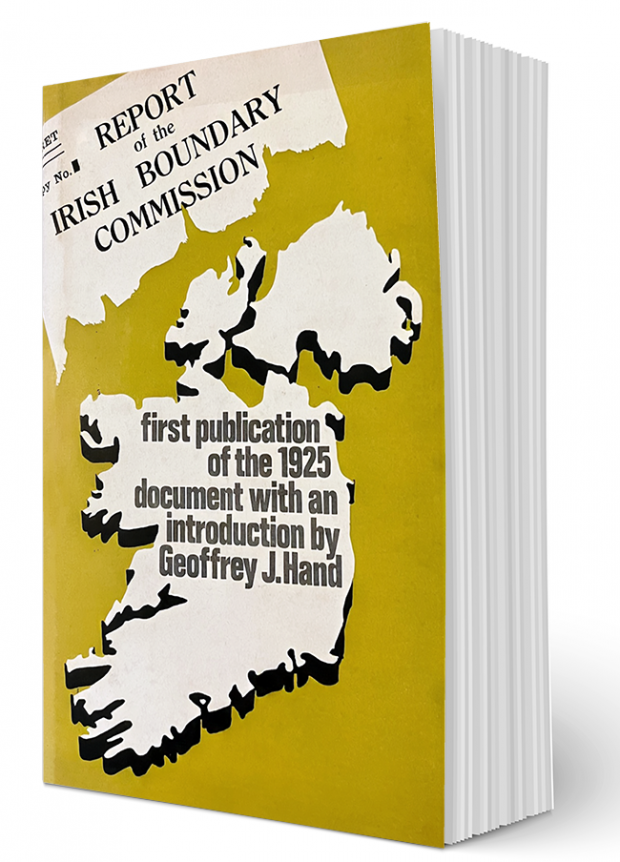
• The Boundary Commission report was only finally published in 1969

As the year 1925 drew to a close there was anticipation in Ireland about the imminent outcome of the Boundary Commission established under the Treaty.
Article 12 of the Treaty provided for a Commission to examine and propose changes to the Partition boundary as set down by the British Government of Ireland Act 1920. Having imposed the border in the first place, British Prime Minister Lloyd George, with typical sleight of hand, offered the Commission as the way to get the Irish delegation in London to sign the Treaty. He convinced Arthur Griffith and Michael Collins that the Commission would lead to Irish unity. At the same time Lloyd George’s government was telling the Unionist government of the new Northern Ireland state that the Commission was no threat to them and that there would be no significant changes to the border.
Despite Lloyd George’s assurances, the Unionist government refused to nominate a representative to the Commission and the British and Free State governments agreed special legislation to allow the Northern Ireland representative to be appointed by the British government. During the summer of 1925 the Commission held hearings in the Six Counties at which nationalists and unionists made their case.
Nationalists in the Six Counties, backed in theory by the Free State government, argued that areas with a nationalist majority should be transferred to the Free State. These were chiefly Derry City, Fermanagh and parts or all of Tyrone, South Armagh and Newry. Detailed arguments were presented to the Commission but the truth was that it was stacked against nationalists from the beginning. The vagueness of Article 12 and its very narrow interpretation by the British-appointed Chairman of the Commission, Richard Feetham, made impossible the outcome promised by Michael Collins.
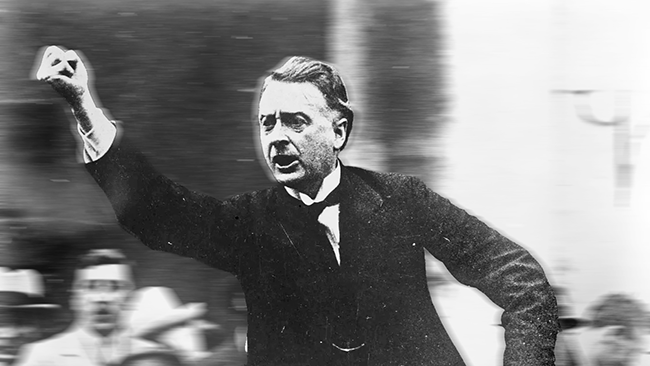
• Free State leader WT Cosgrave
JR Fisher, the Northern Ireland representative on the Commission, kept the Unionist government informed of its highly confidential work, but Free State representative Eoin Mac Néill failed to do so with his government. He adopted a passive attitude during the proceedings and his stewardship then and since has been widely regarded as disastrous for the nationalist position.
On 7 November 1925 a political bombshell dropped. The Tory Morning Post newspaper carried a summary of the Boundary Commission’s report which had been ‘leaked’ to them, most likely by Fisher. There was to be minimal change to the border with very little going to the Free State and even some areas of the Free State going into Northern Ireland. The Free State government was thrown into panic. A key pillar in their defence of the Treaty, on which they had waged a savage Civil War against Republicans, was swept away. Even the pro-Treaty Irish Independent said that if Collins and Griffith had foreseen such an outcome they would not have signed the Treaty.
The reaction of Free State leader WT Cosgrave was not to join in solidarity with Northern nationalists and confront the British government. His only priority was to save his own political skin and that of his government. He appealed to the British to suppress the report which they agreed to do. He then rushed to London to do a deal. The border would remain as in the 1920 Government of Ireland Act and Cosgrave got a financial settlement in return. He completely abandoned nationalists in the Six Counties.
The Boundary Commission had ended in fiasco. The hopes of nationalists, such as they were by the end of 1925, were completely dashed. Republicans, for their part, had never placed any faith in the Boundary Commission, pointing out that no British border in Ireland was acceptable and that rather than leading to a United Ireland a redrawn border would lead to a more compact Orange state. Nationalists and Republicans in Belfast pointed out that in such a ‘re-partition’ their position as a minority would be even worse.
In a final twist of irony the draft Boundary Commission report remained secret and unpublished until 1969, the very year when the Orange state consolidated by the 1925 debacle, was shaken to its foundations as the oppressed minority took to the streets and the barricades.

Centenary of the Boundary Commission (1)
Follow us on Facebook
An Phoblacht on Twitter
An Phoblacht Podcast

Uncomfortable Conversations
An initiative for dialogue
for reconciliation
— — — — — — —
Contributions from key figures in the churches, academia and wider civic society as well as senior republican figures