

6 September 2025
The Irish trade union movement must become a key participant in the Irish unity discussion
Sinn Féin National Chairperson Declan Kearney MLA
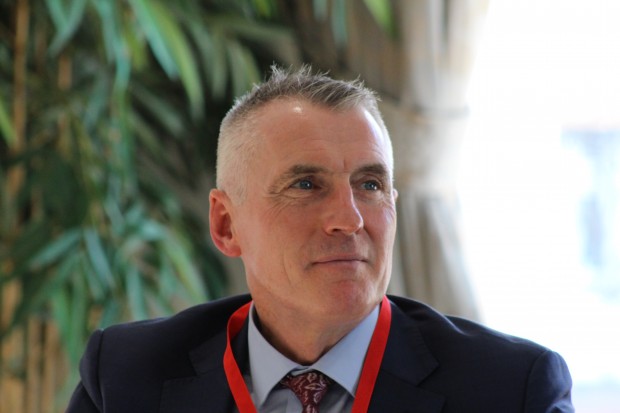
"Fundamental constitutional change in Ireland must be shaped by a progressive, labour agenda."
Today, Irish unity is closer than at any time since the partition of our country and there are many reasons to be optimistic about what national reunification can deliver in terms of economic growth, shared prosperity, and a better quality of life for workers and families throughout Ireland.
An unprecedented political consensus now exists among the majority of political parties north and south about the need to plan and prepare for constitutional transition. The Irish government must take a lead responsibility in doing so.
Last June at St. Mary’s College, Belfast, former Taoiseach Leo Varadkar captured the mood well when he stated, that “building a new and united Ireland is the next step in our national journey, and the future of this island and all our people and communities will be central to that discussion.”
The Irish government has already committed to a shared island programme of major investment in cross border infrastructure, healthcare integration, environmental initiatives and educational measures. This is an important start.
InterTradeIreland has reported that cross-border trade has reached historically high levels, with a remarkable 80% of the €15 billion in cross-border trade across the island driven by locally owned SMEs.
The latest research from the Economic and Social Research Institute (ESRI) records that the 26 counties continue to outperform the north by most measurements, including labour market trends, living standards, economic structures, education, health and overall wellbeing.
Key to advancing the ‘national journey’ towards reunification will be detailed discussions on how to merge the two economies on our island, and to develop a fully integrated economic model with a real capacity to compete in the global economy.
While the north’s regional economy has shown a growth potential in recent years, due to the protections associated with the Windsor Framework, significant structural challenges remain.
Among these are low productivity, regional imbalance, large numbers of unskilled workers, high levels of economic inactivity, major infrastructure deficits, and a lack of inward investment.
A recent NISRA report has revealed that between April and June this year, 25,000 young people between 16 and 24 years are not in education, employment or training.
The Irish Congress of Trade Unions (ICTU) asserts that stronger employment rights, an economic/industrial strategy and apprenticeship reforms are needed. It is arguing for ‘A New Economic Model’ across the island.
The ICTU believes that increased trade union density and strengthened collective bargaining rights, on an all-Ireland basis, are essential to reduce inequality, maximise productivity in the economy, and promote shared prosperity in society.
International evidence confirms that strong trade unions and collective bargaining agreements not only increase productivity, but also improve the provision of public services and enhance standards of living.
Significantly, and despite only 10% of America’s national workforce being unionised, in those states where trade union density is higher, this positively impacts on a variety of economic, social and democratic well being measurements.
In the 17 US states with highest concentrations of organised labour, minimum wage levels are on average 19% higher than the overall federal average, and 40% higher than those states with lower trade union density. There is a direct correlation between union density and higher wages; reduced income inequality, particularly with regard to gender or ethnic pay gaps; and, workplace health and safety.
Elsewhere, the Nordic countries, which maintain high levels of union density and strong collective bargaining, enjoy better quality living standards and excellent public services. They have also been successively ranked as the happiest countries in the world to live.
All of this is relevant to how industrial democracy and workers’ rights should be addressed in present day Ireland.
The “Good Jobs” legislation making its way through the Assembly is a positive move in the right direction because it will legislate for stronger union representation, collective bargaining rights, and enhanced protections for workers. Indeed, it will represent a template for the southern state to adopt similar progressive employment laws, especially at a time when the present Irish government looks set to retreat from its obligations under the EU Adequate Minimum Wages Directive.
Looking forward, Sinn Féin believes that workers’ rights and economic equality should be central to any process of constitutional change. There are important international models of best practice which can be drawn upon.
The International Labour Organisation and ICTU advocate the use of social dialogue as a means to advance social justice, foster inclusive economic growth, and improve wages and working conditions.
In Malta national social dialogue ensures that union and employer representation is placed on an equal footing alongside civic society groups, in designing industrial policy.
Notably the Malta model emphasises consultation in designing apprenticeship programmes. This is of particular relevance for the north and the urgent need to address economic inactivity, particularly among young people.
Nordic countries such as Denmark and Norway, have a strong tradition of social dialogue which directly involves trade unions, with government bodies and employers, in the formulation of a wide range of economic policies, such as wage levels, working conditions, maternity and paternal leave, labour market flexibility, and employment security.
Irish unity may not be inevitable, but all the key factors demonstrate that it is both a politically achievable and economically viable prospect.
This fact strongly underscores the central role which social dialogue and the Irish trade union movement should play to ensure that the process of constitutional transition in Ireland fully incorporates industrial democracy, fairness in the workplace and delivery of good jobs.
Irish society is moving through an historic and seminal watershed. Partition has failed all of our people; it has absolutely failed the Irish working class, both north and south.
But new opportunities are on the political horizon. Irish unity is the big idea whose time has come. The political and social challenge now is to ensure the aspirations and practical needs of workers and families are not ignored. Workers’ rights should not be put on the back burner.
The Irish trade union movement must become a key participant in the current Irish unity discussion.
Fundamental constitutional change in Ireland must be shaped by a progressive, labour agenda. Only mobilised and progressive Irish trade unionists can ensure that will happen.
Follow us on Facebook
An Phoblacht on Twitter
An Phoblacht Podcast

Uncomfortable Conversations

An initiative for dialogue
for reconciliation
— — — — — — —
Contributions from key figures in the churches, academia and wider civic society as well as senior republican figures