

31 July 2025
Is another world possible? The Basque struggle in a changing world
By Gorka Elejabarrieta Diaz – Basque senator – EH Bildu
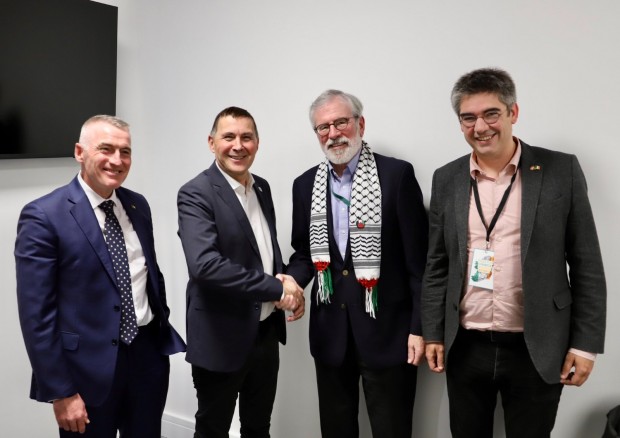
Choosing a new, progressive social order is not possible if a country is partitioned, annexed, or colonized.
A Basque militant once said that national liberation struggle and socialism are two sides of the same coin—words that still ring true today.
The Basque people have endured great challenges in the pursuit of freedom. Conor Murphy once remarked at a solidarity event in South Armagh that “the oppression of the Basque nationality by the Spanish must be seen to be believed.”
Indeed, the Basque people survived a brutal dictatorship that sought to erase their identity, and faced decades of harsh repression. Throughout this time, thousands of political activists joined the fight for national liberation. Despite the adversity, the desire for independence remains strong, and daily efforts continue toward achieving that goal.
As a national liberation movement, the Basque struggle has always embraced international solidarity—supporting liberation struggles from Ireland to Cuba, from South Africa to Uruguay—because all nations have the right to be free. And because there is a better way to organize society, and it is worth fighting for.
Our movement does not simply believe another world is possible—it works to build it, in collaboration with grassroots movements and through the efforts of our political representatives and activists. The goal is to create a fairer, more just society. This belief in a better world is not just idealism—it is a necessity. And progress must be demonstrated step by step, day by day.
The wider world today is far from what it could or should be, and it is rapidly changing for the worse. The international order is collapsing, and a long geopolitical transition is underway, marked by rivalry and uncertainty. U.S.-led neoliberal globalization is in decline, and a unipolar world is giving way to multipolar dynamics. The illusion of a self-regulating market has been shattered by successive crises.
Even the wealthiest states have had to intervene in their economies to protect strategic interests like energy and industry. Neoliberal dogma has been shaken, and Western, U.S.-centric hegemony is now in question.
Meanwhile, Europe is preparing to mobilize more than €800 billion for military rearmament, redirecting resources originally meant to reduce social and ecological inequality. The European Union is increasingly abandoning its role as a humanitarian and peaceful actor, as seen in its failure to stand firmly for Palestine, and in its growing dependence on U.S. militarism.
A wave of conflicts and crises is sweeping across the globe. War and militarism are on the rise—from the battlefields of Ukraine to the genocide in Gaza, and from Syria to Yemen. A “war system” is emerging, driven by great-power competition. States compete for influence and resources, triggering trade wars and fueling a new arms race. Simultaneously, the planet burns, and democratic values erode. The climate emergency is met with denial and inaction. Rights and freedoms long fought for are being rolled back. The far right is growing in many regions.
This social and ecological crisis is rooted in the same neoliberal and militarist system that continues to oppress stateless nations.
The Basque Country is not immune to these global trends. There are clear signs of neoliberal encroachment: attempts to privatize key sectors of the economy, weakening of local industry in the face of global competition, and a disappointing lack of ambition in addressing the climate emergency.
A clear response is needed: sovereignty and public ownership must guide the path forward. That means:
- Reclaiming the economy for the common good and ensuring democratic control over key resources.
- Preventing profiteers from dictating the future.
- Securing sovereign power to protect social welfare, drive ecological transformation, and prioritize people’s needs above the interests of global capital.
In short, it means reclaiming the Basque people’s right to determine our own destiny.
Struggles like those in Ireland or the Basque Country are part of a broader global movement for decolonization, democracy, and ecological justice.
In the 20th century, many peoples cast off the chains of imperialism—from Cuba to Vietnam or South Africa—proving that collective will can overcome even the most powerful empires. The legacy of leaders like Nelson Mandela or Fidel Castro continues to inspire. Their victories were not only national, but global. They remind the world that self-determination and national democracy are fundamental international goals—and that another world is indeed possible.
Every nation has the right, as enshrined in the United Nations Charter, to establish its own laws, conduct its own foreign policy, and determine its own future.
That principle must now be defended with renewed vigor. New imperialist ambitions and neocolonial agendas continue to deny peoples their rights. This is especially visible in Palestine, described by Declan Kearney as “the most totemic national democratic struggle of our generation.”
The ongoing genocide in Palestine reveals the core contradiction between colonial domination and the quest for national democracy.
Similar struggles exist in Western Sahara, in Kurdistan...
But choosing a new, progressive social order is not possible if a country is partitioned, annexed, or colonized.
In other words, “the denial of national democracy is the defining political issue” for nations such as the Basque, as it is for Ireland and many others around the world.
Without freedom, there is no genuine ability to shape the future of society. Achieving Basque sovereignty is both a national necessity and a contribution to the broader global struggle for justice and dignity.
That is why the Basque movement embraces international solidarity as a core value. It stands with all peoples who resist oppression and fight for freedom.
Irish republican comrades have long demonstrated us what true solidarity means—offering support during the most difficult times and sharing in mutual learning and experience.
Internationalism is not charity—it is a shared commitment grounded in common principles. Every time a political prisoner is freed, every time the Basque language is defended a social battle is won or a new degree of self-government is achieved, it becomes part of a global push toward a better world.
Even in these dark times, we have hope and are determined to work for a better future.
And each day of this struggle affirms that a better world is possible. The road ahead will be difficult, but we, Basque and Irish republicans are on the right side of history – and we are not alone.
Gorka Elejabarrieta Diaz – Basque senator – EH Bildu
Follow us on Facebook
An Phoblacht on Twitter
An Phoblacht Podcast

Uncomfortable Conversations
An initiative for dialogue
for reconciliation
— — — — — — —
Contributions from key figures in the churches, academia and wider civic society as well as senior republican figures