

30 May 2024 Edition
The challenge of moving forward into a new Ireland
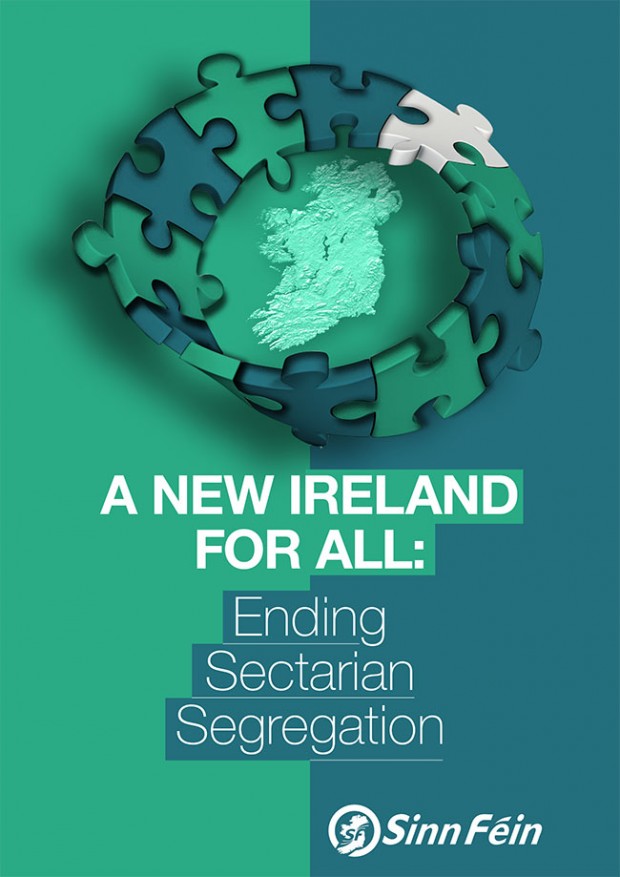
• Sinn Fein’s policy of ‘Ending Sectarian Segregation’

I have a friend who grew up in an all-Protestant estate in Enniskillen and attended school with only children of his own religion. His family were evangelical Christians and staunchly Unionist.
He now identifies as Irish and supports reunification; he wants “a new Ireland that’s not just about Northern Ireland being enveloped into a southern Ireland”.
Speaking about his journey, he said, “You find yourself being seen as a Lundy within your own community, and while not viewed with animosity by Nationalists, you’re not part of the other. You don’t leave one community to become part of another community.”
The man’s comments reflect how years of Partition produced a society that is deeply tribal. His upbringing where Protestants and Catholics lived apart in their own social housing areas and being educated separately is typical of the majority of areas in the North. There’s widespread segregation, and segregation begets sectarianism.
Partition didn’t just split the island geographically, it embedded division which has seen the cancer of sectarianism and bigotry grow. Breaking down the physical barriers, increasing human contact and respecting all communities is crucial to reconciliation in building a new Ireland of inclusion and equality.
Sinn Fein’s policy of ‘Ending Sectarian Segregation’ is a key objective towards that. The document contains many laudable aims, notably on housing, education and building shared communities. At the recent launch in Belfast, I spoke as a Protestant growing up in a divided society in Enniskillen.
It’s a town in which the traditional two sides have more contact than most in the north, despite each side having their own housing estates and schools.
Its large municipal cemetery called Breandrum has a wide path running right through the middle with the Protestant graves on one side and the Catholic graves on the other. Even in the same cemetery, people who were divided in life are divided in death.
The children of the farming community near the Border may travel on the same school bus, but the Catholics kids largely stick together as do the Protestants. And in small towns like Lisnaskea, the two communities went to their own side’s chemist shop, newsagent, and so on.
The conflict in the Border area saw, literally, a war between people of different religion despite knowing their respective neighbours well.
In the circumstances of the conflict, people retreated into their own silos. Human nature means people look for the safety and certainty of associating with ‘their own’.
Indeed, the aim of Sinn Fein’s document in reaching out to those of Protestant, British or Unionist identities will face challenges because there are people within those communities who do not want to listen.
But things are changing, especially among our modern, impressive younger people whose priorities and values are different to previous generations.
Even older people in the Protestant communities were unsettled by Brexit and are wondering about the future. They need reassurance that there is a place for their culture and identity in a new Ireland, whatever shape that will take.
Many other barriers are being broken down. I was intrigued to hear of a Church of Ireland community in County Cavan where there are only 30 families, but recently when they raised €300,000 for a church development, 85% of it was raised by their Catholic neighbours.
Aside from the old binary divide, the island has seen increasing diversity. In Clones, County Monaghan, it’s estimated that more than one-third of the town’s population is from ‘other’ communities, including Syrians, Brazilians, Polish, East Timorese, Romanians, and others.
All over the island, there are numerous nationalities who have made Ireland their home and continue to make positive contributions to society.
So, there has already been massive social and demographic change. But further change is needed in hearts and minds, North and South, in order to build trust and relationships if we are to achieve a truly pluralist Ireland where increasing diverse groups and interests can full play a part in a potentially exciting future.
It will not be easy. There is a saying that “Long after the quarrel stopped making any sense, the memory of the grudge endures”.
The conflict is over, but moving forward into a new Ireland for all means moving past the grudge whereby all sides are welcome.
Denzil McDaniel is a journalist and former editor of The Impartial Reporter