

30 May 2024 Edition
Irish Unity – Till debt do us part
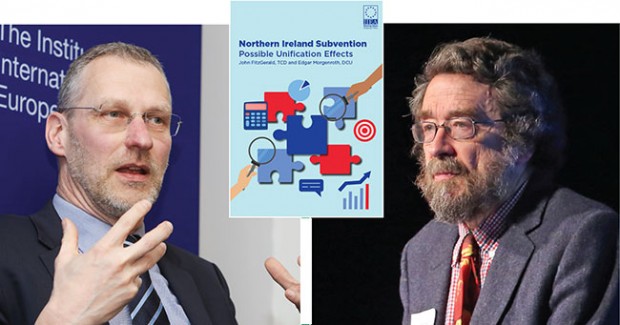
• Academics Edgar Morgenroth and John FitzGerald

Periodically, articles appear and comments are made about what is glibly referred to as the ‘cost’ of Irish Unity. What usually follows is an attempt to reduce the reunification of Ireland and the long overdue restoration of the right of the people of Ireland to self-determination, to an accounting exercise.
‘Costs’ in this narrow narrative are financial, will the books balance? How many billions will it cost and who will pay? There is no importance or value attached to the emotional, psychological, social or democratic tolls which Partition levies on the people of Ireland.
Everyone in Ireland is negatively affected by Partition, regardless of political or religious affiliation or constitutional position. Partition has been so detrimental that it has prevented the nation realising its full potential for over a century.
This includes economic potential. Of course, the keen edge is felt in the North where the Executive lacks most of the necessary fiscal tools to properly manage the economy, but the North being held back means the whole country is being stymied.
The economic affect that reunification could have is obviously of huge importance and research on this topic is both welcome and necessary. It is quite legitimate for people to be concerned about any change which might impact on their lives, whether you’re living from week to week or you’re comfortably off. Any potential worsening of your financial situation is naturally a cause for concern. Attempts to use economic scenarios of reunification to scare people off Irish Unity must be challenged.
The most recent offering in the ‘costs’ analysis side of a United Ireland comes from the Institute of International and European Affairs (IIEA), a body which proclaims itself “Ireland’s leading international affairs think tank”. It was written by academics John FitzGerald and Edgar Morgenroth and is a flawed attempt at counting the costs of Partition by focusing on the scale of the British subvention in Ireland.
Their report was titled ‘Northern Ireland Subvention: Possible Unification Effects’. Media coverage on the release of the paper focused almost entirely on the claim that reunification would cost between €8 billion and €20 billion a year.
It’s interesting to note that a paper by the same authors, ‘The Northern Ireland Economy: Problems and Prospects’, released in 2019 and updated in 2020 stated the following, “While the Irish economy is much stronger today than in 1983, funding the Northern Ireland deficit would pose a massive challenge for Ireland. Based on the experience in dealing with the financial crisis in Ireland, to fund the necessary transfer would require a fiscal adjustment in Ireland amounting €20 billion to €30 billion.”
It appears that in four years FitzGerald and Morganroth have revised the ‘cost’ down by a potential €10 billion. Unfortunately, that that was not the headline which many news editors chose to run with.
In the current paper, the authors state that “Funding the needs of the people of Northern Ireland would put huge financial pressure on the people of Ireland, resulting in an immediate, major reduction in their living standards”.
This is a highly political statement. Surely it is the responsibility of the Irish Government which finally reunites our country to decide how new financial arrangements would be managed?
The report goes on to state that “It does not include any of the wider economic effects of Irish unification, effects which would themselves have major implications for the public finances in both parts of the island”. This admission renders the research questionable in terms of predicting the economic impacts of unity.
Ironically, the biggest ‘major reduction’ in the living standards of people in Ireland in recent memory was due to the financial crash of 2008 and the subsequent decision by the Irish government to bail out the banks which put a huge hole in public spending.
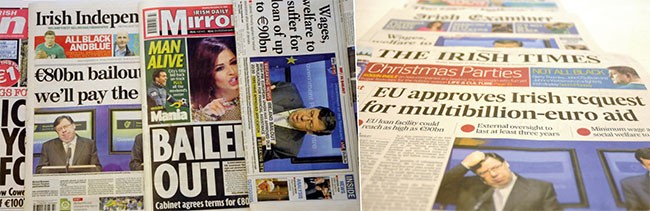
• The decision to bailout the banks and Troika bailout cost the Irish taxpayer €64 billion, with cuts which some communities never recovered
At the time, John FitzGerald was working at the Economic and Social Research Institute. The ESRI’s ‘Medium-Term Review 2008-2015’, authored by FitzGerald among others, stated that the fundamentals of the economy were “sound”, and that “Our essential message in this Review is upbeat”.
By the end of September of the same year, the Fianna Fáil Government had transferred responsibility for its failure to regulate the avaricious and cavalier actions of the Irish banks to the Irish taxpayer through the bank bailout.
Ultimately, the decision to pay the liabilities of the banks, and the subsequent Troika bailout of 2010, cost the Irish taxpayer €64 billion and resulted in wholesale cuts to public services from which some communities have never recovered.
John FitzGerald stated to the Oireachtas Banking Inquiry in 2015 that the ESRI “did not draw the connection between the growth of a property market bubble and the risks to the financial system. In 2008 in our Medium-Term Review, we failed to foresee the impending financial collapse.”
Now is the time for serious analysis and research to be undertaken on the actual costs and benefits of building an island economy. This should be initiated by the Irish Government alongside a process of civic engagement on the future of shared economic potential.
We need to include all the costs of ending Partition including those borne by border communities now as a result of decades of economic stagnation caused by closed border roads, a failure to counter the east-west bias in economic development in the Six Counties, and an absence of a development strategy for the whole North-West region.
The benefits of a United Ireland also needed to be included in this research. It is to advantage of all to have an understanding of the potential of a socially just island economy. It won’t be found in the approaches taken so far.
Emma McArdle is a Campaign and Policy Manager on Sinn Féin’s Uniting Ireland project