


30 May 2024 Edition
Transforming Belfast City Hall
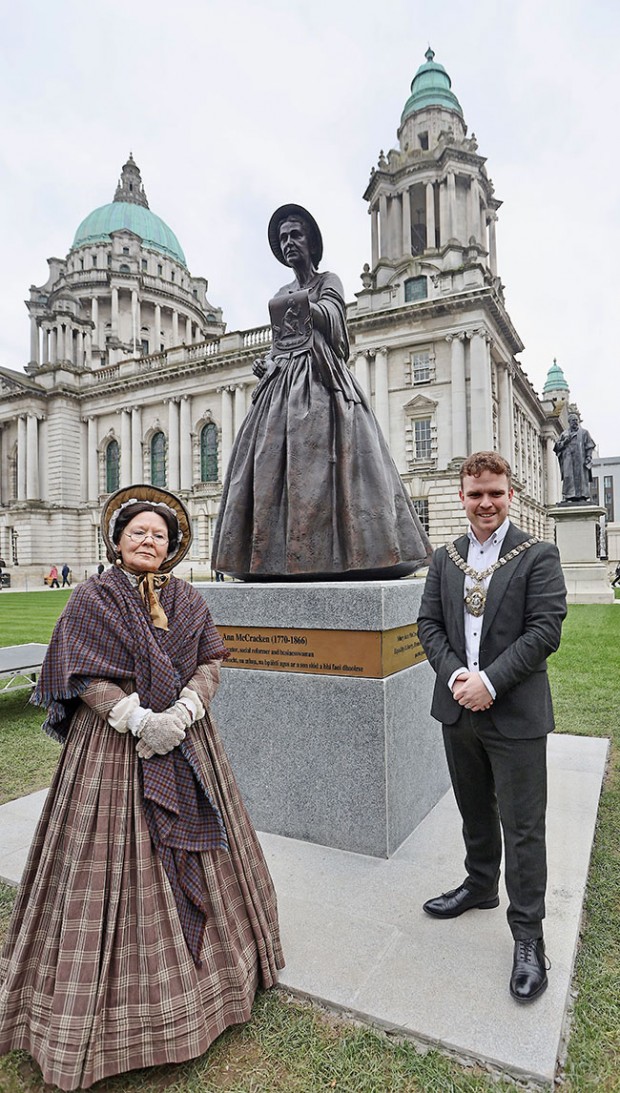
• Belfast Lord Mayor Ryan Murphy, with an actor in period dress who provided a renenactment, at the Mary Ann McCracken statue on International Women’s Day

Former Sinn Féin councillor Tom Hartley explains the long campaign to transform Belfast City Hall into an institution that reflects all strands of Belfast’s political history.
Former Sinn Féin councillor Tom Hartley explains the long campaign to transform Belfast City Hall into an institution that reflects all strands of Belfast’s political history.
In May 1993, I entered Belfast City Hall as a new Sinn Féin Councillor. Back then, the City Hall as an institution was dominated by political unionism. From its opening in 1906, unionist dominance and history were reflected in the City Hall’s political practice, its public art, its memorials, and its statues.
Unionist symbolism and memorabilia equated with unionist dominance. The history of Belfast’s nationalist and republican people was denied all forms of civic expression and recognition.
How was Sinn Féin as a party of change meant to confront this unionist dominance and, at the same time, transform City Hall as a space and an institution which reflects all strands of Belfast society, including unionist history?
We agreed that our task was not to deny unionist history. Instead, we sought to redefine how public art and memorabilia should reflect the complex historical experience of all Belfast citizens. Our approach was to show the complexity and breadth of our Belfast narrative by introducing civic artwork that sat alongside unionist history.
One of our first successful initiatives was our proposal to install a Belfast City Council-commissioned stained-glass window in 1999, which remembered the Famine dead of Belfast. In 2004, Eoin Ó Broin, then a Sinn Féin councillor for North Belfast, proposed a Council-commissioned bust of Mary Anne McCracken.
This was followed in 2006 with another successful proposal; this time to install a Council-commissioned stained glass window commemorating the 1907 Dockers and Labourers strike in Belfast, led by Jim Larkin.
In time, stained-glass windows were commissioned to honour the women of Belfast, the Belfast soldiers of the International Brigade who fought and died in the Spanish Civil war, and the Celtic Myths and Legends window, its theme taken from the Cattle Raid of Cooley. This was the first window in the City Hall to have Irish text.
We also introduced change on a wider front. On 3 December 2012, Belfast City Council decided to limit the flying of the Union flag above the City Hall to 18 days.
In 2015, our approach to broaden Belfast’s historical experience was reflected in the launch of Ag FÍorú na Poblachta in the City Hall, with a civic dinner held in 2016 to commemorate the 1916 Rising.
Despite these successes, the corridors of the City Hall carried multiple artefacts that were overwhelmingly unionist. After a prolonged engagement with all parties represented on the Council, it was agreed that sixteen rooms in the City Hall would be allocated to showcase the historical narrative of Belfast.
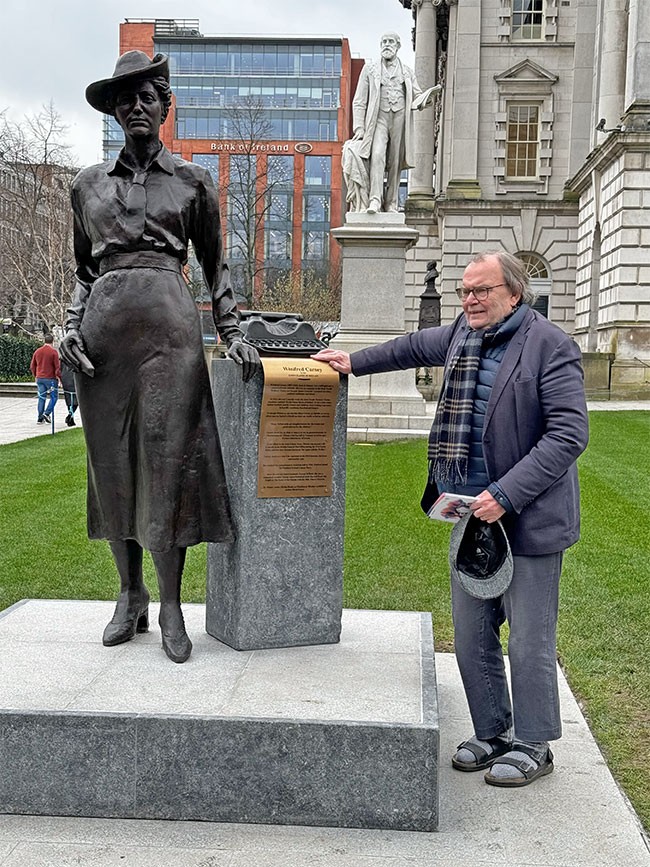
• Tom Hartley at the Winifred Carney statue outside Belfast City Hall
In 2017, many of the unionist artifacts were moved into these allocated rooms, while newer artifacts, which reflected the broader narrative of the city, were added.
The campaign to make the grounds of the City Hall more representative of Belfast’s complex history began in 2012. Ciarán Beattie, the Sinn Féin group leader on Belfast City Council, was successful in commissioning an equality impact assessment, which looked at the City Hall and its grounds.
One of the findings described the statues in the grounds as white, male, and Anglo-Saxon. Following the impact assessment, Ciarán proposed the commissioning of a statue of the Belfast republican and socialist Winfred Carney to be placed in the City Hall grounds.
Winifred Carney was a feminist socialist, suffragette, member of the Gaelic League, trade unionist, and a member of the Irish Citizen Army and Cumann na mBan. She also had a deep interest in politics, art, and culture.
This proposal generated lots of debate across all parties on the Council. At one point, the DUP, Alliance, and the SDLP suggested that Winifred’s statue should be placed in another part of the city, and that a number of other statues should instead be located in the City Hall grounds.
Ciarán challenged this suggestion. He also sought legal advice. Within a year, the Alliance Party suggested that a statue of Mary Ann McCracken should be added to Ciaran’s proposal.
Mary Ann McCracken was a social reformer, an abolitionist and educator who campaigned for the rights of many. Born into a liberal Protestant family, she campaigned for the abolition of slavery and organised the relief and education of the poor. She was also the sister of the United Irishman Henry Joy McCracken who was hung in Belfast on 17 July 1798. Thus began a process of commissioning and designing the statues of these two wonderful Belfast women.
On International Women’s Day this year, the two statues were unveiled on the front lawn of the City Hall. In recognising the importance of these two dynamic women to the history of Belfast, the City Council has now recognised that all strata of Belfast life and history have a right to be seen and heard in our public spaces, and in the public discourse of who we are and where we come from, and in our hopes and aspirations for the future of our city.
Tom Hartley is an author, historian, and former Sinn Féin councillor