

30 May 2024 Edition
Michael Gaughan's hunger for justice
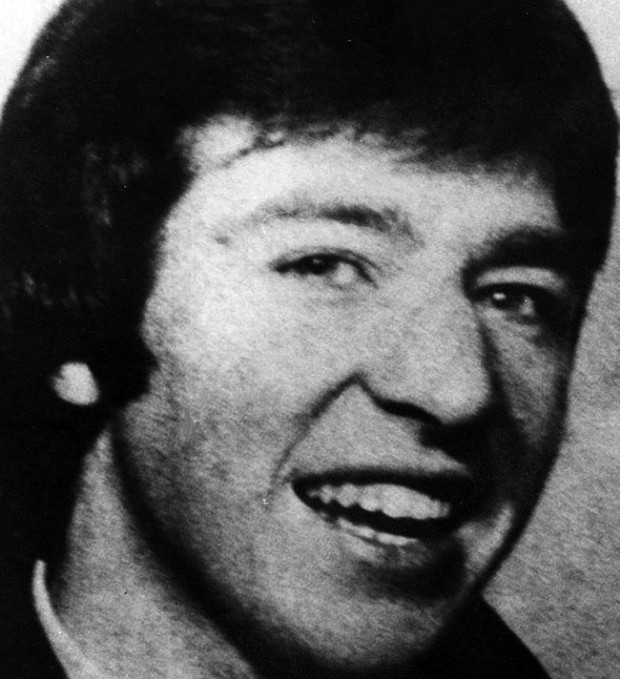
• Michael Gaughan

“My code of life by which I live would make me refuse anyone’s attempts to give up what I believe in”
Michael Gaughan, letter to his parents, 29 May 1974

In historical terms the death of Michael Gaughan marks a halfway point between our time and the end of the Civil War, the consolidation of Partition and of the two partitioned states. Like so many of his generation, Michael Gaughan was to live through the tragic legacy of Partition as it manifested itself in the outbreak of armed conflict in the North in 1969 and he was one of the many young people who once again stepped forward into the ranks of the Irish Republican Army.
Their generation had been failed by those who were described at Michael Gaughan’s funeral as the “well-heeled politicians of the South, the hired scribes and venal churchmen”. Over decades these politicians had uttered anti-Partition rhetoric and had paid lip service to the men and women of 1916. But in reality, they had abandoned nationalists in the sectarian Six-County state, while in the 26 Counties they had presided over a deeply conservative state where social policy was determined by the ‘venal churchmen’.
When the Northern crisis broke the politicians quickly retreated and by 1972 they were jailing republicans and imposing political censorship. And there were plenty of ‘hired scribes’ in the press and broadcasting to back them.
In contrast to all this were young men and women like Michael Gaughan. He came from Ballina, County Mayo, and was in England to make a living in exile, like hundreds of thousands of his compatriots, away from an Ireland of scant employment and mass emigration. He was politicised by the Northern crisis and soon became active in Irish Republicanism. In 1970 he met the late Danny ‘Jack’ McElduff in Manchester. A Tyrone man, he was the senior IRA officer in England and Michael Gaughan volunteered to play his part.
Michael Gaughan’s time on active service in England did not last long. On 21 May 1971 he was arrested in Liverpool Street Station in London with three others, including McElduff. They were charged in connection with an armed bank raid and, two days before Christmas 1971, a sentence of seven years in prison was imposed on Michael Gaughan.
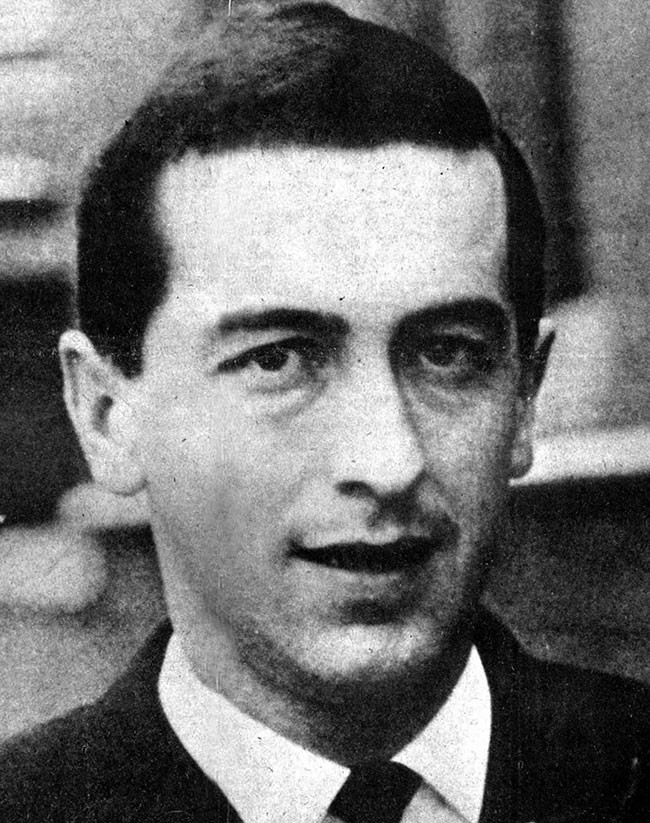
• Fellow Mayo man and hunger striker Volunteer Frank Stagg
For the next two and half years in English prisons Gaughan protested for his rights as a political prisoner and resisted the harsh regime. He was held in Brixton, Wormwood Scrubs, Albany and Parkhurst prisons. In 1972 IRA prisoners in Belfast Prison, Crumlin Road, went on hunger strike for political status and won their demands. Those held as internees and sentenced prisoners in Long Kesh were essentially treated as political prisoners. However, IRA prisoners in England were held as criminals in high security units, subject to frequent punishment in solitary confinement. Inevitably this led to protests, including hunger strikes.
When hunger striking began as a form of political protest by women’s suffrage campaigners in Britain at the start of the 20th century, the British prison authorities resorted to the use of force feeding, an extremely brutal and traumatic practice. This was extended to Ireland in 1917 when Republican prisoners in Mountjoy went on hunger strike. It was force feeding which killed Thomas Ashe in Mountjoy in September 1917. After this, the British discontinued the use of force feeding in Ireland but in the 1970s it was again imposed on Irish prisoners in England.
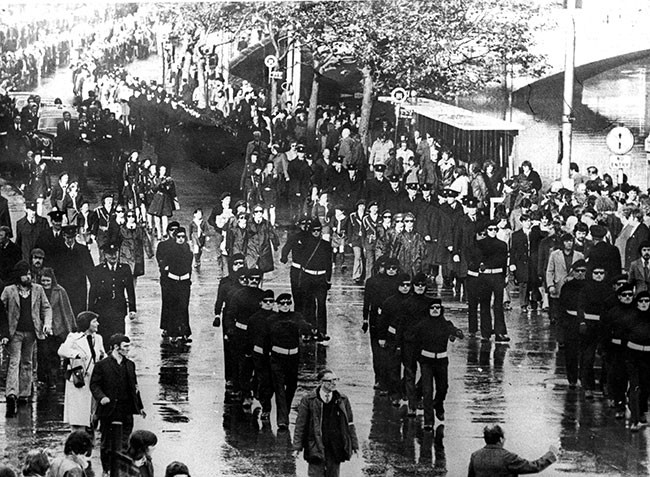
• 10 June 1974, Dublin. The funeral of Michael Gaughan as it passed through Dublin's City Centre
Michael Gaughan, Frank Stagg and Paul Holmes began a hunger strike, demanding repatriation to a prison in the Six Counties, on 31 March 1974 in Albany. They were moved to Parkhurst where force feeding began. Michael Gaughan endured this until the night of 2 June when liquid from the feeding tube entered his lung and precipitated his death from pneumonia. He died on 3 June.
Michael Gaughan knew that he would die on the protest as there was no sign of concession from the British. But he was prepared to make the sacrifice for others. In his last message he said: “I die proudly for my country and in the hope that my death will be sufficient to obtain the demands of my comrades.”
From the testimony of family and comrades, and from his few last prison letters to his family, we can see the strength of Michael Gaughan’s character. Tragically, he was not allowed to fulfil his potential, like so many of that generation, but his legacy endures. He wrote to his mother on 7 May 1974:
“The British hold my life and health in their hands, they may take both rather than give way to my just demand, but I will stand by what is just all the way”.
Mícheál Mac Donncha is a Dublin City Sinn Féin councillor
Michael Gaughan: Prepared To Fight Or Die
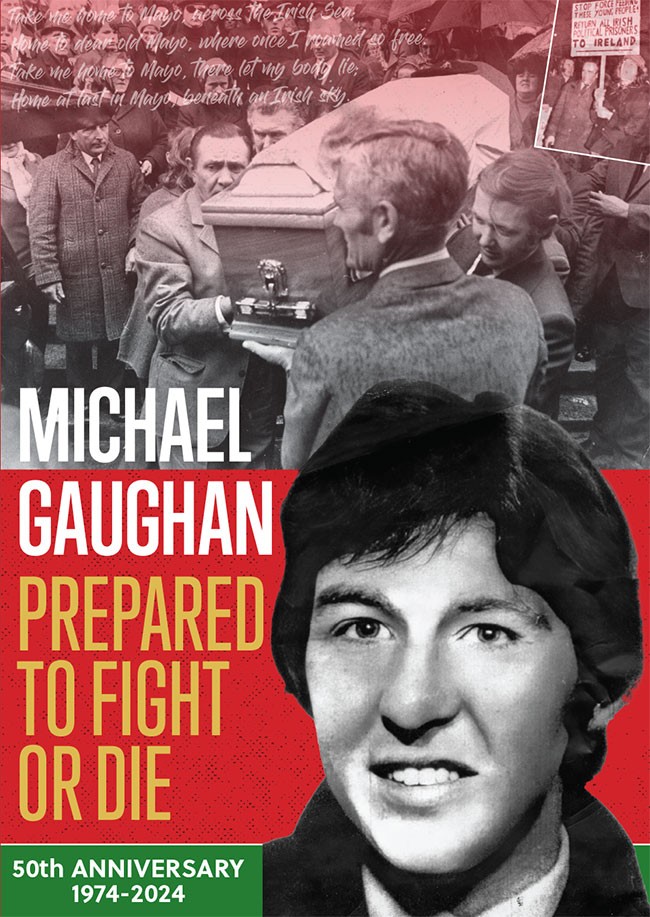
Available from Sinn Féin Bookshop