

30 May 2024 Edition
What would James Connolly think of Ireland today?
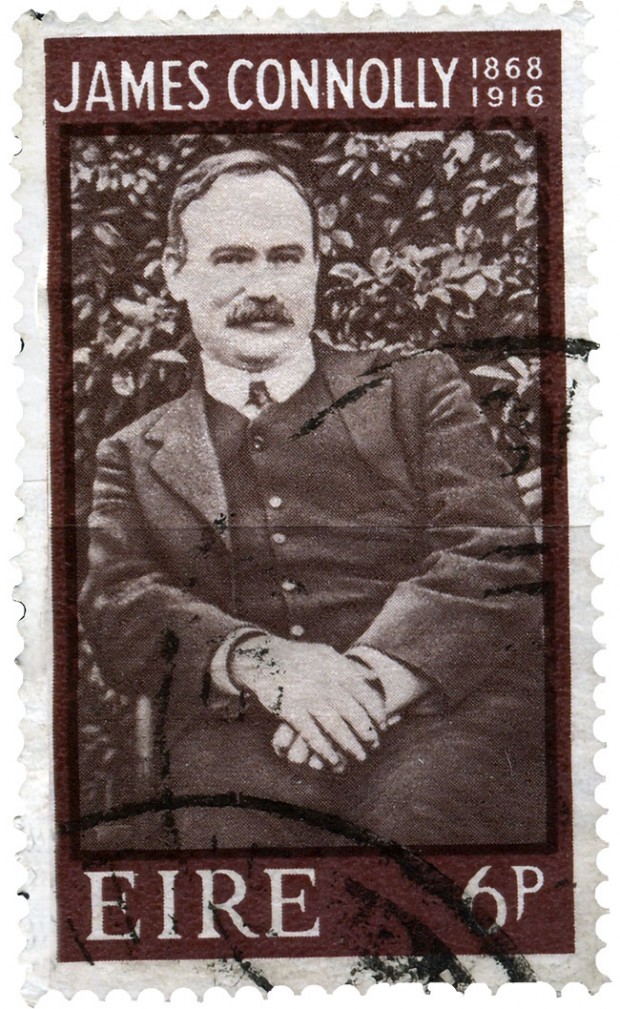

Retrieving James Connolly from the ‘mouldering records of the past’

“I continued to listen to their talk and there was mention continually of somebody named Connolly. Connolly says so and so. Connolly does not agree with that. Connolly’s point of view is this, and so on. Then when I had an opportunity, I asked who was this Connolly. ‘He is a very smart fellow,’ I was told”.
From: William O’Brien, ‘Forth the Banners Go’
Imagine for a moment that James Connolly, signatory of the 1916 Proclamation and Commandant General of republican forces in Dublin during Easter Week, was plucked out of his time and dropped into 2024.
What would he have to say? Putting to one side the wondrous technological advancements and the collapse of once insurmountable institutions, characters, and certainties; what would he have to say about the here and now?
Connolly was a true original. In his praise of Wolfe Tone in the Workers’ Republic in August 1899, he noted; “We are told to imitate Wolfe Tone, but the greatness of Wolfe Tone lay in the fact that he imitated nobody”. It is a sentiment that could readily be said of Connolly today.
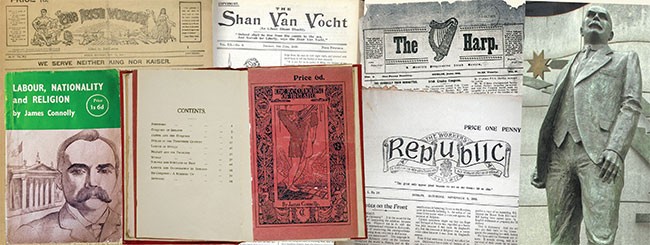
His unique perspective, and almost prescient foresight, single him out from his contemporaries. His inexhaustible intellect and curiosity fuelled a plethora of articles, pamphlets, and speeches, covering almost every facet of national, social, and political struggle.
As he professed in 1915’s ‘An Irish Blackguard’, “Being naturally lazy, I hate to write an article and, being naturally good natured, I hate to refuse”. In this respect, we can be thankful that his good nature often conquered his lethargy.
The writings he left behind remain his greatest legacy. His erudite, but nonetheless accessible, writing style sets his works apart from many, equally hefty, tomes of his day.
As an observer and activist, firmly rooted in the world around him, it would be fair to question what value there is in transplanting Connolly to our own time. As L.P. Hartley famously told us, “The past is a foreign country; they do things differently there”.
However, as a counterfactual thought exercise, or even simply as an inoffensive daydream, it is a worthwhile hypothetical. By seeking to apply Connolly’s thinking to the challenges of today, one can hopefully begin to extract and isolate his most enduring insights.
It could be said that Connolly’s writings are more discussed than they are actually read. Therefore, this encounter between past and present might reveal the continued relevance of his words and what value there is to be found in revisiting them.
So, in the interest of curious consideration, what would Connolly make of Ireland in 2024? Would he stand by his judgement in 1913 that “Ireland is a country of wonderful charity and singularly little justice”. Would he have cause for newfound optimism?
As a committed trade union organiser, Connolly’s first interest would be the standing of workers in the country. The expansion of precarious work, and in particular zero hours contracts, would have discomforted him.
In the December 1899 issue of Workers’ Republic, he was clear that the “onward march of capitalist society crushes the workers lower and lower in the mire, makes life more and more precarious for the toilers, and as a consequence confronts the manhood of Labour with the grim alternative:- Either revolution to enable the workers to grasp the power of the State and so render possible the restoration to the labourer of the control of the means of existence, and thus of a healthy, happy, human life, or else a lifetime of degrading toil with the workhouse as a final reward.”
The workhouses might be long gone, but social welfare provision for the unemployed remains woefully inadequate, both North and South. Connolly would certainly echo those calling for an appropriate system of income protection to assist those who are experiencing unemployment.
Connolly would also be alert to the changing nature of work. Particularly the creeping automation and accompanying isolation within the workplace. As he noted in the Workers’ Republic in August 1898, “Every new labour-saving machine at one and the same time, by reducing the number of workers needed, reduces the demand for goods which the worker cannot buy, while increasing the power of producing goods, and thus permanently increases the number of unemployed, and shortens the period of industrial prosperity”.
There can be no doubt that he would have smiled at scenes across the Six Counties on 18 January when public sector workers took to picket lines to demand fair pay. The joint strike action marked the single biggest day of industrial action for a generation and put those holding the political institutions to ransom on the backfoot. As Connolly once observed in April 1908’s The Harp, “The real battle is being fought out, and will be fought out, on the industrial field”. This remains true today.
Undoubtedly, Connolly would be appalled at the scale of the housing crisis. As he articulated in November 1899’s Workers’ Republic, “Our cities can never be made really habitable or worthy of an enlightened people while the habitations of its citizens remain the property of private individuals. To permanently remedy the evils of city life the citizens must own their city”.
The private rental sector in the 26 Counties is fundamentally broken and the Fianna Fáil-Fine Gael partnership has abjectly failed to deliver social and affordable homes. Their suggestion of further tax credits for landlords is simply not going to remedy the situation. I wonder what Connolly would have to say about the vulture funds buying up property around Ireland?
In December 1915, Connolly attended a meeting in Dublin’s Mansion House that issued an urgent call for an “adequate loan to the Dublin Corporation to enable that body to provide homes for the housing of the workers”. As Connolly summarised, it represented, “a square issue that can neither be avoided nor ignored”. It is yet another observation of his that still stands true today.
While only representative of a small minority, one can be confident that Connolly would have no truck for those stoking hostility against refugees and asylum seekers. The scenes of masked parties marauding the streets of Dublin, looting shops and shooting fireworks or the pictures of newly arrived women and children being barracked in Roscrea stand in sharp contrast to James Connolly’s worldview.
In October 1914’s Irish Worker, during the early days of the First World War, he cautioned, “Whatever we may think of the war, let not any wrath or displeasure be vented upon the refugees themselves. They are but helpless victims of a criminal war for which they were in nowise responsible… Say no harsh word to them.”
As a committed socialist and anti-imperialist, Connolly rejected any attempts to provoke racial or sectarian divisions. Recognising, in The Harp in January 1908, that, “All races are mixed more or less; a pure race does not exist. In all the world there cannot be found a territory of any size still inhabited exclusively by the autochthonous or original inhabitants.”
As he outlined in 1910’s ‘Labour, Nationality and Religion’, Connolly believed that “All men are brothers, that the same red blood of a common humanity flows in the veins of all races, creeds, colours and nations, that the interests of labour are everywhere identical, and that wars are an abomination”.
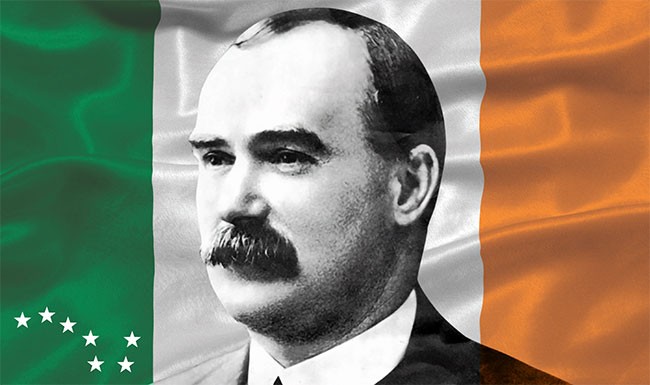
If Connolly could see the daily headlines of 2024, he would be disturbed by Israel’s bombing of Gaza and slaughter of innocent Palestinians. Just as he would be dismayed at Russia’s military invasion of Ukraine. As he wrote, in the midst of the outbreak of the First World War in August 1915, “This war appears to me as the most fearful crime of the centuries. In it the working class are to be sacrificed that a small clique of rulers and armament makers may sate their lust for power and their greed for wealth. Nations are to be obliterated, progress stopped, and international hatreds erected into deities to be worshipped.” They are words that uncannily speak to the global scene today.
With regard to the recent referendums, Connolly certainly never saw a woman’s place as being ‘in the home’. If anything, he considered their place to be in the revolution.
As he outlined, in his seminal ‘Re-Conquest of Ireland’, “In Ireland since the conquest, the landlord-capitalist class has ruled; the beliefs, customs, ideas of Ireland are the embodiment of the slave morality we inherited form those who accepted that rule in one or other of its forms; the subjection of women was an integral part of that rule”.
Perhaps most of all Connolly would be troubled to find himself in a partitioned Ireland in 2024. It was the scenario that he feared most of all. As he caught up on all that he had missed over the course of a century, he would quickly discover that his worst predictions were proven correct. Partition did indeed mean “a carnival of reaction both North and South”, it did “set back the wheels of progress” and destroy the unity of the labour movement.
Having surveyed the current state of affairs, through the lens of Connolly’s words, it is clear that there is a great deal that Connolly would - unfortunately – recognise today. From precarious employment to inadequate housing, to racial prejudice and foreign wars, to the ongoing subjugation of women and the festering wounds of Partition.
Hopefully, however, Connolly would also identify some cause for optimism. The anticipated elections this year, both North and South, provide a clear opportunity for genuine change. It is an opportunity that he would have embraced. As Connolly wrote in the Workers' Republic in July 1899, “The ballot box was given to us by our masters for their purpose; let us use it for our own”.
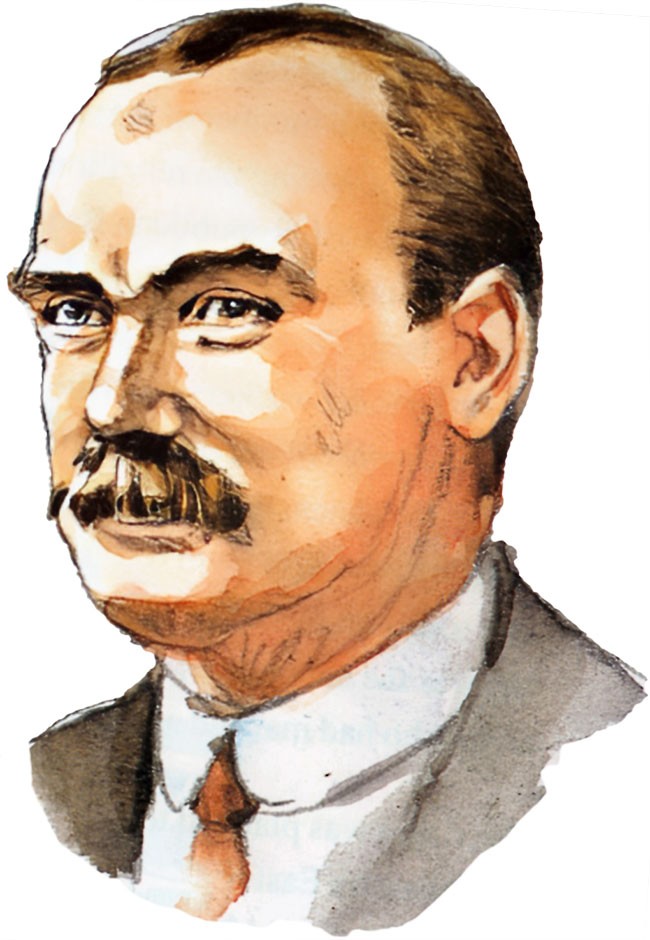
While Connolly recognised the legitimacy of physical force, he considered it only justified in exceptional circumstances. Indeed, he had long advocated for the “conquest by the Social Democracy of political power in Parliament, and on all public bodies in Ireland” as “the readiest and most effective means whereby the revolutionary forces may be organised and disciplined to attain that end [a Socialist Republic]”.
As he argued, in the November 1896’s Shan Van Vocht, “Were a political party formed in Ireland to educate the people in sound national ideas by pledging every candidate to openly repudiate the authority of the Crown and work for the realization of republican principles, it would achieve a much-needed transformation in Irish politics”.
Admittedly, there is no victory to be found debating how Connolly would vote in 2024. But whatever else, in the June 1911 issue of Forward, he clearly recommended that, “Any Irish Socialist who recognises Ireland’s right to self-government should logically embody his political activities in a form of organisation based upon the principle of Irish self-government”. This writer shall leave it to the reader to draw their own judgement from this guidance.
None of this supposition is intended to treat Connolly’s writings as inherited dogma or inviolable truth. Truth is a relational concept; therefore, critique can only ever engage with systems of ideas. While the clarity and certainty of his beliefs still hold value, Connolly was not infallible and his writings are not scripture.
Indeed, as he himself stipulated, in the Workers’ Republic in August 1898, “Any movement which would successfully grapple with the problem of national freedom must draw its inspiration, not from the mouldering records of a buried past, but from the glowing hopes of the living present, the vast possibilities of the mighty future”.
Now that Connolly has himself fallen into those same mouldering records, it is the application of his words, and not their recitation, that truly matters. As inspiring as his example may be, he would not have wished for anyone to imitate him. The aim of Irish republicanism must always be to guard the flame, not worship the ashes.
As Connolly ably explained, in Shan Van Vocht in January 1897, “Our nationalism is not merely a morbid idealising of the past,” rather it is a guide to action, “capable of formulating a distinct and definite answer to the problems of the present and a political and economic creed capable of adjustment to the wants of the future”.
Quite appropriately, following her historic appointment as First Minister in the North, Michelle O’Neill told the Northern Assembly that “Every generation must write its own chapter, define its own legacy”. But so too did she recall Connolly’s immortal words, “Our demands most moderate are, we only want the earth”. In every action going forward, we must carry with us that demand.
Joe Dwyer is Sinn Féin’s Political Organiser in Britain