

30 May 2024 Edition
Francie Molloy – A life in political struggle
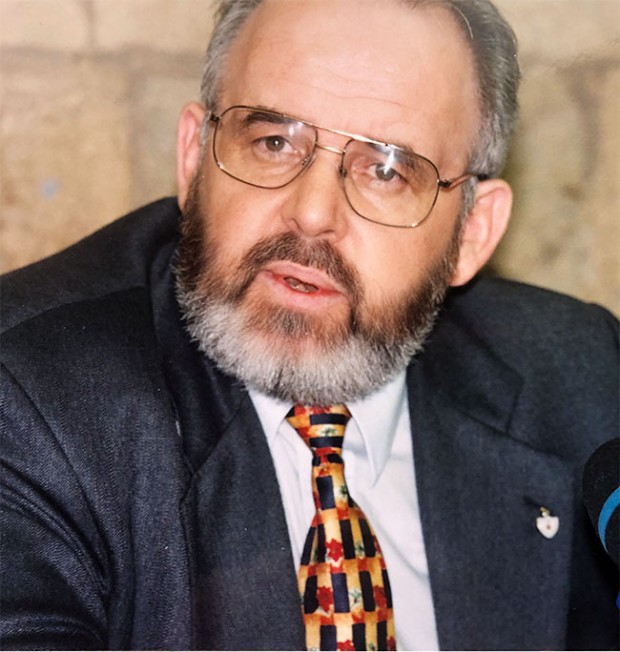

Francie Molloy joined the Republican Clubs in 1967 aged 16, beginning a nearly 60 year odyssey in republican struggle. He has been a street activist, community defender, an election director for Bobby Sands in Tyrone, and a builder of the Sinn Féin team and organisation in Mid-Ulster. Francie was elected a councillor in 1990, an MLA in 1998, and an MP for Mid-Ulster in 2013. After the announcement that Francie would not contest the next Westminster election, we asked Jim Gibney to interview the republican veteran. Below, we have Jim’s take on a life lived in struggle.

The omnipotent power of the unionist state was ever present in the life of the outgoing MP for Mid-Ulster Francie Molloy when he was growing up in Tyrone. The state’s malign tentacles reached into every facet of the lives of the northern nationalist and republican people and regularly expressed itself as a reminder to nationalists that they were deemed second class to unionists who were the privileged and preferred class of the state.
The institutional eyes and ears of the Orange state were at work politically in its political apparatus - government, judiciary and civil service, local councils, the single unionist party, and the Orange Order.
The glue that held it all together was the infamous Special Powers Act and its draconian laws were enforced by the RUC and the B Specials. Francie’s parents' generation grew up in fear of the B Specials and the Special Powers Act and with good reason.
Francie recalled his father being stopped on the road by his neighbour who was a ‘B man’. Dressed in his black uniform and armed, he knew well Francie’s father, yet he insisted on him giving his name and address under pain of being arrested immediately if he refused.
‘Sean South of Garryowen’ was a very popular republican ballad in tribute to IRA volunteer Sean South who was fatally wounded during attack by the IRA on Brookeborough barracks in 1957.
Francie’s father hid the words of the song in the house in case it was found if the house had been raided and the song discovered.
Regularly on the morning of St Patrick’s Day, the local unit of the B Specials made a point of parading on the lane way leading up to Francie’s parent’s home in their ‘brand new tractors’ ploughing up the lane without recompense.
Land, new tractors, and armed men in uniform were the visible trappings of unionist power and domination which Francie and his family and other nationalists encountered routinely. Unionist farmers had new tractors, nationalist farmers had second-hand bikes. The message was clear about who was in charge.
The unionist writ ran from the government and its establishment in Belfast to the country lanes, cities, and towns across the Six Counties. This power was also reflected economically; six of Francie’s sisters and brothers were forced to leave home and work in England. No work for Catholics at home.
The Orange Order controlled land ownership and land sales and rent. No land was sold to or rented to Catholic farmers. And while the unionist government and unionist people had almost total control of every facet of life in the Six Counties, they could not control nor repress the desire for a united Ireland which nationalists clung to after partition.
Joining the Republican Clubs
Francis grew up in a political household where local and world politics were discussed. Partition and its consequences were never far away from the kitchen table.
In the late 1960s when he was dipping his toe into street politics and Sinn Féin, the national flag, the tricolour, and the Sinn Féin paper The United Irishman were banned by the unionist government.
At 16 years old in 1967, Francis joined the Republican Clubs, which were set up to overcome the ban on Sinn Féin. In 1968, he attended his first Sinn Féin Ard Fheis in Dublin’s Liberty Hall.
In the same year, he attended a large meeting of Republican Clubs activists in the renowned Brackaghreilly Hall in South Derry - a venue used by nationalists and republicans involved in civil rights protests and related activities.
The key themes of the civil rights movement included the discrimination in the allocation of housing that deprived nationalists of homes as well as systemic vote rigging, known as gerrymandering, which deprived them of political power.
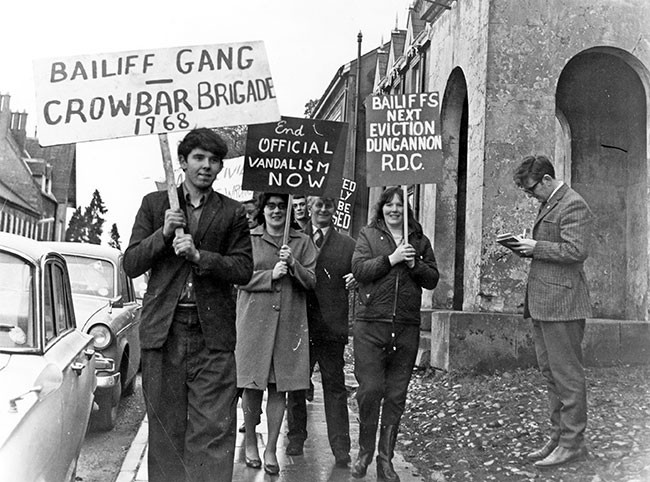
• Caledon courthouse protest (Francie front left)
Caledon on the Tyrone-Monaghan border briefly emerged as the fulcrum of protest at housing discrimination when the Goodfellow/Gildernew families were involved in occupying two houses in 1968 in protest at this injustice in housing was being allocated.
They were forcibly evicted from the houses by the RUC. There was widespread anger at the evictions and the ‘Caledon squat’ boosted interest in the early civil rights protests across the North.
The Unionist Government banned the Republican Clubs, but Francie and others carried on their activities regardless. He was a teenage activist in the Civil Rights Movement from the outset when it was set up in 1967.
He described being at discussions “in barns” across Tyrone about building a mass civil rights movement to campaign for reform of the state which happened - a campaign which ultimately brought down the Unionist Government and state. He was a steward on the civil rights march from Coalisland to Dungannon which was banned from Dungannon town.
From the earliest days, he helped to build Sinn Féin across Tyrone. He was active in his cumann and Comhairle Ceantair and was a member of the Ulster Executive and the Ard Comhairle.
He was an active witness of the violence of the state against the civil rights marches he was on, and others across the six counties, like the march organised by ‘Peoples Democracy’, a student-led movement, from Belfast to Derry, which was ambushed by the RUC, B Specials, and loyalists at Burntollet.
In the few years prior to the massacre of 13 civil rights marches in Derry by the British Army in January 1972, the RUC attacked Derry in what became known as the Battle of the Bogside; Bombay Street and surrounding streets in Belfast were destroyed in a pogrom; the Ballymacarrett, Shortstrand area was besieged by loyalist gunmen and the modern IRA emerged from the Battle of St Matthews; and the British Army imposed a military curfew on the community of the Falls Road.
Before Francie’s eyes, the political scene was dramatically changing and the political demands were shifting from basic reform of the state to its disbandment. Francie said, “We knew when the British Army reoccupied the streets of Derry and elsewhere that Partition and a United Ireland had become the main issues again”.
The 1950s and Operation Harvest
In the 1955 Westminster general election, two republican political prisoners were elected MPs for Mid-Ulster and Fermanagh and South Tyrone, Tom Mitchell and Phil Clarke respectively. They had been arrested in an IRA raid for arms on a British Army base in Omagh in October 1954. Sinn Féin stood candidates in the general election across the Six Counties and polled 152,000 votes, 23.6% of the total poll.
The following year, the IRA launched its border campaign, Operation Harvest, which lasted for six years. Francie said the election of Mitchell and Clarke in both constituencies was highly significant for a number of obvious reasons and the main one was that it established a precedent for independent candidates not belonging to nationalist political parties to stand and be elected.
In the late 1960s and early 1970s, Frank McManus was elected MP for Fermanagh and South Tyrone and Bernadette McAliskey was elected for Mid-Ulster. Both elections gave a huge boost to nationalists and republicans.
The elections were part of the wider civil rights campaign which republicans like Francie were involved in. Throughout his life of front line, on the streets activism Francie believes that Coalisland, a small town in county Tyrone, was the epicentre of political resistance for the county and beyond.
St Patrick's Hall in the town was the location where republicans mobilised to take part in the 1916 Rising. And the hall was in constant use from the days of the civil rights marches in the 1960s to the days of the marches in support of political prisoners on protest for political status and the hunger strike of 1981 when ten republican prisoners died on hunger strike.
In 1966, on the 50th anniversary of the Easter Rising, he marched in the town with Kevin Mallon, who carried the banned tricolour. Mallon had been sentenced to death for killing an RUC man during the 56-62 border campaign.
The 50th anniversary was the trigger that brought Francie to United Ireland and republican politics. He was involved in school projects marking the Rising.
The first civil rights march in Tyrone left Coalisland for Dungannon. He was a steward. Francie was on the civil rights march in Duke Street in 1968 in Derry which was beaten off the streets by the RUC. The unprovoked baton attack was filmed, and the scenes of brutality were on television screens across the world.
The political activism that Francie was involved in during the 1970s, 80s and 90s reflected the political shift in the struggle away from reform to the consequences of the war. The ‘Northern Resistance Campaign’ in Tyrone involved civil rights and republican activists.
People were protesting on the streets calling for an end to Internment without trial. They also embarked on a ‘rent and rates’ strike against torture and brutality of detainees in RUC barracks in support of the prisoners on protest for political status and highlighting the murder campaign of collusion between the British Crown forces and loyalists, as well as the British Crown forces’ shoot-to-kill policy against IRA volunteers and civilians in Tyrone and Armagh.
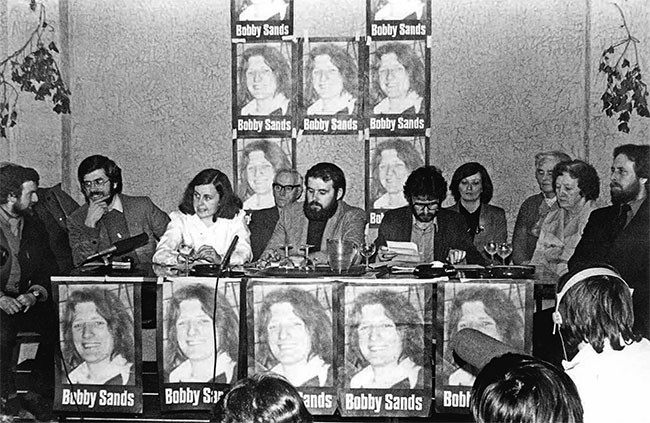
• Bobby Sands’ election campaign (Francie centre front) with Jim Gibney to his left
The Bobby Sands election
One of the most important and politically significant campaigns that Francie was involved in was the campaign to elect Bobby Sands as MP for Fermanagh and South Tyrone in April 1981. He was the Director of Elections for the South Tyrone end of the constituency.
His detailed knowledge of how to fight elections, which he acquired from being involved in the successful election campaigns of MPs Frank McManus and Frank Maguire, he applied to Bobby’s election campaign.
Others like Aidan Corrigan, Bernadette McAliskey, and Owen Carron were also highly skilled election campaigners.
Gerry Adams and I and many other republicans across Ireland were also involved in Bobby’s election. Francie described the campaign as a massive human undertaking.
A frenetic 10 day campaign with a cerise pink single decker bus, nicknamed by a journalist as ‘The Pink Panther’, led the canvass charge setting the unstoppable momentum towards polling day.
A group of young people in the election headquarters wrote by hand addresses on 10,000 envelopes. With not enough time to carry out a comprehensive canvass of the area, voters knew what they had to do - vote Bobby Sands and they did.
People came home from England, the south of Ireland from Belfast’s universities and colleges to vote for Bobby.
Based on the successful election of Frank McManus and Frank Maguire, Francie was confident that Bobby would win, as was Bernadette McAliskey he recalled. By voting for Bobby, the people of Fermanagh and South Tyrone fundamentally changed the struggle for the better in so many ways especially elections.
Francie was keen to encourage republicans to debate the benefits of Bobby’s election and that of Kieran Doherty, Paddy Agnew, and Owen Carron, all of which happened in 1981.
But a proposal from him and Jimmy McGivern to Sinn Féin's Ard Fheis in 1981 for the party to stand candidates in local government elections in the North got firmly rejected by the party president Ruairí Ó Brádaigh. Francie said the motion was thrown out and “we were nearly thrown out of the hall with it”.
Francie’s home was on the townland of Derrymagowan, close to the Moy in County Armagh.
He was raised not far from his own home and although he lived in an area described as ‘The Murder Triangle’, because of the number of Catholics killed by loyalists, he resisted turning his home into a fortress because he wanted his wife and his children to have as normal a childhood and life as possible.
He also declined suggestions from well-meaning people advising him to leave the area for safety reasons to live elsewhere. He said he felt a responsibility as an elected representative to the people living around him to stay.
The night before Charlie and Tess Fox were killed by loyalists, Charlie had been at his home advising him to tighten his family’s security at his home.
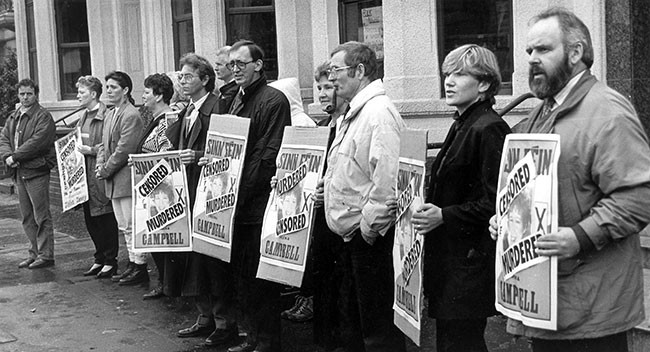
• Protest at the death of Sheena Campbell, York Hotel, Belfast
An elected representative
Within hours of being elected councillor in a by-election in 1990 caused by the SAS killing councillor Martin McCaughey with Dessie Grew in October, his son Oliver rang him to tell him that the notorious loyalist Billy Wright was sitting in a car with another man outside the family home.
Francie advised his son to use the shot gun that was in the home should Wright attack the house. A very close friend and political colleague who was his Director of Elections and got him elected to the Council, Sheena Campbell, was shot dead on 16 October 1992 by loyalists in a hotel in Belfast when she was studying law at Queens University.
Sheena’s partner, and also a close friend of Francie’s, Brendan Curran was shot and maimed by loyalists before Sheena was killed.
Francie described Sheena as one of Sinn Fein’s brightest; an expert on fighting elections who through what became known as the ‘Torrent Strategy’ encouraged the party to systematically fight elections by identifying its vote and recording it on ‘green registers’. An approach which brought many victories to the party and is still used to this day.
A near 60 year legacy of struggle
His son Dominic is now a Sinn Féin councillor and is the chairperson of Mid-Ulster Council. His son Oliver works for First Minster Michelle O’Neill in her Cookstown office. He too was formerly a Sinn Féin councillor.
In his almost 60 of activism, Francie has been part of and witnessed many momentous happenings which helped bring the republican struggle to this juncture.
His family and political life were entwined. He could not have been involved in the struggle without the active and full support of his wife Anne and family. Anne made it possible for Francie to be the full-time activist he was for all of their married life and before they got married.
They had four children Dominic, Oliver, Fiona, and Marcella. Bobby Sands used the penname ‘Marcella’ on many of the articles he sent out of the prison about the harrowing life on the blanket protest in the H-Blocks of Long Kesh. Francie and Anne’s daughter was named as a tribute to Bobby. As a child in school, the origin of the name was a topic of conversation.
As can be seen from this article, Francis Molloy MP led from the front throughout his nearly 60 of political activity. He used whatever arena was required to highlight the many areas of injustice created by Partition.
Francie was comfortable on the streets marching, debating in elected political chambers, canvasing on doors, handing out leaflets, putting up posters, representing the cause of a United Ireland across the world.
While writing this article about Francie, I thought of the relevance of Bobby Sands quote, “Everyone, republican or otherwise has their own part to play. No part is too great or too small, no one is too old or too young to do something.”
Francie can be proud of the outstanding contribution he has made to bringing about a United Ireland. He hands the baton of freedom on to a younger generation at a time when the struggle for aUnited Ireland has never been stronger.
It has been a remarkable journey for him and his family from the streets of Coalisland marching in the Easter parade in 1966 as a 15 year old teenager determined to take on the all-powerful unionist state to now where his friend and comrade and Tyrone woman Michelle O’Neill is First Minister and that unionist state is gone never to return.
Comhghairdeas, go raibh maith agat and well done Francie.
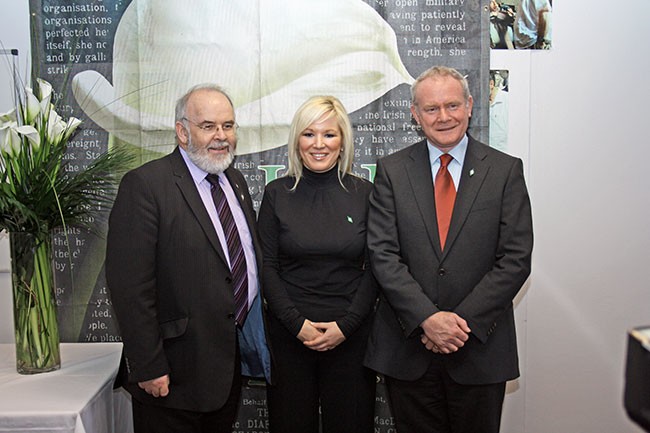
• Francie, Michelle O'Neil and Martin McGuinness at the launch of the Easter Lily in Stormont, March 2010