

30 May 2024 Edition
Two tragedies – two tortuous paths to truth
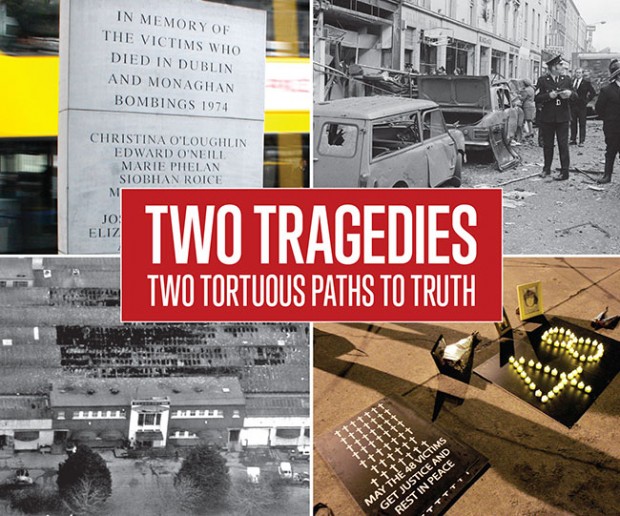

The 50th anniversary of the Dublin and Monaghan bombings falls exactly a month after the verdict in the Stardust inquests. These two horrific tragedies are deeply etched in the collective consciousness of Dubliners and of the whole country. In both cases, the victims were predominantly from working-class communities in the capital city.
Only seven years separated them. No-warning bombs in Talbot Street, Parnell Street, and South Leinster Street, Dublin, and in the centre of Monaghan town claimed 33 lives on 17 May 1974. The fire in the Stardust night club claimed the lives of 48 young people on St Valentine’s Day, 14 February 1981. Whole families were wiped out, many more were torn apart and hundreds of survivors were injured and traumatised.
The periods of national mourning after each tragedy were quickly followed by a much longer and in many ways more painful ordeal for the families. The demand for truth was met with silence. The efforts of families to get justice met the stone wall of the State. Each tragedy in its own way showed starkly the intransigence and coldness of political establishments when challenged to reveal truths that would undermine what they perceived as their vital interests.
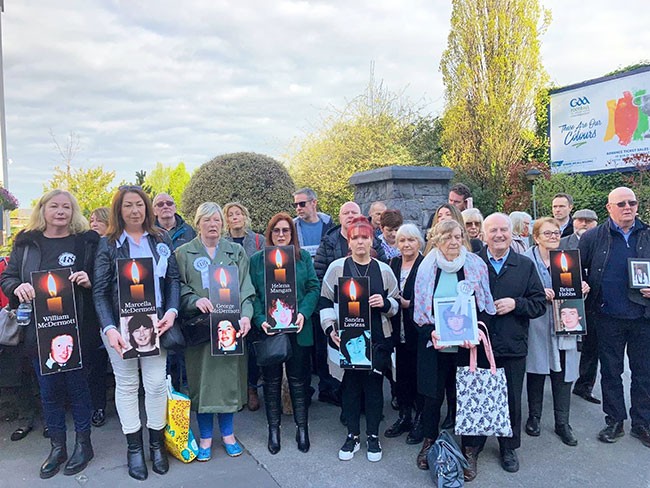
• The Stardust families when they gathered before the opening of the new inquests
For the Stardust families, the tragedy was greatly compounded by the disgraceful initial inquiry which concluded that the cause of the fire was probably arson, thus stigmatising the dead and injured and their community. It took the families decades to erase that false conclusion, to remove the stigma and to expose the truth. Through all that time, successive Irish governments failed the families, culminating in a report by retired judge Pat McCartan who said that nothing more could be done.
It was well noted that the only person ever hauled to court in relation to the Stardust was singer Christy Moore, when his song ‘They Never Came Home’ was banned. The ‘offending’ line was the one which spoke of the fire exits being chained.
The families persisted heroically and their campaign went on. After many bitter disappointments and false starts, the key to truth was the reopening of the inquests into the 48 deaths. The individuality of each of the dead was highlighted. The full horror of that night was relived.
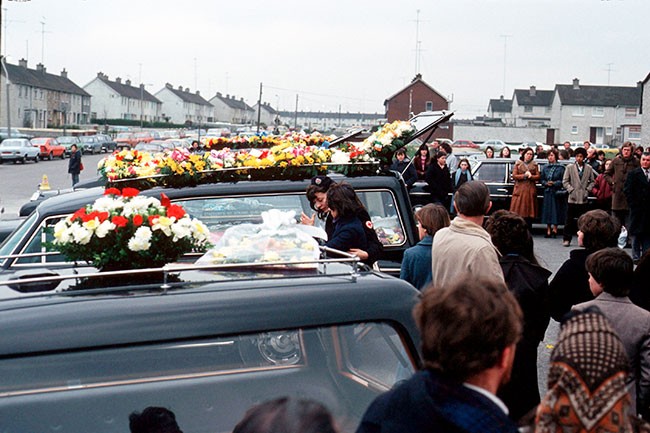
• The coffins of four young victims, who died in the fire in the Stardust disco on the morning of St. Valentines Day February 1981, the fire killed 48 young people
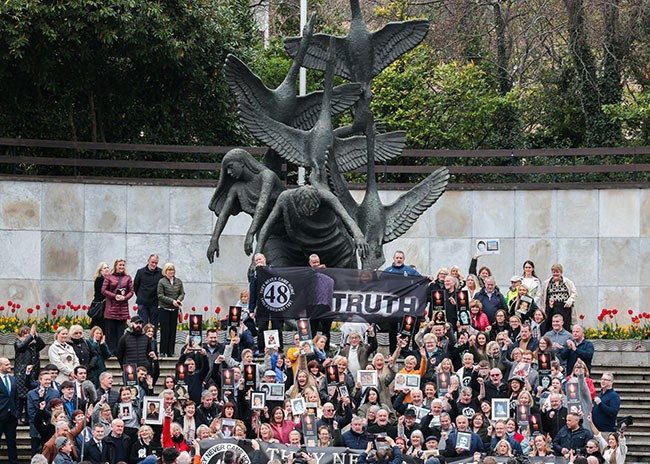
• The Stardust families when they gathered before the opening of the new inquests
The catastrophic failures and shameful neglect of the night club owners, the Butterly family, were exposed, including chained fire exits. And the jury returned a verdict that vindicated the dead, the injured and the bereaved – unlawful killing. That verdict also exposed the neglect of the State as represented by successive governments and a formal apology by Taoiseach Simon Harris quickly followed.
No such apology has yet been given by either the Irish or the British government to the families of those killed 50 years ago in the Dublin and Monaghan bombings. These families too faced stone walls in their search for truth – not just of one state but of two.
The bombings which took the lives of 33 people, including a pregnant woman, were claimed by the loyalist Ulster Volunteer Force. But it was clear to many from the beginning that the co-ordination and technical expertise of the bombings pointed to British crown forces’ collusion.
As the years went by, the evidence for collusion mounted. But the Fine Gael/Labour government in power in 1974 did not want to know. In the aftermath of the tragedy, they had used it to pursue their anti-Republican agenda, blaming the IRA for ‘provoking’ loyalists.
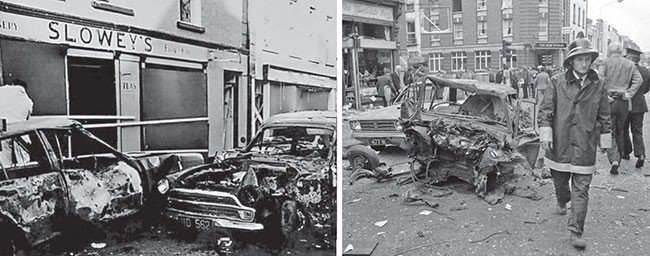
• In the aftermath of the Dublin and Monaghan bombings, the Fine Gael/Labour government used it to pursue their anti-Republican agenda, blaming the IRA for ‘provoking’ loyalists
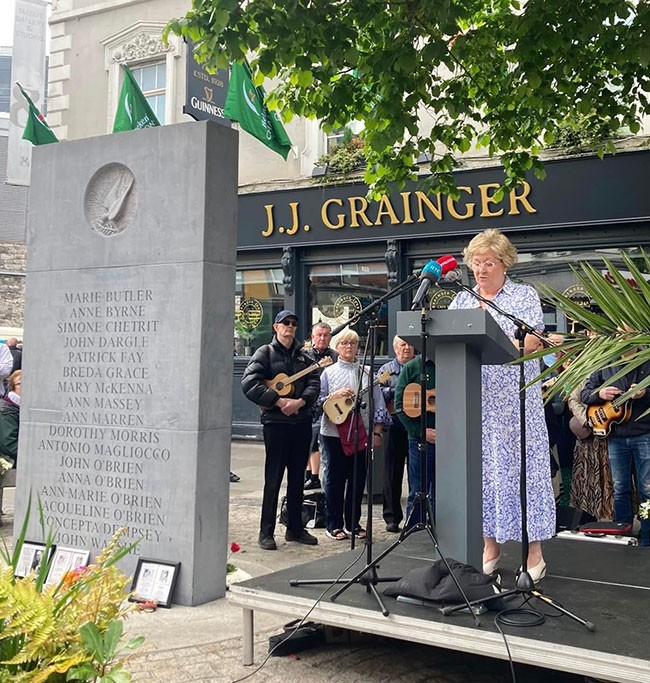
• Bernie McNally speaking at the 2023 commemoration
Labour Minister Conor Cruise O’Brien went further, warning that people who supported Irish Republicans were responsible for the horror that visited Dublin and Monaghan. More seriously, the actual Garda investigation was closed down prematurely; evidence was lost, leads were not followed, and the British government was not confronted with its responsibility.
Since then, hundreds of deaths in the conflict have been directly attributed to collusion between British crown forces and loyalist paramilitaries who acted as an effective ‘third force’ in Britain’s war. This includes the 2003 Justice Henry Barron Report on Dublin and Monaghan which pointed to collusion.
And right up to the present day, reports are being published showing how the RUC and the PSNI failed to properly investigate many killings. Among those with serious questions to answer on all this is current Garda Commissioner, and former senior RUC and PSNI officer Drew Harris.
The long tradition of twisting, concealing, and suppressing the truth with regard to the actions of British forces and their allies continues. Despite repeated unanimous calls by the Dáil and by Irish governments, the British government has refused to reveal its files on the Dublin and Monaghan bombings. And of course, the British Tory government’s shameful legacy legislation which came into force on 1 May is designed to suppress truth, thwart justice, and protect its forces.
And so, on the 50th anniversary of the Dublin and Monaghan bombings, the long search for truth and justice by the families goes on. Like the Stardust families, their campaign has been heroic and dignified. They too deserve full vindication.
Mícheál Mac Donncha is a Dublin City Sinn Féin councillor