

29 February 2024 Edition
What does the spirit of 1798 mean today?
“The mind once enlightened cannot again become dark” – Tom Paine 1781
‘Who fears to speak of ’98’ has been the mantra down the years, spoken softly with republican passion of days gone by. A distant memory lost somewhere in time, but never really forgotten. A cry of unfinished business, a desire that burns deep into the very soul of those who believe in the unity of ‘Protestant, Catholic, and Dissenter’ across our island as it did in that hot summer of 1798.
What does it all mean to us now, what relevance does it have today in these times of seismic political change some 230 years later? Some sense a feeling of a quiet renaissance rumbling in the undergrowth about these ideas of republicanism, first spoken in whispered breath in the narrow dark alleyways of Belfast and Dublin all those years ago. Ideas just as relevant today as they were then.
In the latter half of the eighteenth century, Ireland experienced a transformative intellectual and cultural movement—its very own Enlightenment. It had spread like wildfire from Europe to Belfast and beyond. The Americans had driven the British out of the colonies and declared independence in 1776.
Then came the French Revolution of 1789, and in 1791-92 Thomas Paine’s pamphlet ‘Rights of Man’. It was so widely read locally that, according to Wolfe Tone, it was known as the ‘Koran of Belfast’. The chatter in the smoke-filled taverns was thick with anticipation and excitement of embryonic radical change, influenced by European ideals of reason, science, and individual right.
Irish thinkers, and particularly northern Presbyterians, had found their political calling, Republicanism, which challenged traditional norms and questioned societal structures. Its message was that tyranny not only persecuted them, but also their Catholic neighbours. Under the Penal Laws, Presbyterians had also suffered discrimination by the Anglican Ascendancy which controlled much of Ireland’s political and economic power.
Young Dublin barrister, Wolfe Tone, and his close confidant and friend from Cork, Thomas Russell, a commissioned officer in the British Army came to Belfast. It was Tone who had declared England "the never-failing source of all our political evils." Along with the Belfast radicals, they would change the course of Irish history with the founding of the first ‘Society of United Irishmen’ in October 1791. Nothing would be the same again.
They fostered a climate of intellectual curiosity and progressive thought. The ideas of the United Irish movement disseminated throughout Irish society; democracy, religious tolerance, human rights, and abolitionism.
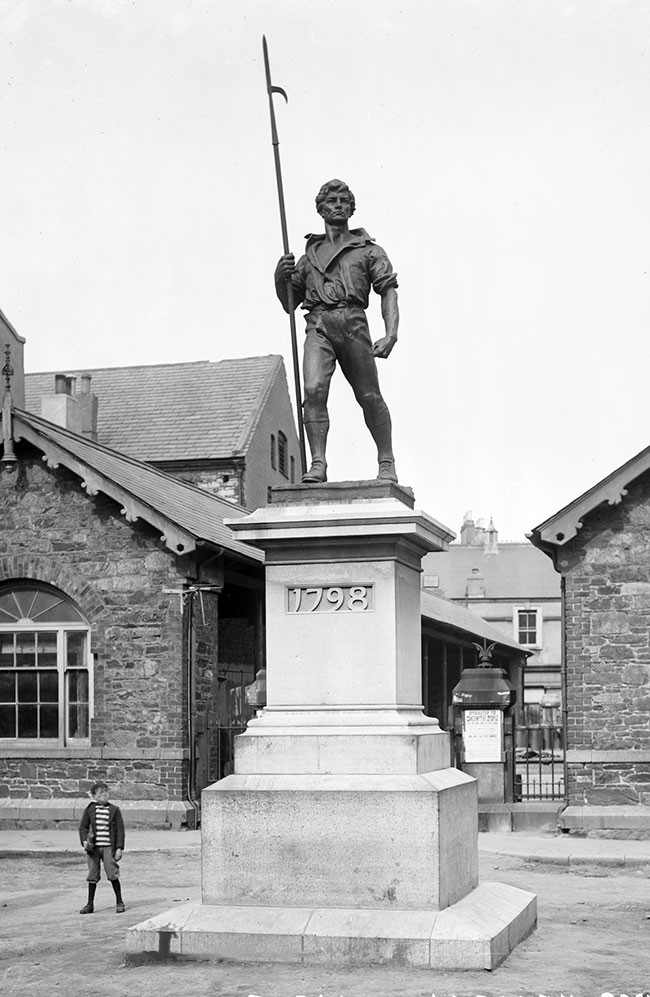
• Today, it is hard to visualize the generational trauma, particularly among Presbyterians, which left in its wake ‘the fear to speak of ‘98’
Their newly founded republican newspaper, The Northern Star, set out their mission in their first editorial in January 1792, they wanted “To make the Irish people aware of their common interests so that they might act together with one heart and with one voice to assert their freedom and endeavour by all constitutional means to shake off the badges of slavery which yet disgrace them as a nation.” It would lead for demand for change and when this was denied it led to rebellion in 1798.
The cost of that rebellion would be savage reprisal and the destruction of the homes and communities of the poor tenant farmers across Ireland. Today, it is hard to visualize the generational trauma, particularly among Presbyterians, which left in its wake ‘the fear to speak of ‘98’. It was of such magnitude that it would lead, incredibly, not to resistance but to many Presbyterians switching to and embracing Orangeism as a demonstration of their loyalty.
However, as a result of the peace process, as a fallout of Brexit and our future being undemocratically determined by English nationalists, people from unionist backgrounds are exploring the past and their role in being the founders of Irish republicanism.
It is also part of my own history. A Presbyterian antecedent of mine was hanged after the Battle of Ballynahinch as a rebel leader against King and Country. Ironically, his great grandson, my great grandfather, would die for King and Country in rat-infested trench of the Pas-de-Calais, France during the First World War. His name is on the war cenotaph in Ballynahinch, but there is no monument to 1798.
I feel an almost spiritual resonance and connection the more I delve into this history. It was the reason why I started the ‘1798 Walking Tour’ in Belfast. I give the dead their voice back and their rightful place in history.
I build and weave a picture of bravado and hope of a youthful Henry Joy McCracken along with Wolfe Tone, Russell, and Neilson as they go on a boozing session with Edward Bunting during the Belfast Assembly of Harpists in July 1792 in the Washington Tavern or Peggy Barclays Inn down Sugar House Entry.
There is the curse of all struggles—the stories of informers and spies that sold and betrayed their friends for silver and gold to Dublin Castle, the real seat of British rule in Ireland and not the pseudo-parliament at College Green.
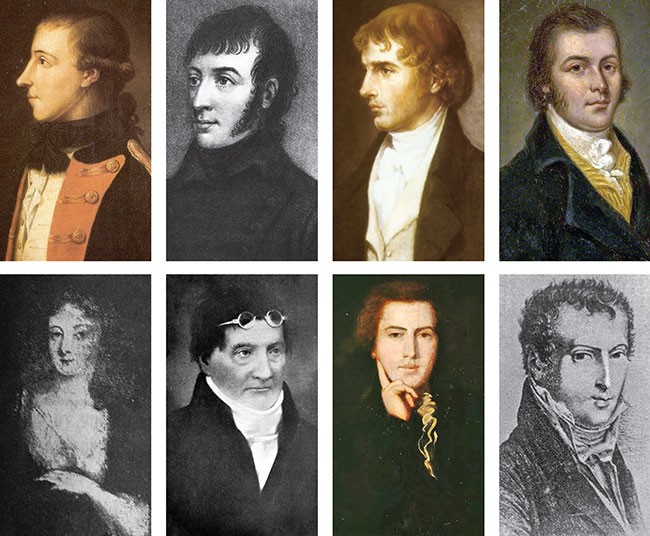
• Wolfe Tone, Thomas Russell, Henry Joy McCracken, Samuel Neilson, Rev. David Baillie Warden, Dr William Drennan, Edward Bunting and Betsy Gray
I was brought up the son of a happy, mixed marriage of Orange and Green, in a Protestant working-class housing estate in Newtownards. My Dad, a working-class Protestant, married my Mum, a Catholic farmer’s daughter. I joke to people on the tours that, like Wolfe Tone, I’m from a religiously mixed marriage with a French-sounding Huguenot surname out to cause dissention in Belfast.
Our estate had a sprinkling of Catholics, mainly from mixed marriages. There was none of this ‘us and them’. Nobody bothered, nobody cared. We were all equally poor, borrowing cups of sugar and loose tea from each other before pay day or the bru on Fridays.
I lived amongst the descendants of the United Irish who had proclaimed a Republic for three days in June 1798 in Newtownards. I was lucky to have a primary school teacher who captivated me by the story of Ulster’s own Joan of Arc—the local rebel Betsy Gray.
What fascinates me most and a question I’m constantly asked is what happened to all those Presbyterian republicans. It’s as if they just vanished. Their republicanism was a Belfast-born Protestant invention. Wolfe Tone and Thomas Russell came to Ulster and Belfast to meet the likes of Samuel Neilson, perhaps one of the greatest republicans of them all. Belfast-born Dr William Drennan’s pamphlets also greatly influenced republican politics.
Yet, at the end of the rebellion, the tables had turned and somehow it was labelled a Catholic insurrection, a Popish plot hell bent on treason and destruction.
Earlier, in 1782, the British government to counter political restlessness had conceded a measure of restricted devolved power in what is referred to as Grattan’s Parliament. But real power effectively rested under the control of the Lord Lieutenant at Dublin Castle. Britain exploited the Rebellion to ‘abolish’ this parliament, establishing the United Kingdom under the 1800 Act of Union. Through bribery and corruption, Britain had actually persuaded the parliament to abolish itself.
After 1798, the record of history would be written by the victors. The truth about the rebellion in Ulster against the crown would be buried with their dead, their graves unmarked and dates changed as not to create suspicion as to the reason of their demise. The radical Presbyterianism of the meeting house, the engine of republicanism in Ireland would vanish into the ether, the memory lost.
In the words of historian Professor Thomas Bartlett, "The rebellion cast a long shadow before it … it determined Catholic and Protestant relationships for the remainder of the 19th century and beyond."
So far as Antrim and Down were concerned, the Presbyterians and Anglicans who had fought each other at Saintfield, Ballynahinch, and Antrim buried their differences, to some extent superficially, but the old Protestant consensus was once again established. In a sense, they shed themselves from their rebel past and any whiff of republicanism.
Nothing would ever be the same again. The united movement was vanquished. Protestant involvement in 1798 was written out of the history books, as Catholic atrocities were exaggerated as tribal warfare, petty and obtuse.
Post Union from 1800 onwards, the birth of the revisionist school of thinking would reinforce old dogmas and suspicions burying deeper the memory of ’98, a new narrative of ‘us and them’ was amplified. Gone was the memory of Henry Joy McCracken and his army of 10,000 men at Donegore Hill in Antrim.
Gone was the pride in the small French-style revolutionary committees set up across Antrim and Down declaring for independent Republics from Larne to Ballymena and to Newtownards, where the Rev. David Baillie Warden led the ‘Hearts of Down’ to battle at Ballynahinch.
England would spend the next two centuries cementing the victor’s myth, until eventually democracy, insurrection, and modernity would rise once again and weaken Britain’s stranglehold on this island, it would move the dial in the direction of Irish self-determination and independence. We are nearing there. Dá fhada an lá tagann an tráthnóna.
Seán Napier is a Belfast republican who runs 1798 walking tours in Belfast and Dublin.