

29 February 2024 Edition
The days of second-class citizenship are over
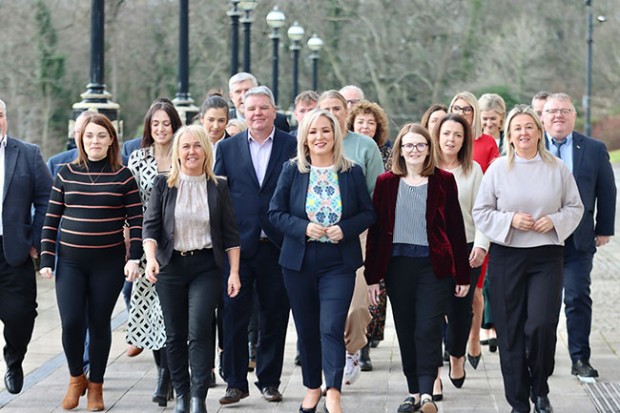
• Sinn Féin is focused on a shared future, an agenda for change, a common cause where no-one would be asked to surrender their allegiance, where you can be Irish, British both or none

Jim Gibney takes us through the momentous day that saw Sinn Féin Vice President Michelle O’Neill take office as First Minister. Jim was in Stormont on 3 February with a cast of old and young republican activists. And here he charts the historical journey republicans have made over the past 50 plus years.

In the 36 hours before the historic and momentous election of Michelle O’Neill as First Minister, I spent time texting republican veterans and also phoned some people whose loved ones had been killed or injured during the conflict.
A few weeks before, I had attended the AGM of the much valued and respected Relatives For Justice organisation which is dedicated to helping relatives traumatised by the loss of their loved ones.
It was a hugely significant day, but also a day to reflect on the loss of life and those injured on all sides – in the community of the Ballymacarrett Short Strand area where I grew up for me particularly – a sentiment echoed in Michelle’s acceptance speech in the assembly chamber.
On the morning of the great occasion, I travelled with my friends Danny and Leslie. We were to pick up Tom Hartley, but he was out of the country and would have been kicking himself, for Tom, a historian and archivist, would have been in his element.
Tom once told a packed room in Dublin Castle in the days of the Forum for Peace and Reconciliation that it was a dangerous act to be seen on Belfast’s Royal Avenue in the 1960s openly carrying a copy of the Irish News for fear of attack by unionists. Today, people carry Tricolours and hurls and wear GAA and Celtic tops in Royal Avenue without garnering notice.
Danny Morrison was driving and was looking in his rearview mirror. “Is that Edwin Poots behind us?” “It is indeed”, I said, “And Paul Givan is sitting beside him. Two ministers-in-waiting”, I joked. Poots car drove into the inside lane beside us, but there was no eye contact. Though for a second it looked like we could be in a race.
As we neared Stormont, I recalled that Danny had written for The Guardian on the Friday afternoon nearly 26 years ago when the Good Friday Agreement was signed.
He wrote, “As I drive out of Stormont, past the statue of Lord Edward Carson down Prince of Wales Avenue I feel that something fundamental has shifted. My view of East Belfast is always from the West of the city, my home. Stormont lies in the Castlereagh Hills, foreign. On this afternoon, I look from the Avenue across Black Mountain above West Belfast, distinct and familiar and realise that it’s not that far away, after all.”
Danny’s observation was laden with history as Stormont was the seat of Orange power and our oppression, and symbolised our position as second-class citizens for 50 years under the Ulster Unionist Party.
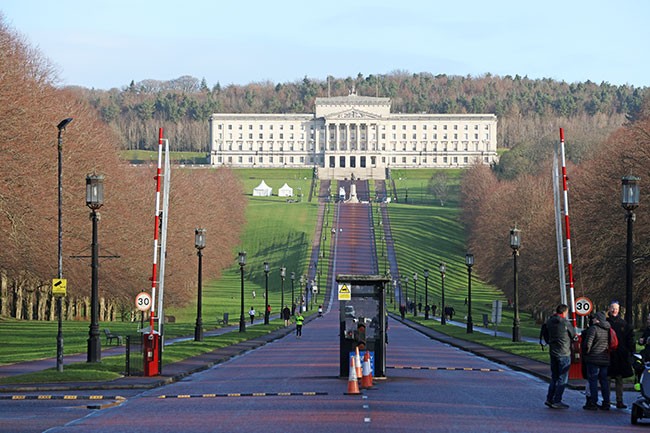
• Stormont was the seat of Orange power a ‘cold house’ for Catholics. The days of second-class citizenship are over
It was a cold house for Catholics, to pirate a phrase from former leader of the UUP David Trimble. Going through the security gate, the main guard joked with Danny and said, “Do you not know me?”
It turned out that he was an old friend of Danny’s from Corby Way in Andersonstown. Back in the '50s and '60s, few nationalists, if any, would have got a job at Stormont.
As we left the security hut, Colm Gildernew MLA enthusiastically waved from his car. In 1968. Colm’s mother was pregnant with him, when she, his granny, and godmother were violently evicted from their home in Caledon, an iconic event which gave a huge boost to the Civil Rights Movement.
Approaching Stormont’s front entrance on foot, I noticed the smiling face of Sinn Féin President Mary Lou McDonald. She joked that her job today was as “an usher” directing people into the Great Hall.
But there was a queue for selfies and a queue of journalists looking to interview her. It was during one such interview that she said, “A united Ireland is in touching distance”, which sparked off days of contrived controversy.
After registration at reception, we were met by Eoin Rooney, one of Sinn Féin’s economic advisers and personal assistant to now Economy Minister Conor Murphy, who escorted us to Sinn Féin’s ‘big room’ on the third floor.
Unionists often complain about republicans referring to the North as the Six Counties, but it was they who built Stormont with six floors, and they have six pillars at the entrance representing each of the six counties.
The room and the corridor were packed with faces old and new, representing the past and future progress. Over 50 years of experienced struggle mingled on the corridor. Veterans and young fluent Irish speakers and elected representatives like Pádraig Delargey from Derry, Belfast Councillor Caoimhín McCann, Gaeilgeoir Seán Ó Ceallaigh who is chairperson of the cumann I am in, advisers to Ministers, cumann activists like the highly skilled election strategist Lauren Slane, friends and families, including some loud infants silenced by chocolate biscuits.
A beaming Sinéad Walsh hugged me with a strength that said it all. A former political prisoner and a friend and comrade of Mairéad Farrell, who was shot dead in Gibraltar by the SAS alongside Dan McCann and Seán Savage.
The Baker family has a long history of republican activism going back to the early '70s. Danny Baker MLA, former Mayor of Belfast, represented that history on this occasion.
MPs Francis Molloy and Mickey Brady brought to mind the pivotal role the people of their constituencies played in the struggle; Bobby Sands elected in Fermanagh South Tyrone and the IRA in South Armagh whose determination helped bring the British government to negotiate peace.
On a wall in the Sinn Féin room, Bobby Ballagh’s painting of a youthful Martin McGuinness watched over an impressive lineup of TDs, including Rose Conway Walsh, Ruairí Ó Murchú, Martin Browne, Maurice Quinlivan, Darren O’Rourke, as well as Seanadóir Paul Gavan. Their presence is a powerful reminder that Sinn Féin is the only all-Ireland party.
Bernie McGuinness, her son Fiachra, and his wife brought home Martin’s impact. Without him, there would not have been peace or this very special day. They were relaxed in conversation with Gerry Adams – adorned with a Palestinian scarf – a horrific reminder of Gaza.
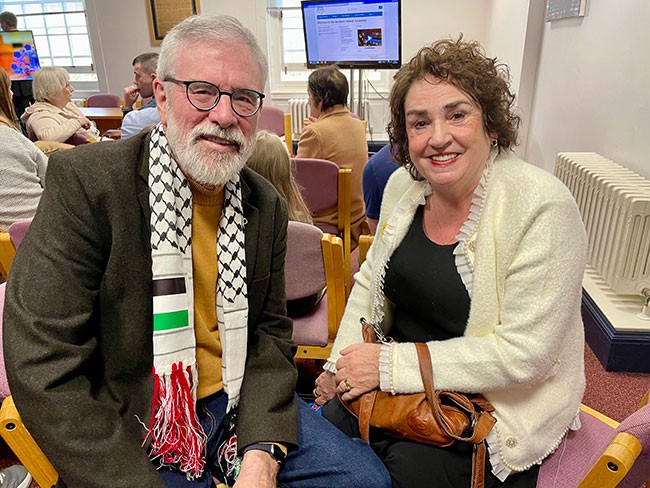
• Gerry Adams and Bernie McGuinness
Also present was lifelong activist, former minister, MLA, MEP and party peace process negotiator Bairbre de Brún.
Maolíosa McHugh MLA, brother of the late Councillor Charlie McHugh, introduced me to Charlie’s son, Ruairí, himself a local councillor. Charlie gave great service to the struggle.
When I shook the hand of Lurgan republican, former Minister for Education, and one of the party’s most able debaters John O’Dowd MLA, I thought of Sheena Campbell. A Craigavon woman with a meticulous electoral brain who was shot dead by loyalists.
Others in the crowded room were in a reflective mood. Sinn Féin councillor Geraldine McAteer spoke about her late sister Theresa Lunny, also a party councillor and the second woman to be interned in Armagh Women’s Prison. The first was her comrade Liz Maskey, who was also in the room.
Louise Ferguson, a long-time policy adviser and researcher, her late husband Michael was an MLA. My late brother Damien and Pat Rice were the first two Sinn Féin councillors to be elected to Lisburn Council in the days of unrestrained bigotry.
In tribute to him, I collected names on a ‘Thinking of You’ card for his wife May and daughter Sinéad. Thoughts too of close friend John Leonard senior, as well as IRA Volunteers John Leonard and John McComb, who was one of four brothers imprisoned, and former prisoner Mickey Cupples. They would have relished the occasion.
Glowing and genuine tributes from all parties across the chamber for the outgoing speaker Alex Maskey set the scene for the election of Michelle and the other ministers.
Alex was praised for his integrity, impartiality, neutrality, for being friendly, robust, fair, and a speaker for all.
Fermanagh’s Seán Lynch, a former MLA once critically injured in an SAS ambush, was in high spirits as was Ian Milne, another former MLA, who served a life sentence and was a comrade of Francis Hughes who died in the 1981 hunger strike.
I had a chat with Martina Anderson who spent 13 years in English prisons and was an MEP and MLA and now lobbies support for a United Ireland across the EU.
Seasoned activists like Gerry Kelly MLA, Marty Lynch and Padraic Wilson were enjoying the occasion. I thought of their very close friend and comrade the late Bobby Storey, who said, “A life of struggle is a life well lived”.
In the early 1980s, Marty Lynch spent time in my cell in the Crum recovering from serious injuries when shot by a British soldier. Padraic Wilson’s father Leo was one of a small group of Belfast republicans who kept the struggle alive during the lean years. So too Aidan McAteer’s parents. Aidan has been one of the party’s key advisers and negotiators for nearly 30 years.
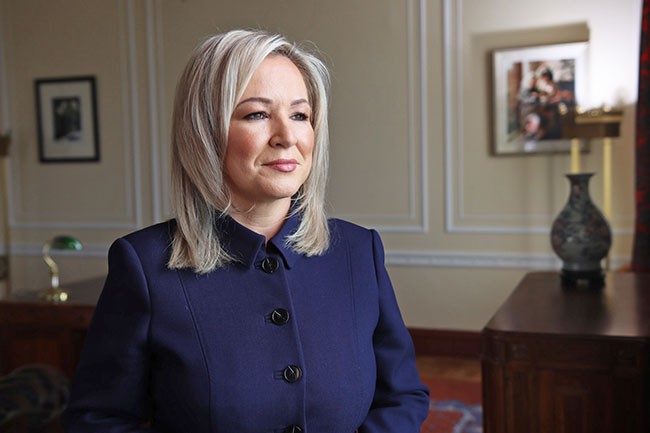
• First Minister, Sinn Féin Vice President Michelle O’Neill
There was complete silence in the room as we watched in disbelief, in the heart of a building which was built to last as a symbol of Partition and exclusion. It had done so for too many years and what was about to happen should never have happened.
Gaeilgeoir and world champion handball player from West Belfast Aisling Reilly nominated Michelle for the post of First Minister. Aisling was subsequently elected a junior minister.
And when Michelle said ‘Tá’ to accepting the nomination the crowd erupted on its feet in a visceral roar that seemed to last forever with prolonged applause.
Broad smiles, tears and hugs greeted the announcement that Michelle O’Neill from Clonoe in west Tyrone was to be the North’s First Minister from a Sinn Féin nationalist background.
Michelle’s speech focused on a shared future, an agenda for change, a common cause where no-one would be asked to surrender their allegiance, where you can be Irish, British, both or none. The days of second-class citizenship were over. The old state was gone. In its place, an assembly for Catholic, Protestant and Dissenter.
Gerry Kelly unintentionally provided the serious occasion with some laughter when he mistakenly proposed former political prisoner and Minister for the Communities, Carál Ní Chuilín as Deputy Chief Constable instead of Deputy Speaker.
I met Mike Nesbitt, the former leader of the Ulster Unionist Party, in a corridor. We agreed it was a good day for reconciliation between unionists and nationalists.
I got a lift home with Gerry Adams, his omniscient aide-de-camp Richard McAuley, and loyal and patient driver Crickie. Tom Hartley rang in to praise all. Gerry told him how much he was missed on the grand occasion.
I ended the day in the company of the irrepressible Eibhlin Glenholmes, a generous friend of nearly 50 years, whose father and mother Dicky and Lily, like tens of thousands of others, made the unimaginable occasion happen.
It was a day when the past and the present shared a solemn and hopeful space.
Jim Gibney is a republican activist and former political prisoner