

31 August 2023 Edition
Birney and McCaffrey case is vital for press freedom
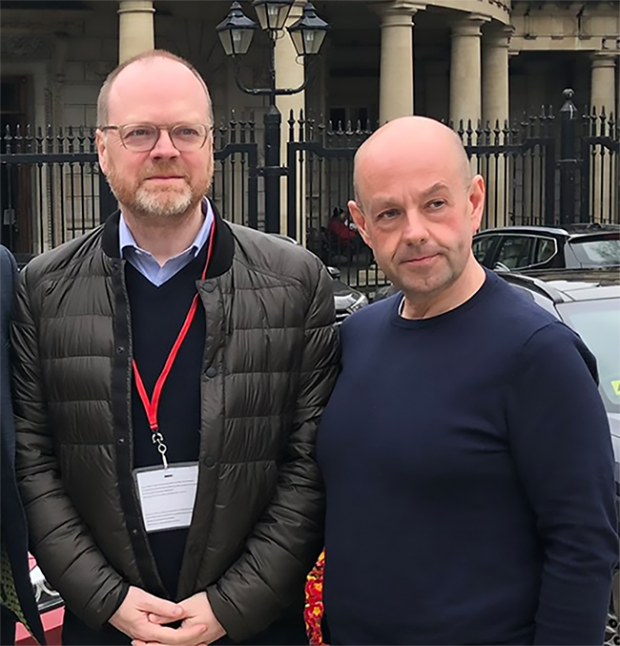
• Irish journalists Trevor Birney and Barry McCaffrey are hoping that the Investigatory Powers Tribunal will hold a full hearing into their complaint

News that a British judicial body known as the Investigatory Powers Tribunal (IPT) is to examine a complaint by two Irish journalists that they were subject to surveillance by police and secret services deserves the widest possible publicity.
At this point, the story hasn’t had much coverage because, as we know, Britain’s and Ireland’s mainstream media are controlled by individuals and corporations who constrain their journalists from holding intelligence agencies to account.
Down the years, these cloak-and-dagger bodies have avoided proper scrutiny, often operating with impunity, by asserting that their work is all a matter of “national security”. Many such claims are bogus.
That’s why the case of Trevor Birney and Barry McCaffrey is so important and so fascinating because it offers an unrivalled opportunity to cast light on the unwarranted secrecy of the secret services in their dealings with journalism.
To recap. These two upstanding men, ornaments to their journalistic trade, had the temerity to discover evidence – by which I mean unimpeachable proof – that there was a cover-up following the murder of six Catholic men by the UVF in Loughinisland, County Down, on 18 June 1994.
Those men were sitting in a pub, watching World Cup football, when a loyalist gunman burst in and sprayed the place with bullets from an automatic weapon. He was accompanied by two other men. All were masked.
However, the killers’ identities were known to the RUC Special Branch who watched, and occasionally interfered, as the regular police carried out what was a make-believe investigation into the crime. This is a matter of record, having been revealed in a distressing 2016 report by Michael Maguire, the then police ombudsman for Northern Ireland.
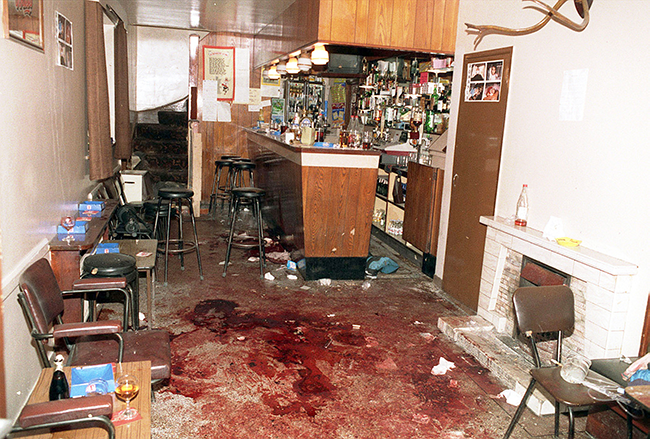
• The scene at Loughinisland on the morning after the UVF shot dead six people
His findings of collusion were devastating. The RUC Special Branch had prevented a proper investigation by destroying key information and spiriting away physical evidence. They did so in order to protect an informant who was one of the gang.
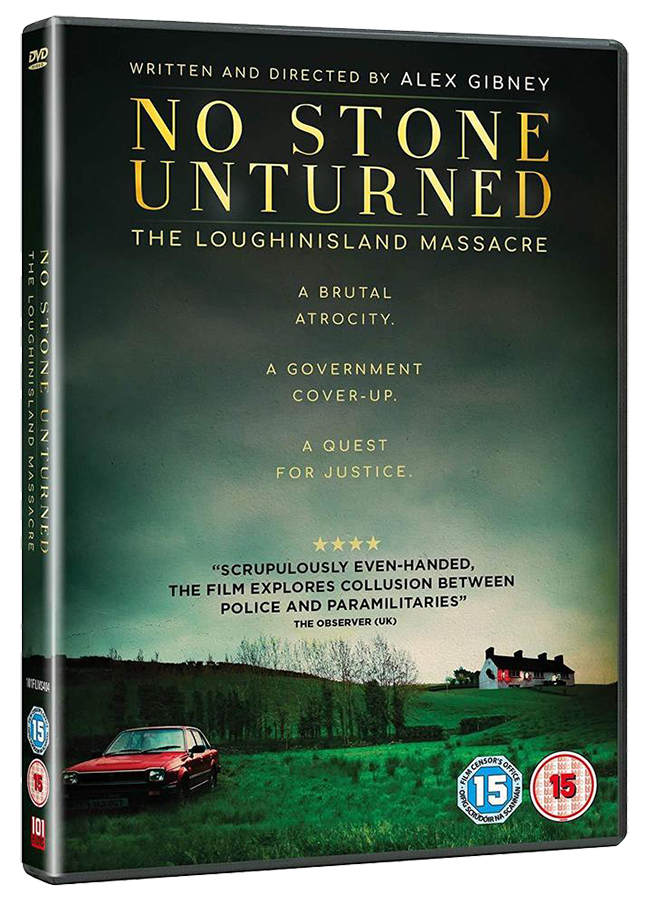
So far, so bad. Enter award-winning documentary maker Trevor Birney and award-winning reporter Barry McCaffrey. Following Maguire’s report, they produced, in company with American film director Alex Gibney, a documentary film ‘No Stone Unturned’, which explored the police cover-up in forensic detail. It identified the suspects and pointed to the links between the police and the UVF gang.
The police, in the guise of the RUC’s successor, the PSNI, were outraged at having the facts presented to the public. So, in time dishonoured fashion, the cops decided to obscure the message by attacking the messenger.
In order to avoid an alleged conflict of interest – hard not to laugh at the cynicism – the PSNI recruited an English force, Durham Constabulary, to carry out an arm’s length investigation into Birney and McCaffrey. Not, you might note, to investigate the murders and those responsible for covering up the crime. Much more important, in their view, was to discover how the journalists had allegedly obtained an unredacted copy of the Ombudsman’s report.
Durham police obliged by arresting the journalists and raiding their homes and offices to seize thousands of documents and digital files. This was an outrageous assault on press freedom, a gross intrusion of privacy, and a breach of the men’s human rights.
Northern Ireland’s Lord Chief Justice, Sir Declan Morgan, agreed. When the pair went to court in 2019 to challenge the legality of the police action, he declared that the search warrants were “inappropriate” and the journalists had been acting properly in protecting their sources.
He ordered the police to return the confiscated documents. A month later, it was announced that Durham police and the PSNI had dropped their inquiries into Birney and McCaffrey. Bail was eventually lifted. The PSNI’s police chief issued an apology. Then, in November 2020, the PSNI paid out £875,000 in damages; £600,000 to the film-making company, £150,000 to Birney, and £125,000 to McCaffrey. That settlement seemed to be the end of a disgraceful episode.
But the truth – the whole truth and nothing but the truth – had not emerged in public. Both Birney and McCaffrey had long suspected that they had been subjected to covert surveillance by agencies of the state. Before his work on the Loughinisland massacre, McCaffrey learned that while he was looking into a case of potential corruption within the PSNI in 2013, the force accessed his phone.
With that in mind, along with suspicions that their phones had been compromised while making ‘No Stone Unturned’, McCaffrey and Birney lodged a complaint in 2019 with the Investigatory Powers Tribunal, a body created specifically to look into allegations of unlawful surveillance by the intelligence services.
For two years until July this year, the IPT kept the matter behind closed doors. Now, the journalists are hoping that the tribunal will hold a full hearing into their complaint. As McCaffrey points out, with the PSNI treating journalists as the enemy in the Six Counties, every reporter working there has to wonder if they have been subjected to similar treatment.
His solicitor, Sinn Féin MP for Belfast North John Finucane, also sees the wider significance of the case, arguing that it is “a matter of huge public interest as we seek to ensure the freedom of our press and the rights of journalists”.
It is also significant that the Birney-McCaffrey persecution has not engendered an outcry in Britain, neither among journalists nor the wider public. Partly, that is because so much of what happens in the north of Ireland is entirely ignored in Britain.
In addition, there has long been a journalistic failure to report properly on the shadowy activities of Britain’s secret services. The spooks – and the police acting as spooks – have traditionally been given a free ride by the press.
Even when the police secretly obtained the phone records of a reporter for The Sun during a Westminster political scandal in 2014, the so-called ‘Plebgate’ controversy, it did not generate a full-throated campaign against surveillance.
Around the same time, police desperate to know the source of a Mail on Sunday story about a British politician accessed the phone records of one of its reporters.
Despite understandable anger by the individual journalists involved, and leading articles in their newspapers criticising such actions, the protests were tame.
Underpinning these intrusions is a British law, enacted in the name of fighting terrorism, called the ‘Regulation of Investigatory Powers Act’ (Ripa), which is rightly known as the snoopers’ charter.
Spying on journalists is not only a British disease. In June, the European Union published draft legislation, risibly called the ‘European Media Freedom Act’, which would allow national security agencies to spy on journalists.
It would make it legal for governments to place spyware on journalists’ phones if deemed necessary for the sake of national security.
This initiative, as with Ripa, as with the Birney-McCaffrey case, exemplifies a sad truth; journalism is viewed by state authorities, wherever they exist, as the enemy of democracy rather than its hand-maiden. Now that really is spooky.
• Roy Greenslade is a journalist, author and former Professor of Journalism, City, University of London