


31 August 2023 Edition
Where is Unionism at today?
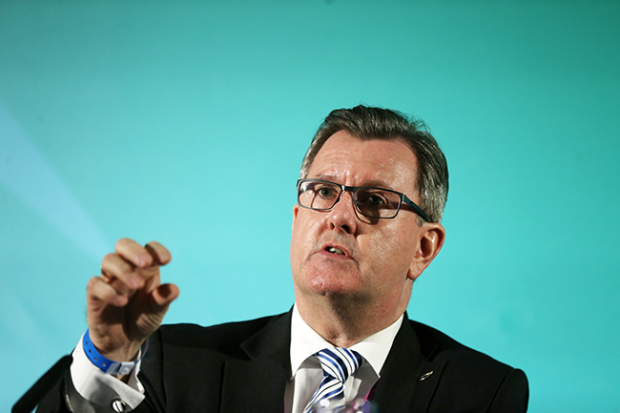
• DUP leader Jeffery Donaldson said he could live with 40,000 job losses as a result of Brexit
I am sure that the question of where Unionism is at today has occupied the minds of many of the public, political commentators as well as the political establishments across these islands and beyond.
In seeking to answer the question as to where Unionism is at, it is important to understand one part of the Unionist psyche that has existed down through the years. Political Unionism has continually displayed a siege mentality in their public actions and pronouncements.
This has usually manifested itself along a psychological continuum from unionist Prime Minister Basil Brooke’s 1933 declaration of “not having a Catholic about the place”, to the patronising condescension of Terence O’Neill in 1969 asserting: “If you give Catholics a good job and a good house, they will live like Protestants”.
Today’s unionists are in a position they never expected to find themselves in; they are a minority in a statelet originally designed to ensure that they would always be the majority.
Today’s version of the siege mentality has manifested itself along new continuum of a ‘hard Brexit’ to reinforce Partition to ‘the best of both worlds’ where access to both the European and British markets would make the North more acceptable to nationalists.
There had been much political commentary to the effect that the DUP would go back into the Executive and Assembly once the EU and the British government settled some outstanding issues. This came about with a revised Protocol, the Windsor Framework, but of course the DUP balked at reestablishing the political institutions.
The current political commentary now is that the DUP will restore the political institutions once the summer is over. It isn’t even clear if unionist themselves know how to respond to a set of political conditions beyond their comprehension, that unionist hegemony is clearly at an end.
If the DUP were minded to reinstate the political institutions at the end of the summer, they would be embracing the current status quo. This would entail their collaboration with a Sinn Féin First Minister.
A prevalent belief among many is that a key factor to the DUP’s refusal to reestablish the political institutions is because they couldn’t stomach serving alongside a Sinn Féin First Minister. An updated adoption of ‘not having a Catholic about the place’.
Furthermore, in a scenario where the political institutions were to be reinstated based on the present mandate, the DUP are aware they could likely confront an Irish government led by a Sinn Féin Taoiseach.
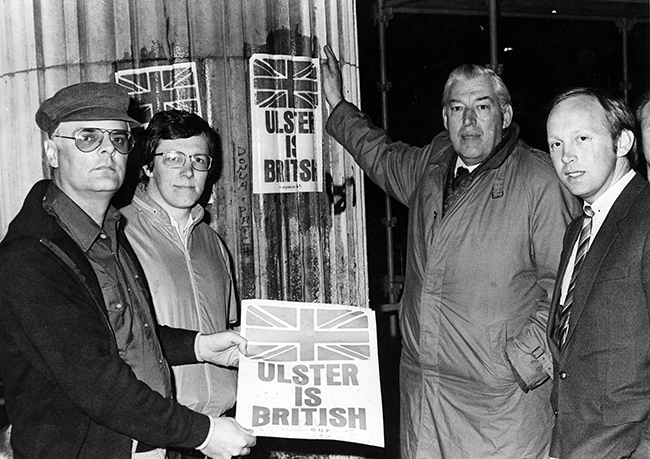
• 1984 - failing to learn the lessons from history: DUP early morning protest, GPO, Dublin, Ivan Foster, Peter Robinson, Ian Paisley and Jim Allister
The British government has made it clear that its negotiations with the EU have concluded and that the Windsor Framework will not be amended. Whatever fig leaf the British government may offer unionism, they know that they cannot wind the clock back to implement the original terms of the 1800 Act of Union. The world has moved on. Unionism’s majority is gone.
So, what are their options? The DUP could simply refuse to form an Executive in Stormont, hoping that the British government will re-introduce Direct Rule. They might see this as a strategy to delay the onward march towards a United Ireland.
They may feel that with an expected general election in Westminster next year that they could have some influence in the event of a hung parliament. In the past. unionism has propped up Conservative governments. The UUP propped up John Major’s government in 1996 and the DUP signed up to the Supply and Confidence deal to support Theresa May in government in 2020.
On both occasions, their price of support was financial. They were not able to get any political concessions. The understanding that British governments took from these experiences was that unionism can be bought and what can be bought can also be sold.
Despite their experiences of trusting previous British governments to look after their interests, the DUP has failed to learn the lessons from history. Do they forget that it was a Conservative government under Margaret Thatcher that introduced the Anglo-Irish Agreement in 1985 and that John Major introduced the Joint Declaration in 1993. Under a Labour government in 1998, the Good Friday Agreement was signed. In more recent years, the Conservative government negotiated and signed the Withdrawal Agreement, the Protocol and, most recently, the Windsor Framework. The DUP have opposed all of these Agreements and Protocols, claiming that they damaged the Union but that has cut no ice with British governments.
In reflecting on unionism’s experience of dealing with British governments, the words of Edward Carson come to mind. “What a fool I was, I was only a puppet, and so was Ulster, and so was Ireland, in the political game that was to get the Conservative Party into power”.
The DUP supported a hard Brexit in the hope of reinforcing Partition on the island of Ireland despite knowing the political and financial consequences. Today’s DUP leader Jeffery Donaldson said at the time that he could live with 40,000 job losses as a result of Brexit.
They were taken in by a contender for the Conservative leadership, Boris Johnson, when he told them that only “over his dead body that there would be a border in the Irish Sea”. Of course, when Johnson became British Prime Minister, he negotiated and signed the EU Protocol which reinforced the Irish Sea border, which had existed for decades.
The question has to be asked, at what point will the penny finally drop that Britain will always look after its own interests and that consideration of what unionism wants will always play second fiddle.
The recent email from the DUP leader to party members, warning members over briefing against the party, makes it clear that there is a group within the Party that will never learn the lessons of history.
The current DUP leader may want some sort of a fig leaf from the British government in the hope that he can sell it as a victory to his supporters. However, he knows that any claim to a hollow victory is long gone with their refusal to accept the Windsor Framework, and that their nemesis, Jim Allister, will expose any such fallacy alongside the naysayers within his own party.
They may want a new Assembly election in the hope that they can regain the position of First Minister. That’s a throw of the dice where they may feel that they have nothing to lose because the current political situation means that they have to serve with a Sinn Féin First Minister.
So, to return to the question that I asked at the start, where is unionism at today. The answer is, ‘who knows’. It’s not even clear that unionists and unionism know themselves what their next move is. One thing we can be clear about is that their calculations will focus on what many people now see as Ireland’s future, a United Ireland on the horizon.
Thankfully, there are those from within the unionist tradition who are starting to look to Ireland’s future with a different perspective. They know that being part of an all-island political, social, and economic unit offers a brighter destiny for them and their children. A future where their rights and identity will be protected, a place where they are wanted and respected, a space where they will have a political voice that is heard, that matters and where they will have a real say in their future.
That future must be planned for. We have all witnessed the mess of an unplanned Brexit. With that lesson in mind, it is imperative that the Irish government starts preparing and planning for Irish reunification. That is the call from communities across Ireland.
We need to plan for a transition out of a failed two state system to a unity stage. That requires proper planning and careful preparation and only a foolish Irish Government would ignore the most recent lessons that history has taught us.
• Paul Kavanagh is a former Republican prisoner and was a Special Adviser to the late Martin McGuinness