


31 August 2023 Edition
Escapes by air and by land
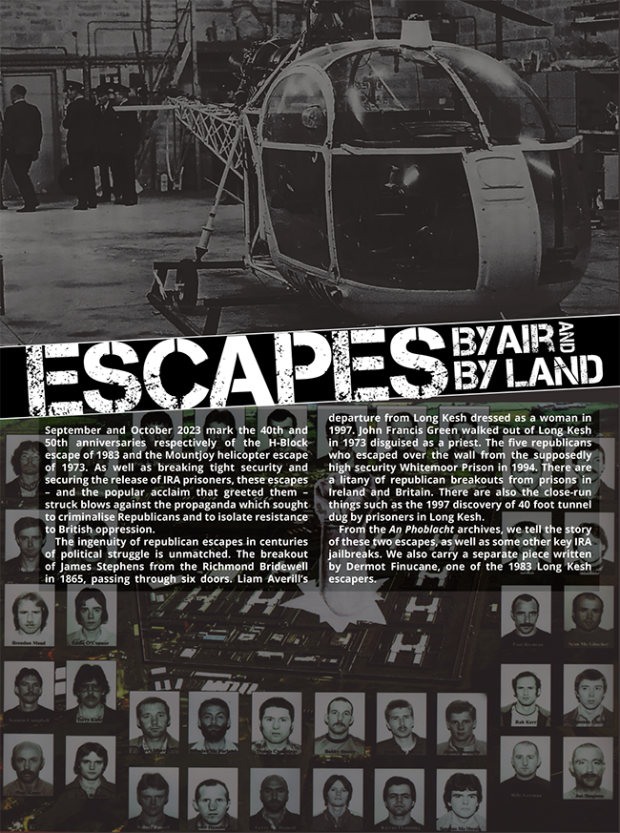
September and October 2023 mark the 40th and 50th anniversaries respectively of the H-Block escape of 1983 and the Mountjoy helicopter escape of 1973. As well as breaking tight security and securing the release of IRA prisoners, these escapes – and the popular acclaim that greeted them – struck blows against the propaganda which sought to criminalise Republicans and to isolate resistance to British oppression.
The ingenuity of republican escapes in centuries of political struggle is unmatched. The breakout of James Stephens from the Richmond Bridewell in 1865, passing through six doors. Liam Averill’s departure from Long Kesh dressed as a woman in 1997. John Francis Green walked out of Long Kesh in 1973 disguised as a priest. The five republicans who escaped over the wall from the supposedly high security Whitemoor Prison in 1994. There are a litany of republican breakouts from prisons in Ireland and Britain. There are also the close-run things such as the 1997 discovery of 40 foot tunnel dug by prisoners in Long Kesh.
From the An Phoblacht archives, we tell the story of these two escapes, as well as some other key IRA jailbreaks. We also carry a separate piece written by Dermot Finucane, one of the 1983 Long Kesh escapers.
• — • — • — • — • — • — •
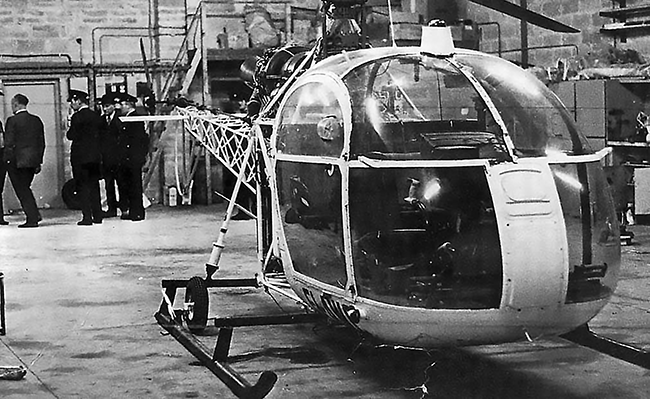
• The Aérospatiale Alouette II helicopter used in the spectacular escape from Mountjoy Jail
Chopper escape from Mountjoy
By Seán Mac Brádaigh
Halloween 1973 in Dublin; one of the most audacious, cleverly planned jail escapes in Irish history occurred when three political prisoners – JB O’Hagan, Séamus Twomey, and Kevin Mallon – were lifted by helicopter from the exercise yard of Mountjoy Jail’s D Wing at 3.40pm to the cheers of other prisoners and to the bitter embarrassment of the 26 County coalition government.
As the hijacked helicopter landed in the yard to collect the three Republicans, one screw was heard to shout vainly and ludicrously “shut the gates”.
Another Republican prisoner who was incarcerated in Mountjoy at the time of the escape wrote in particular reference to one of the escapers, Séamus Twomey, “One shamefaced screw apologised to the Governor and said he thought it was the new Minister for Defence arriving. I told him it was our Minister of Defence leaving.”
In Belfast, bonfires blazed in celebration of the event while over 300 Garda detectives searched hundreds of homes in Dublin in a vain attempt to track down the escapers. A typically downbeat IRA statement referred to the Mountjoy escape at the end of a list of IRA operations against the British crown forces: “Three Republican prisoners were rescued by a special unit from Mountjoy Prison on Wednesday. The operation was a complete success and the men are now safe, despite a massive hunt by Free State forces.”
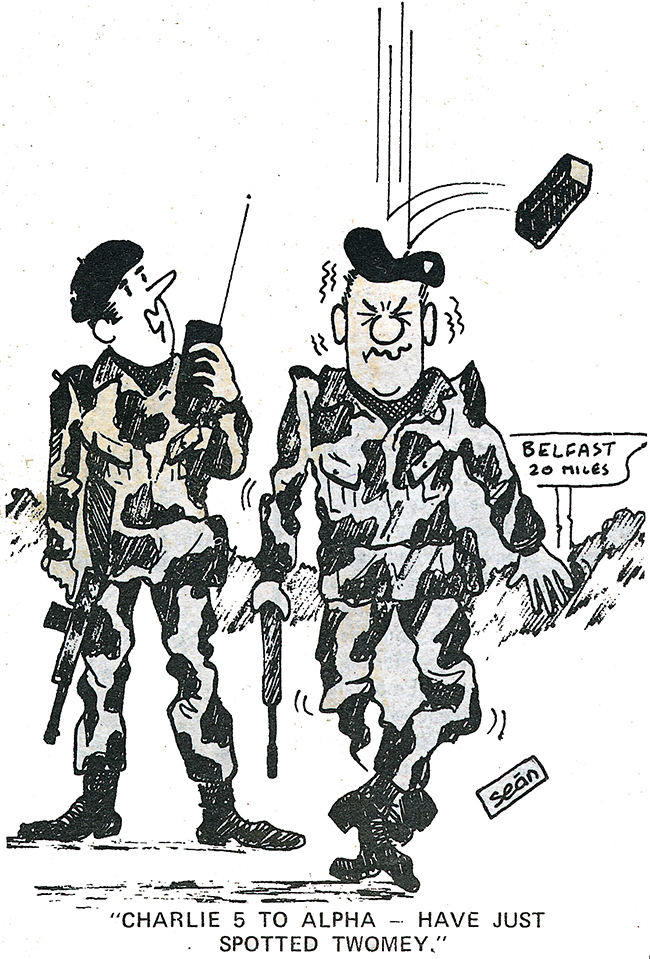
The escape was a great morale boost for Republicans throughout Ireland and abroad and a bitter disappointment for British political and military leaders who were attempting militarily to suppress Republican resistance in the Six Counties. It was also a cause of deep embarrassment for the Cosgrave coalition in Dublin, widely regarded as the most repressive 26 County administration since the 1940s. This was a government which was a self-proclaimed ‘law and order’ regime and which was making a particular crusade of suppressing support for the Republican cause in the 26 Counties.
On the day following the escape, a conference of military and Garda security chiefs took place in Dublin. Top of the agenda was how to ensure that such an occurrence could never take place again. At the same time, a judicial inquiry into the State’s ‘security system’ was initiated by the Dublin government.
The Mountjoy helicopter escape became one of the most celebrated jail breaks of all time and has been immortalised by the highly popular ‘Helicopter Song’, which contains the memorable lines: “It’s up like a bird and over the prison, There’s three men a missing I heard the warder say”.
The Great Escape from the H-Blocks
By Mícheál Mac Donncha
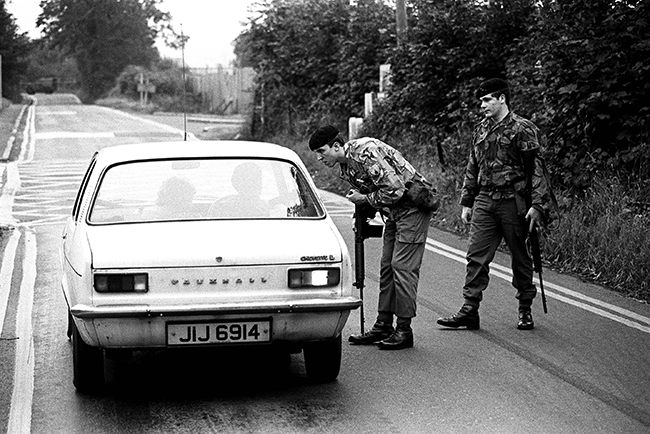
• British troops at scene of 1983 H-Blocks escape
Two years after the epic 1981 H-Block Hunger Strike in which ten young Republicans died, there was another epic event at Long Kesh that dealt a huge blow to the Thatcher regime in Ireland. This was the escape of 38 IRA prisoners from H-Block 7 on Sunday 25 September 1983.
At 2:15pm, three prisoners, carrying concealed pistols fitted with silencers which had been smuggled into the prison, moved into the central administration area of H-Block 7 on the pretext of cleaning out a store.
They were joined by four others who took up key positions covering prison officers (or ‘screws’, as the prisoners called them) stationed beside alarm buttons. Brendan ‘Bik’ McFarlane (IRA Officer Commanding in the H-Blocks during the Hunger Strike) was allowed through two locked grilles on cleaning duties. His job was to arrest the prison officer there.
When a signal was given, the IRA prisoners overpowered and arrested all the screws, whose uniforms were then donned by a number of the prisoners. Complete control of H-Block 7 was gained when ‘Bik’ McFarlane, with two prisoners dressed as screws, arrested the officer on duty at the front gate enclosure.
When the food lorry arrived, 37 prisoners climbed into the back while the 38th lay on the floor of the cab, covering the driver with a gun.
The food lorry was then driven through a series of security gates in full view of prison guards and British Army watchtowers. The use of the food lorry led to the most memorable wall slogan celebrating the escape: “Open up the Long Kesh gate – Meals on wheels for 38!”
The lorry arrived at a first ‘tally hut’, where the plan was to take control, arrest all the screws, leave prisoners in charge, and drive the lorry on to the front gate ‘tally hut’ and then out of the prison to freedom. However, there was a larger number of screws than anticipated at the first hut, where others were coming on and off duty. The escapers could not control them all and the alarm was raised.
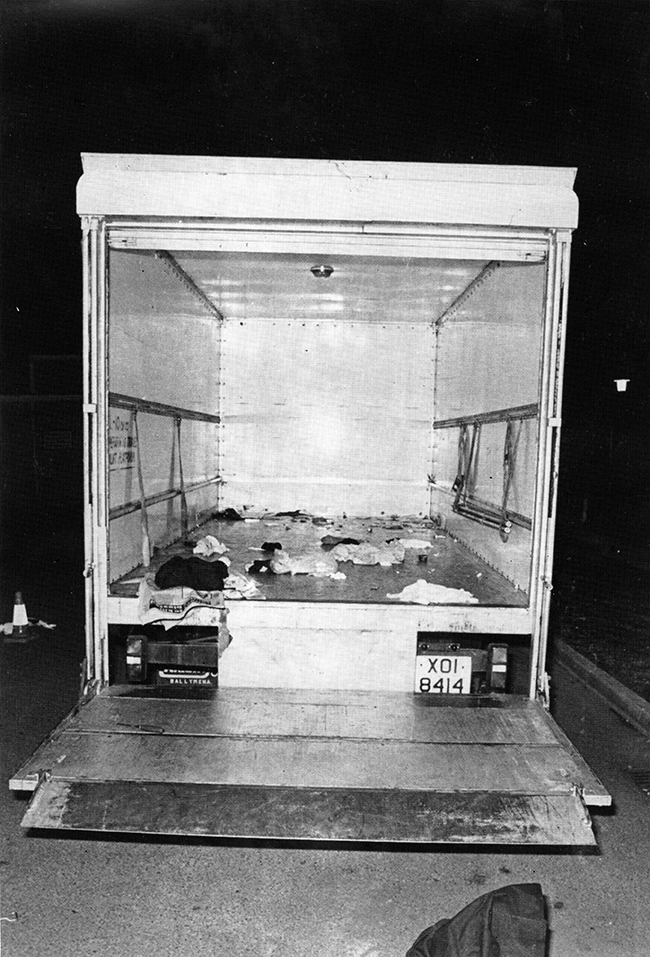
• 38 Republicans POWs broke out in a food lorry
Now unable to use the lorry, the prisoners made a dash for freedom across the fields, some of them commandeering vehicles. Of the 38 prisoners who broke out, 19 were recaptured while 19 got clean away.
In an interview in An Phoblacht/Republican News at the time, the IRA described the escape, “We perceived the escape as a military operation from beginning to end. It could not have been achieved in any other way, and the Active Service Unit – as Volunteers of the Irish Republican Army – were under strict orders throughout from an operations officer whose judgement was crucial and whose every order had to be obeyed.”
A number of the 19 escapers later died on active service with the IRA, while others were extradited back to prison in the Six Counties.
The escape remains one of the most significant IRA operations of the entire conflict. Thatcher described it as “the gravest in our prison history”. Lord Colville, a senior British judicial figure who conducted a report into the escape, had to admit:
“One cannot fail to admire the competence of an organisation which enables the prisoners of war to bring to fruition an escape plan which, apart from last-minute calamities, was largely successful”.
IRA Jailbreaks a long tradition
By Brian Mac Domhnaill
Published 29 September 1983
THERE has been a long tradition of IRA jailbreaks which stretches back over more than six decades.
1981: The one immediately prior to the mass breakout from the H-Blocks of Long Kesh displayed similar ingenuity and courage. On 10 June 1981, eight remand prisoners in Crumlin Road Jail shot their way to freedom and managed to evade arrest or injury despite coming under heavy fire from RUC and British Army personnel stationed opposite the jail in Crumlin Road Courthouse.
1980: A year earlier, on 16 December 1980, Gerard Tuite managed, with the aid of two non-political prisoners, to escape from the top-security wing of Brixton Prison in England.
1977: The Dublin government suffered severe embarrassment in the Special Court when, on 15 July 1977, four prisoners escaped after explosives blew a hole in the wall. Although three were caught in the vicinity of the court, the fourth, Michael O’Rourke, succeeded in escaping.
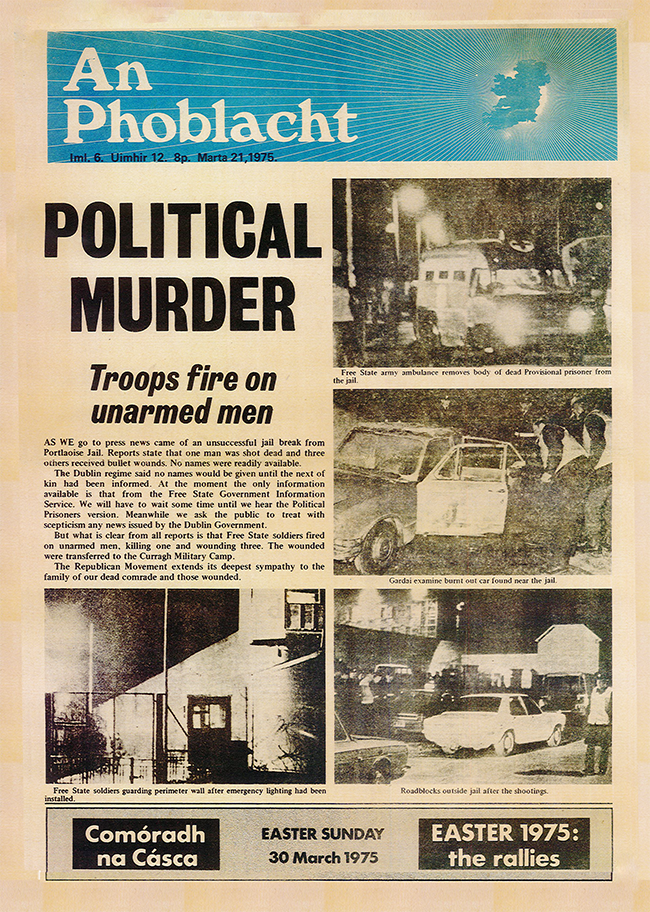
1975: An escape planned for Portlaoise Prison in March 1975 failed, with IRA Volunteer Tom Smith shot dead by troops guarding the jail. Elsewhere the same month, there was a successful escape when 12 prisoners broke free from Newry Courthouse. Ironically, the prisoners were being tried for previous attempted escapes. Two of the men were quickly recaptured but the remainder got away.
Magilligan Camp also lost a few prisoners in 1975, including Tyrone man Martin Monaghan whose resemblance to a teacher in the camp prompted prisoners to take over a class and dress Monaghan in the teacher’s clothes. Without any bother, he then walked to freedom, as did Derry man Patrick O’Hagan and Toomebridge man Malachy McCann who hid in a laundry basket and when this was brought to the laundry both escaped through a window and left the camp.
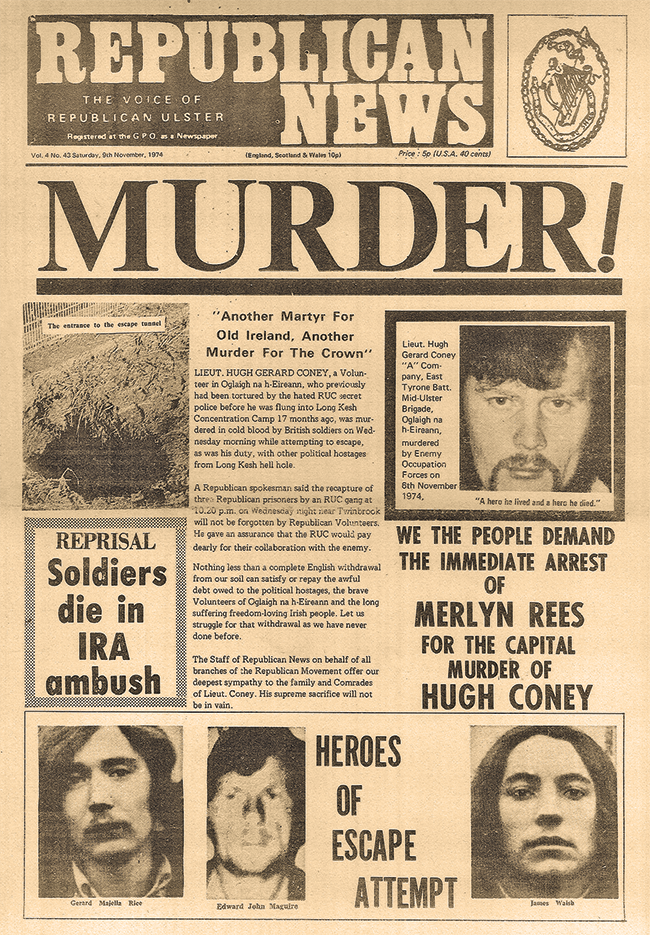
1974: In November 1974, a mass break-out from Long Kesh by 33 prisoners using a tunnel witnessed the death of Volunteer Hugh Gerard Coney, who was shot dead by British soldiers concealed in a secret observation post. As the prisoners had to escape on foot, all were captured within hours.
Other individual escapes in 1974 included that of Owen Coogan in July. Following the pattern of a previously successful escape, he left the prison camp in a refuse lorry. When he was ‘dropped off’, he stripped to his running shorts and sneakers, pretending to be a jogger. Unfortunately, his performance did not convince a British Army patrol and he was recaptured.
Belfast man William ‘Blue’ Kelly had more luck when, with the help of two comrades, he cut his way out of Long Kesh. As they finished their task, on a miserable night, a British patrol arrived on the scene. They failed to notice Kelly as they rearrested his two comrades and he managed to get away.
The most successful breakout of 1974 was without doubt, the 18 August mass escape from Portlaoise. A total of 19 prisoners got quickly away through a hole blown in the wall. For days, the gardaí searched high and low, occasionally announcing that arrests were imminent as they looked in the wrong places.
1973: Nor were republican prisoners idle in 1973, which witnessed yet more escapes from Long Kesh, including separate escapes by Brendan Hughes in December and John Francis Green in September. Hughes, who later led republican prisoners in the 1980 hunger-strike, made use of the refuse truck and was, along with several tons of rubbish, dumped in a tip-head at Dromara, County Down, and from there returned safely to Belfast.
Green, on the other hand, used a visit by his brother Gerard, a priest, to change garb and leave as his brother had come in. Nobody recognised that he was not the same priest until some time later when Gerard was found tied up within a compound. John Green was later assassinated by SAS men who crossed into County Monaghan to kill him.
In September, Eamonn Campbell was dressed only in pyjamas when he broke away from his captors in the Royal Victoria Hospital, West Belfast, where he had been sent for treatment. He was forced to jump through a plate glass window to make his escape, but his plans almost ended in disaster when a passing motorist gave him a lift and presuming he was sick, drove back into the RVH before being told that this was not quite what Campbell had intended. All ended well and yet another prisoner was whisked away to freedom.
The late Jim Bryson of Belfast was one man who could not stomach imprisonment as was shown in February 1973 when he escaped from captivity in Crumlin Road Courthouse. His four guards were somewhat at a loss when Bryson produced a revolver and after forcing one of them to strip, escaped through a window dressed as a screw.
Escape was easier for John Francis Green, a prisoner in Long Kesh, when, also in February, he availed of something more than spiritual comfort when a group of clerics visited the camp. After putting on a dog-collar and pious air, he walked with the group to freedom.
Renovation work often provides a ready means of escape as Daniel Keenan, a prisoner in Magilligan, found out. He simply lay in a skip which workmen in the camp were using and left with them.
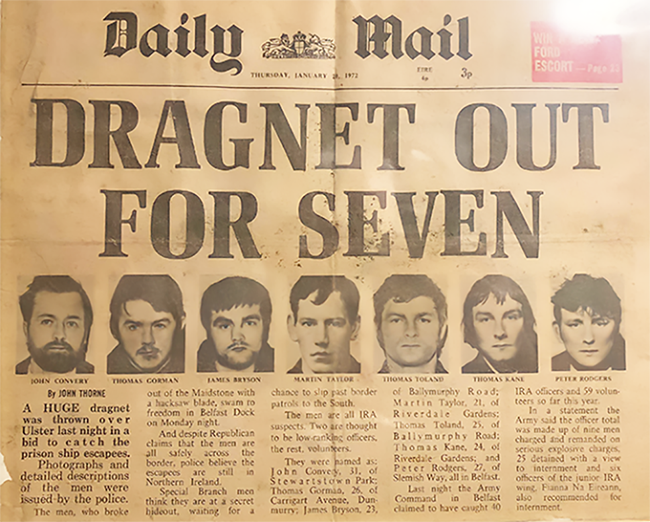
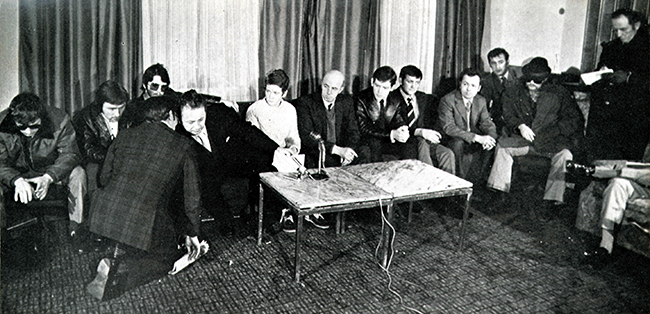
1972: Besides the escape of James Brown, who was being held under guard at Lagan Valley Hospital, 1972 witnessed one of the hardest and most daring escapes when the ‘Magnificent Seven’ captured the headlines with their escape from the prison ship Maidstone. Covered in grease, the men, including Jim Bryson, swam through icy waters, having to avoid the barbed wire surrounding the ship, until they reached the shore. There, after hijacking a bus, they headed for the Markets area and later to West Belfast.
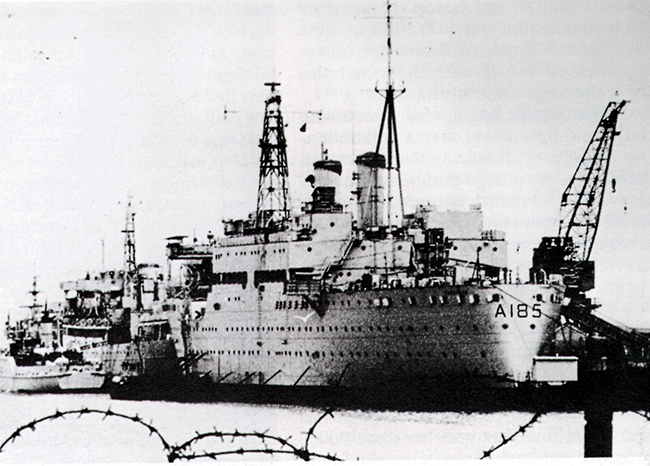
• (above) The 'Maidstone' and (below) 'The Magnificent Seven' escapers speaking at a press conference in Dublin
1971: There was serious overcrowding in Crumlin Road Jail in December 1971, with more than 900 inmates in the building. Perhaps to ease this congestion three prisoners, Martin Meehan, ‘Dutch’ Doherty and Hugh McCann made their exit by hiding under a manhole in the exercise yard and then, under cover of darkness and a thick fog, climbing over the wall.
A month earlier, in an escape remembered in folk song ‘Crumlin Kangaroos’ by Wolfhound, 11 prisoners, dressed in football gear, cut short a football match by clearing the walls of the prison and escaping in two waiting cars.