

31 August 2023 Edition
Letting people have their say on Ireland’s future
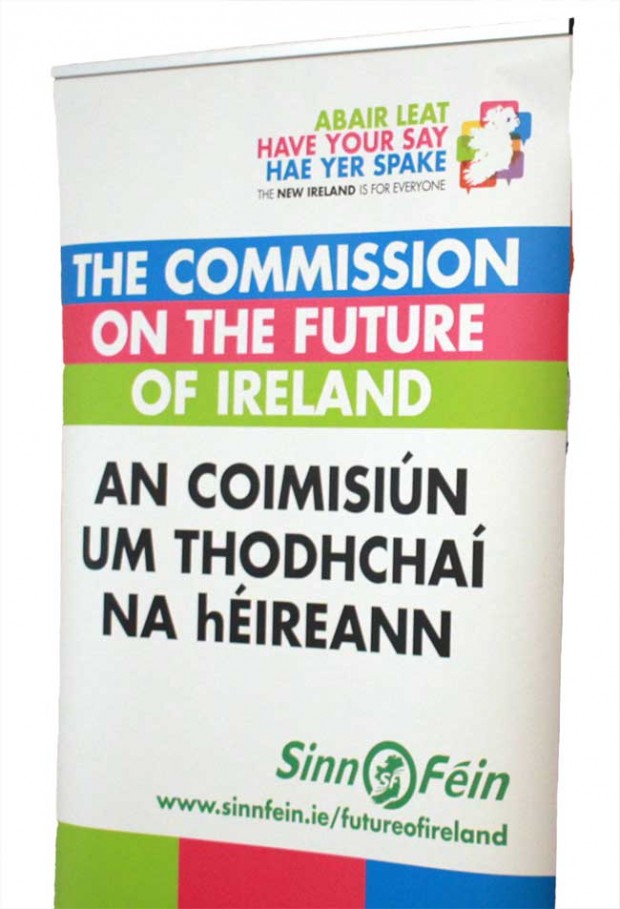

As the People’s Assemblies organised by the Commission on the Future of Ireland moved onto their next stage, Emma McArdle reflects on the elements that help make an excellent engaging political discussion.
Ingredients:
Enthusiastic and informed participants
A Room
A Facilitator – high quality in this ingredient is essential!
Materials
A Feedback Mechanism
Step 1 – Put the enthusiastic and informed people in a suitable room
Step 2 – Provide engaging materials to stimulate discussion
Step 3 – Let the Facilitator work their magic
Step 4 – Marinade for approx. 2 hours
Step 5 – Observe the amazing dynamism, energy, and fresh ideas which are generated
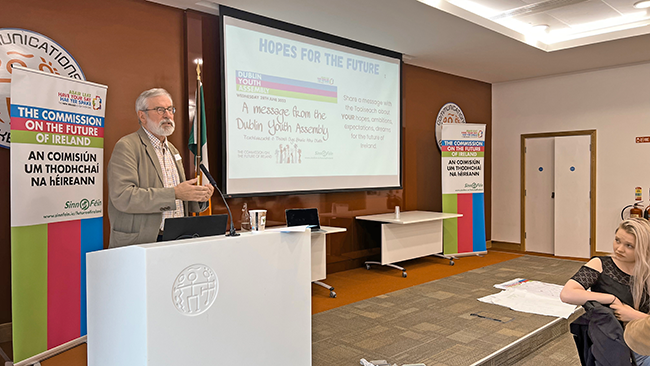
• Gerry Adams speaks at the recent youth session of the Commission on the Future of Ireland in Dublin
Prior to June 2023, Sinn Féin’s Commission on the Future of Ireland had focused its energies on running a series of very successful People’s Assemblies.
Four such meetings have taken place to date in Belfast, Derry, Donegal, and Louth and two more are planned for Waterford in October and the Connemara Gaeltacht in November.
The nature of People’s Assemblies is that they are large in scale and are open to any member of the public to attend. The meetings feature a chairperson and a panel of speakers, but the style of the meeting is discussion focussed with an equal balance between comments from panel members and audience participation.
In June, the Commission pivoted to organise two sectoral events – the Belfast Women’s Assembly and the Dublin Youth Assembly.
These events had a totally different style and method to the previous meetings, but the basic premise was the same – letting people have their say on the future of Ireland.
The Belfast Women’s Assembly took place in the Europa Hotel, and over 140 women from across the wider Belfast area joined in the discussion about what a new united Ireland would mean for them.
Women from diverse backgrounds and political persuasions were there, contributing and sharing experiences and ideas generously. Belfast remains a divided city and, in the past, many might have had reservations about attending a political party event, but this meeting was oversubscribed within days of its announcement.
The event chairperson, the calm, competent, and positive Eilish Rooney, ensured that all voices were heard and the questions she posed to the women in the gathering were engaging and thought provoking. Eilish’s decision to include the question ‘What parts of the Union do you want to retain?’, is evidence of the mature and respectful discussion which characterised the event.
The Dublin Youth Assembly took place in the Communication Workers Union headquarters and while it was a smaller event, with 50 people attending, the buzz and energy and positivity was evident from the outset.
For many of the young participants, it was the first time they had really considered the question of Irish unity and the effect that it could have on the nation and on them.
The star of the show on this occasion was the lead facilitator Daisy O’Brien. Daisy is a youth leader of many years’ experience and it showed. He was effervescent and the young people responded to his energy with zeal of their own.
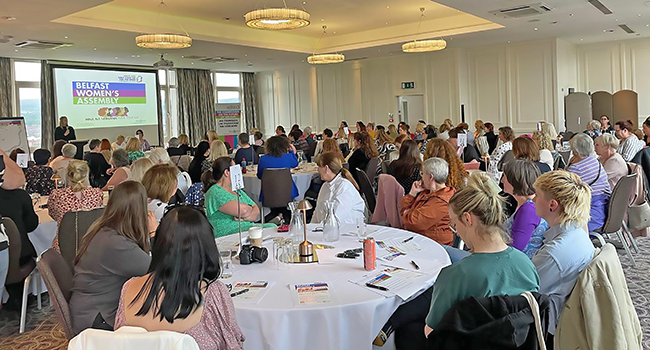
• Belfast Women's Assembly
The round table nature of the discussion at the Youth and Women’s Assemblies meant that everybody who wanted to had numerous opportunities to speak. The dynamic generated within a small group is interesting to observe – the over and back around the table enables participants to hear new concepts or to see things from an alternative point of view. It is also easier for many people to speak to a table of 8 or 10 instead of a room of 200.
As with many events looking towards the future, participants at the Women’s and Youth Assemblies were frustrated with the dreaminess of ‘the future’. Exasperation was expressed around the lack of detail and the absence of a plan to help navigate from ‘now’ to ‘then’. People were incredulous and angry regarding the lack of planning which has been undertaken by the southern government.
Seanadóir Lynn Boylan, who is vice chairperson of the Commission and who addressed both events, said, “There is an urgent imperative for the Irish government to establish a Citizens’ Assembly to begin the work of planning for the future. It should work with the British government to set a date for the unity referendum provided for in the Good Friday Agreement.”
And that’s what it always comes back to, the Good Friday Agreement and the inclusion within of the mechanism to achieve Irish unity – the referendums.
The road to the referendums is only unclear because the government in Dublin don’t want to travel that path. They want to halt discussions and stymie plans for Irish unity. There are many reasons for this, but self-preservation trumps them all.
Speed on the day a government rules in Dublin in the interests of the Irish nation and all of the people who call this island home.
In addition to the Waterford People’s Assembly which will take place on 12 October and the Connemara Gaeltacht Assembly which will occur on Monday 27 November, the Commission is hosting an event ‘Exploring northern Protestant identities & culture in a shared future’ in Derry on 13 September and a ‘Rural Communities in a New Ireland’ event at the Ploughing Championship on 21 September.
For further information on the work of the Commission, please see www.sinnfein.ie/futureofireland
• Emma McArdle is a Campaign and Policy Manager on Sinn Féin’s Uniting Ireland project.