


21 February 2016
Irish Republican Brotherhood recruiting inside the British Army
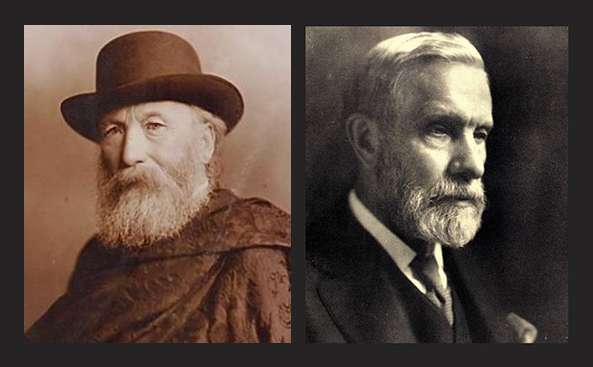
● James Stephens and John Devoy
DURING THE EARLY 1860s, strenuous efforts were made by the Fenian movement to infiltrate regiments of the British Army stationed in Ireland by recruiting soldlers into the Irish Republican Brotherhood.
In addition to widespread recruiting by the IRB among the civilian population and the mobilisation of American support in the form of arms and men for an invasion of Ireland, great efforts were made by James Stephens, the 'Fenian Chief' and founder of the IRB, to infiltrate the British Army.
By recruiting large numbers of British soldiers, particularly Irish men attached to regiments stationed in Ireland into the IRB, Stephens believed that when the time came for a rising these men could mutiny, cause havoc among the army of occupation and desert, bringing with them their expertise and weapons for deployment by the army of the Irish Republic.
The principal and most successful IRB recruiting officers during this period were John Devoy, John Boyle O'Reilly, Patrick 'Pagan' O'Leary and William Roantree. During the following years it is estimated that 15,000 soldiers were recruited into the organisation, the majority of them in Dublin, Kildare (near the vast Curragh military camp) and the garrison towns in the midlands.
O'Leary was a colourful character who deplored the influence of St Patrick and Christianity on the Irish people. He alone was said to have recruited several thousand soldiers, mainly In the Midlands, into the IRB. Roantree (whose 'Centre' around Leixlip in County Kildare with 2,000 men was one of the largest in Ireland) concentrated on recruiting soldiers stationed at the Curragh.
Devoy carried out the risky business of swearing soldiers into the Fenian Brotherhood, especially those in the Dublin garrisons. At the suggestion of Devoy, O'Reilly actually joined the British Army so as to be in a better position to have direct access to potential recruits. In 1864, he enlisted in the 10th Hussars, stationed in his native Drogheda, and during the following two years he brought hundreds of soldiers into the IRB.
One of the first prominent recruiting officers to be captured was Roantree, who was arrested in September 1865 in the raids after the suppression of the Fenian newspaper, The Irish People, and was sentenced to ten years' imprisonment.
Both Devoy and O'Reilly were arrested in February 1866 in the huge swoops that followed the suspension of Habeas Corpus. Sentenced to long terms of imprisonment, they were respectively sent to jalls in England and transported to Australia.
O'Leary, however, managed to evade capture until 1867, when he was arrested in Athlone while administering the Fenian oath to a soldier and was sentenced to several years' imprisonment.
Following the arrest of Devoy and O'Reilly, and fearing widespread infiltration of the British Army by the IRB, large numbers of Irishmen serving in regiments throughout Ireland and England (where Fenian recruiting officers were also active) were transferred to regiments stationed abroad.
Five days after the suspension of Habeas Corpus, John Devoy, a prominent Fenian recruiting officer, was arrested on 22 February 1866 – 150 years ago this week.
Follow us on Facebook
An Phoblacht on Twitter
An Phoblacht Podcast

Uncomfortable Conversations
An initiative for dialogue
for reconciliation
— — — — — — —
Contributions from key figures in the churches, academia and wider civic society as well as senior republican figures