


16 February 2016
British minister Villiers's self-serving speech on anniversary of Pat Finucane murder provokes anger
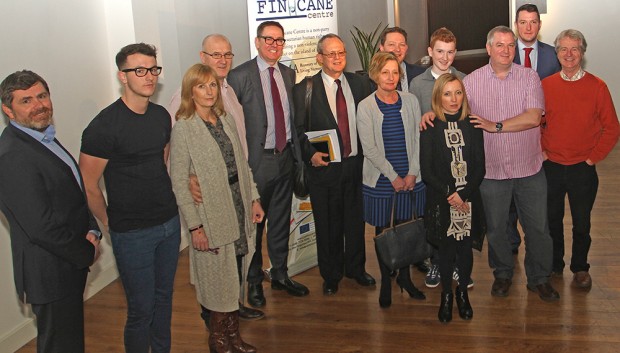
• Members of the wider Finucane family and representatives of Relatives for Justice

THE ASSASSINATION of human rights lawyer Pat Finucane was being marked by upwards of 300 people gathered in Belfast's Europa Hotel on 11 February, the eve of the 27th anniversary of Pat's murder by a unionist death squad infiltrated if not run by British state agents. Across the city, British Secretary of State Theresa Villiers delivered a keynote address in which she set out to airbrush the role of the British Government in the conflict in the North.
Geraldine Finucane, Pat's wife, however, addressing the anniversary event, challenged the British state.
She said:
“I want the British state and its government to accept their obligations with regard to the past in Ireland and the wrongs they have committed.
“In simple terms, I want what everyone who has lost a relative wants. Nothing will bring our loved ones back. They are gone forever but their legacy is not.
“It is in the name of that legacy that I and so many others ask for the one remaining thing that the British state can give us – the truth behind the killings.
“If they accept their responsibility in that then not only will they give us justice but they will also give our lost loves their well-deserved rest.”
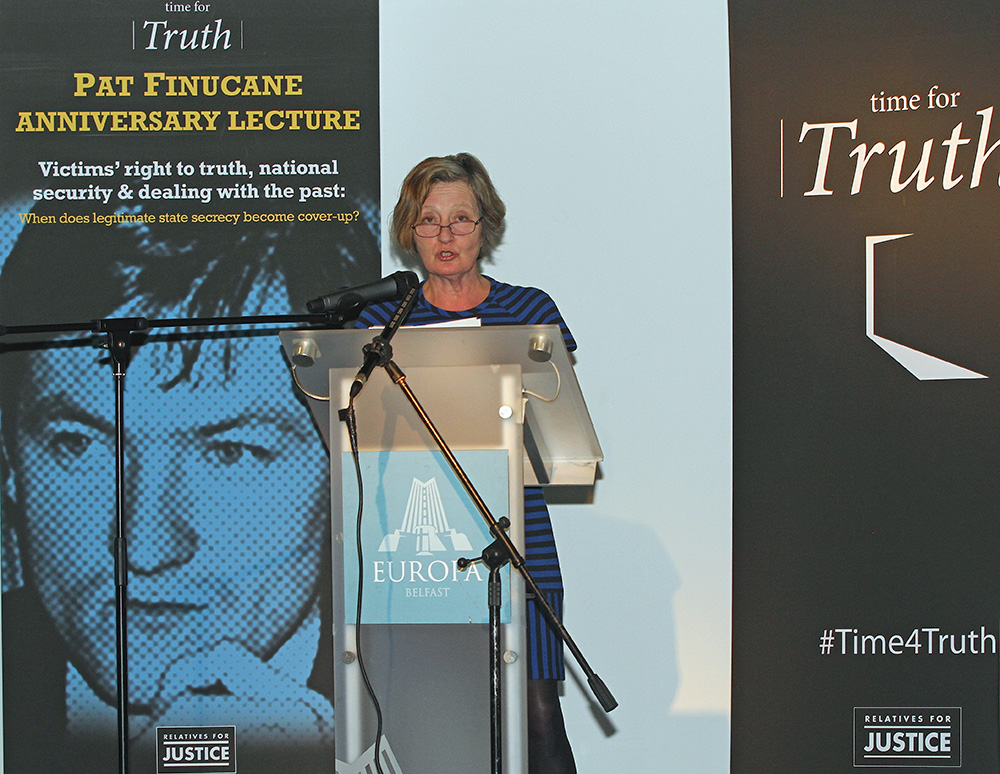
• Geraldine Finucane addresses the audience
The Guatemalan human rights lawyer and former UN Special Rapporteur on the Freedom of Expression, Frank La Rue, dismissed the idea that “national security” interests should be used by the British Government to justify withholding of information from families of victims.
La Rue has advised governments on the Tshwane Principles, on national security and disclosure, to which the British Government is a signatory.
Among other points, Principle 4 states:
“Governments should never withhold information concerning violations of international human rights and humanitarian law, including information about the circumstances and perpetrators of torture and crimes against humanity, and the location of secret prisons. This includes information about past abuses under previous regimes, and any information they hold regarding violations committed by their own agents or by others.”
Principle 5 states:
“The public has a right to know about systems of surveillance, and the procedures for authorising them.”
Both the main speakers at the Pat Finucane event, Frank La Rue and Paul Seils, who are renowned for their work in the field of human rights and truth recovery, were clear in the view that national security concerns are not justifiable grounds for a government to withhold information from families of victims.
That same evening, in the speech made by Theresa Villiers to a handpicked audience at the University of Ulster's York Street campus, th minister maintained that the British Government would decide on the grounds of “national security” what information it would make available to the families of people killed in the conflict.
Villiers also dismissed what she called the “pernicious counter argument” that highlighted the role of the British Security Service MI5, British Military Intelligence and the RUC as major actors in the conflict rather than 'neutral' peacekeepers.
Representatives of Relatives for Justice, the Pat Finucane Centre and family members of people killed by state forces, including by loyalist death squads as part of the policy of collusion, were angered at the Tory minister's insistence that the British Government would retain a veto on the information that would be accessible to families.
Emma Rogan, whose father is one of six nationalists killed by the UVF in the 1994 Loughinisland attack, slammed Villiers over her statement that “It wasn't the RUC or [British] army that pulled the triggers at Loughinisland.”
Emma Rogan countered: “It was the British Army that imported the weapons – it was RUC agents who pulled the triggers!”
See more pictures »
Follow us on Facebook
An Phoblacht on Twitter
An Phoblacht Podcast

Uncomfortable Conversations
An initiative for dialogue
for reconciliation
— — — — — — —
Contributions from key figures in the churches, academia and wider civic society as well as senior republican figures