

10 December 2015
‘Fair Recovery’ agenda should be common ground across Ireland and Britain

CUTS TO PUBLIC SERVICES, job losses, dismantling of the welfare state, and political disregard for the special circumstances of the North are the hallmarks of the present British Government’s agenda.
This Tory doctrine is being reinforced with levels of political authoritarianism not witnessed since the Thatcher era, and an increased role for the British military and security establishment has become central to setting state policy.
The most pernicious byproduct of the Tory austerity and authoritarian agenda is the Trade Union Bill currently before the Westminster parliament.
Today, the Scottish Trades Union Congress (STUC) is hosting a high-profile demonstration of anti-austerity unity and support for workers’ rights at a public rally in Glasgow involving First Minister Nicola Sturgeon, Labour Party leader Jeremy Corbyn and Greek economist Yanis Varoufakis. It will specifically focus on the Trade Union Bill.
Last week, the NI Committee - Irish Congress of Trades Unions (NIC-ICTU) set out its position on the Stormont House/‘Fresh Start’ Agreement.
It expressed the trade union movement’s support for the political institutions and the restoration of political stability in the North. It recognised that the British Government’s responsibility for the austerity crisis in the North contributed directly to the increased political instability in recent years and that the Irish Government has failed to live up to its responsibility as a co-guarantor for both the peace and political processes.
The trade unions also set out their concerns about economic and financial elements of the Agreement, including Corporation Tax and the Voluntary Exit Scheme.
Importantly the NIC-ICTU position paper outlined a number of constructive strategic proposals which can contribute to the restructuring of the regional economy and help limit the imposition of austerity by encouraging economic growth and a fair recovery.
Sinn Féin is committed to a sustained engagement with NIC-ICTU on these ideas and would encourage all political parties and civic society to do likewise.
The election of a majority Conservative Party government in Britain and the implications of that have changed everything for the North, so the regional economic and social policy paradigm must now also be changed.
That means effectively targeting patterns of inequality and the under-investment and economic underdevelopment west as well as east of the Bann.
The local trade union movement – and the other civic stakeholders, including the business and employers’ organisations – should be actively involved in helping to shape future manufacturing, industrial, investment and training policy and strategies for the North.
Sinn Féin is already committed to working closely with the trade unions and other sectors in the North and across the island to oppose austerity and build support for a fair recovery.
However, the success of that will depend upon mobilising maximum political and social solidarity. Political sectarianism or opportunism from the negative Left and within some sections of social democracy makes no constructive contribution to securing that objective.

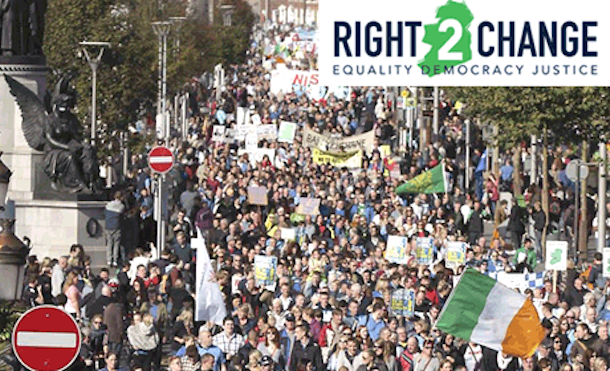
Right2Change has emphasised the importance of common ground and alliances in the 26 Counties. Maximum cross-community and sectoral solidarity against the austerity crisis in the North is also crucial.
A ‘Fair Recovery’ agenda should be common ground for civic society and progressive parties across Britain and Ireland. The regional executives of Scotland, Wales and the North of Ireland should now provide joint political leadership on the importance of maximum solidarity and co-ordinated opposition to austerity by the trade union congresses, churches, and regional businesses, employers and voluntary organisations.
The example set by the STUC in hosting its Glasgow meeting could be replicated with a similar initiative in Belfast.
A positive axis against austerity, spearheaded by the regional executives of Scotland, Wales and the North of Ireland – supported by the British Labour Party, the TUC in Britain, the Irish Congress of Trade Unions, Right2Change, and other civic stakeholders – would be a game-changer.
This would represent a powerful challenge to the negative status quo which is ascendant in Britain and Ireland.
It could be the catalyst for a new progressive roadmap.
Follow us on Facebook
An Phoblacht on Twitter
An Phoblacht Podcast

Uncomfortable Conversations

An initiative for dialogue
for reconciliation
— — — — — — —
Contributions from key figures in the churches, academia and wider civic society as well as senior republican figures