


3 October 2014
Fine Gael MEPs let Israel off the hook for bombing EU infrastructure in Gaza
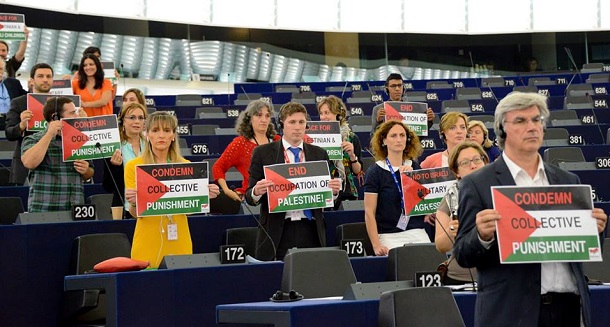
GUE/NGL MEPs (including Sinn Féin MEPs) protest at the European Parliament in Strasbourg

FINE GAEL MEPs in the European Parliament have voted against an amendment which demanded Israel pay reparations to the EU for destroying EU-funded projects during its 50-day bombing blitz of the besieged Gaza Strip.
Over 2,100 people, mainly civilians, were killed during Israel's bombing campaign during July and August.
The attacks also caused $5billion in damage and destroyed infrastructure funded by European taxpayers.
Sinn Féin Senator Kathryn Reilly asked:
“Is it not proper that all Irish MEPs demand at EU level that Israel be made accountable for the destruction of EU-funded infrastructure funded for by Irish taxpayers?"
The amendment was tabled by Sinn Féin MEP Martina Anderson and three other MEPs on behalf of the GUE/NGL group sought to include reparations in the 'Joint motion for a resolution on Israel-Palestine after the Gaza war and the role of the EU'.
It demanded "reparations from Israel for the EU-funded projects destroyed during repeated aggressions in both Gaza and the West Bank".
Senator Reilly called on Irish MEPs who voted against the amendment on 18 September, including the four Fine Gaelers and Independent Marian Harkin (Brian Crowley abstained), to explain why they felt Israel should not have to bear any of the cost for rebuilding EU infrastructure it destroyed or seriously damaged during its aggression in the region.
"It's a twisted situation where Israel is continuously allowed to obliterate EU-funded infrastructure with impunity, but be held accountable for none of the cost in its redevelopment," she said.
The same Irish MEPs also opposed another amendment which would have banned weapons exports to Israel from the EU, along with the importation of weapons to the EU from Israel.
Follow us on Facebook
An Phoblacht on Twitter
An Phoblacht Podcast

Uncomfortable Conversations

An initiative for dialogue
for reconciliation
— — — — — — —
Contributions from key figures in the churches, academia and wider civic society as well as senior republican figures