

26 August 2013
Reliving the Dublin Lockout 1913–2013 – Community re-enactment
Re-enactment schedule
State commemoration of 1913 Lockout followed by
COMMUNITY RE-ENACTMENT OF BLOODY SUNDAY
Saturday 31st August
11am Assembly points for community re-enactment participants
Dockers (men): Custom House
If coming as a docker, please wear dark trousers (not jeans or combats) with a belt or braces, collarless shirt with a muffler or handkerchief around the neck, dark waistcoat or jacket, hat or cap and dark shoes (no trainers).
Contact: Des Bonass 087 7925120
Jacobs Workers (women): Rear of Central Bank
If coming as a Jacobs worker, please wear a dark ankle-length dress or skirt, a light-coloured blouse and dark boots or flat shoes (no trainers). If possible, please wear a dark coloured or straw hat.
Contact: Patricia McCarthy 087 9172749
Poor of Dublin (men, women and children): Gloucester Diamond
Men, women or children coming as the ‘poor of Dublin’ should wear old, torn or shabby clothes (see notes for men and women above) and very old shoes (no trainers). Contact: Terrry Fagan 087 9210673
The audience may wear any of the above, or any Edwardian costume (such as those worn on Bloomsday).
For general enquiries on the re-enactment please contact Brian Treacy on 086 2536130
Timetable
11.45am Leave assembly points and proceed to O’Connell Street, gather at Clery’s and across the road
12 noon Assemble for state commemoration
12.30pm State commemoration starts
1.30pm Wreath-laying ceremony at Larkin statue
1.45pm Transition to Community re-enactment
2pm Re-enactment of ‘Bloody Sunday’
2.30pm Re-Enactment participants move to Foley Street
3pm Unveiling of plaque for those who died
3.30pm Soup kitchen and fleadh in Foley Street
Remembering 1913 in 2013
A full listing of events commemorating the 1913 Dublin Lockout is available at www.1913committee.ie
Below are a few highlights:
August 27th – 31st, 8pm
James Plunkett’s The Risen People will be performed by the East Wall PEG Variety And Drama Group – East Wall Community Centre, St Mary's Road, East Wall
SATURDAY 31st AUGUST
RE-ENACTMENT OF ‘BLOODY SUNDAY’
O’Connell Street
Tuesday, September 3rd
Premiere of new play on the Lockout by RADE
Smock Alley Theatre, Temple Bar
Contact [email protected] for further details
Saturday, September 14th
Plaque to be unveiled on Merchants’ Road, East Wall, commemorating the strikers’ families who were evicted by Merchant Warehousing in 1913
Saturday, October 5th – Monday October 7th
Re-enactment of the arrival in Dublin of the SS Hare, a food relief ship commissioned by the National Transport Workers’ Federation in 1913 help feed starving Dublin workers. To mark this event, when British workers came to the aid of their Irish comrades, a ship sponsored by trade unions will set sail from the Liverpool docks to Dublin.
This information was provided with the support of Unite the Union
Why should we remember the 1913 Lockout?
IN 1913, many Dubliners were casual labourers working for starvation wages with no trade union representation. They lived in over-crowded tenements which were home to around a third of the population.
Poverty, overcrowding and lack of healthcare contributed to one of the highest infant death rates in Europe.
In 1909, James Larkin launched the Irish Transport and General Workers’ Union (ITGWU) to represent unskilled workers.
The employers reacted swiftly to this challenge, led by William Martin Murphy, President of the Dublin Chamber of Commerce, who owned the Irish Independent Group and controlled the Dublin Tramways Company.
In August 1913, Murphy offered his workers a stark choice: you can join a union or have a job.
When ITGWU members on the trams struck for higher wages he locked them out. Other employers joined Murphy, locking out any employee who refused to renounce the ITGWU and resign if they were already a member.
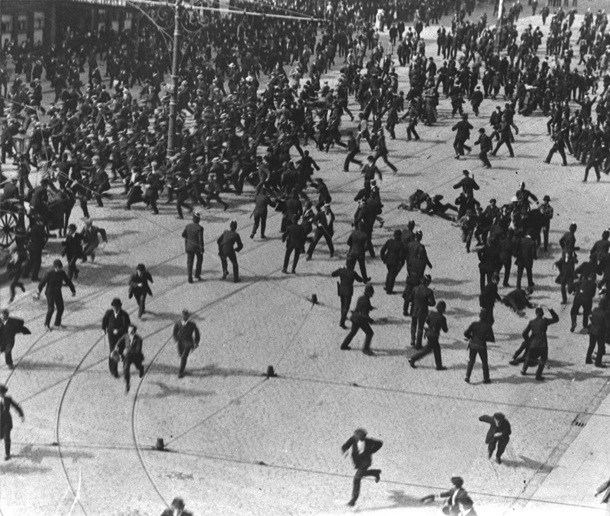
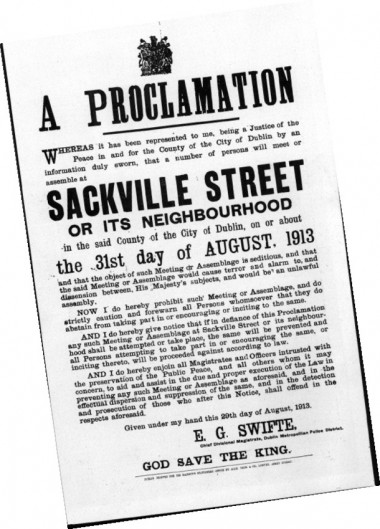
On Sunday, 31 August, Dubliners in O’Connell Street were baton charged by the police when Larkin attempted to address them. Up to 600 people were seriously injured.
Workers continued battling for their rights during the autumn and winter of 1913-1914.
Dubliners suffered immense hardship during this period, and many would have starved to death were it not for the help received from the Trades Union Congress, Co-operative movement, Labour Party, Socialist Party and other organisations in Britain who raised funds and sent food ships that enabled the ITGWU and Dublin Trades Council to feed trade unionists and their families.
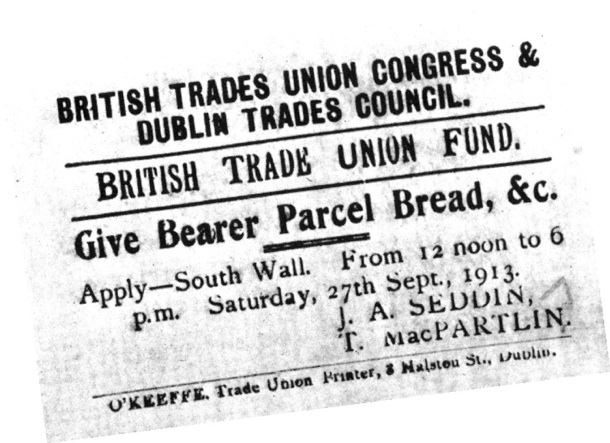
The odds were stacked against the workers, and in early 1914 many were forced back to work.
Although employers claimed victory, the workers of 1913 laid the groundwork for many of the rights that we today take for granted, ranging from holidays via health and safety rules to the minimum wage. However, the fundamental right to collective bargaining is still denied to Irish workers.
1913 and the Inner City
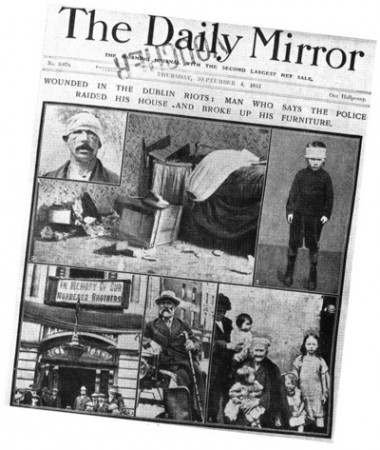
The 1913 Lockout was not just a Dublin event – it was above all an Inner City event. Not only did the majority of workers and their families live in tenements north and south of the Liffey, in areas such as Gardiner Street and Inchicore, but these areas also witnessed violent scenes as police officers stormed workers’ homes. The front page of the Daily Mirror (reproduced at the bottom this piece) shows the aftermath of one such raid, on Corporation Buildings on Foley Street.
The police baton charges on Sackville Street (now O’Connell Street), on August 31st 1913, were preceded by furious rioting in Ringsend, Pearse Street, and in the area around Liberty Hall, headquarters of the ITGWU. A food kitchen was established at Liberty Hall, Beresford Place – the site of the current building.
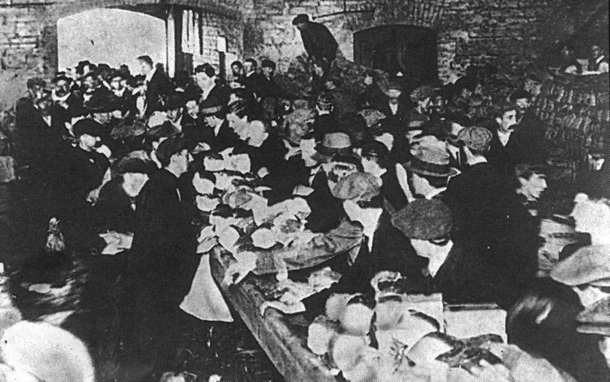
The Lockout covered hundreds of workplaces, including the Jacobs biscuit factory on Bishop Street, mainly involving women workers, and the city’s building sites.
For further reading see A Capital in Conflict: Dublin City and the 1913 Lockout, edited by Francis Devine and published by Four Courts Press.