


18 September 2012
Cuban 5 delegation meet Sinn Féin at Free Derry Wall
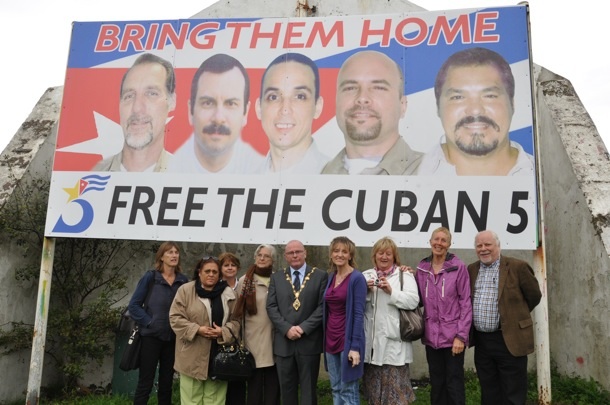
At Free Derry Wall (Photo: Charlie McMenamin)

Cuba waited for the FBI to start arresting the architects of these operations but, instead, on 12 September 1998, it arrested the Cuban Five – the very men who had come to Miami to monitor the activities of the violent Miami exile groups
THE CUBAN FIVE – Antonio Guerrero, Fernando Gonzalez, Ramon Labañino, Rene Gonzalez and Gerardo Hernandez – were imprisoned in the US for conspiracy to commit espionage in September 1998. The men had infiltrated Miami-based terror gangs composed of Cuban exiles which were plotting atrocities against the Caribbean island.
The five men were initially sentenced to life imprisonment plus 77 years but this was reduced after the UN Working Group on Arbitrary Detention ruled that their imprisonment violated Article 14 of the International Convention on Civil and Political Liberties
The men are still being held in US prisons.
Activists have highlighted the hypocrisy of the US authorities who claimed to be engaged in a “war on terror” yet at the same time imprisoned unarmed anti-terrorist officers who were collecting information on terrorists operating against civilians from US soil.
 Since 1959, anti-Cuban terror groups have
carried out thousands of bombings, shootings and arson attacks, leaving more
than 3,400 people dead and thousands more wounded. One of their most notorious
attacks was the bombing of Cubana Flight 455 which killed all 78 people
onboard. Most recently these groups are blamed for the firebombing of the
Airline Brokers’ offices in Coral Gables, Florida, on 27 April this year.
Since 1959, anti-Cuban terror groups have
carried out thousands of bombings, shootings and arson attacks, leaving more
than 3,400 people dead and thousands more wounded. One of their most notorious
attacks was the bombing of Cubana Flight 455 which killed all 78 people
onboard. Most recently these groups are blamed for the firebombing of the
Airline Brokers’ offices in Coral Gables, Florida, on 27 April this year.
A public meeting on the Cuban Five campaign will take place in Dublin at the Connolly Room, Liberty Hall at 6:30pm on 19 September.
Speakers at the event include Magali Llort; mother of Fernando Gonzalez and Dr. Haymel Espinosa; the daughter of one of the pilots of Cubana Flight 455 which was bombed by Miami-based terror groups in 1976 killing all onboard.
Cuban 5 Campaign Website
SINCE 1959, Cuba has been subjected to threats, sanctions, invasions,
sabotage, and violent attacks on its soil, resulting in 3,478 deaths and
another 2,099 wounded. It has thus developed vigilance against foreign
attacks.
In 1976, 73 people died when a bomb exploded aboard a commercial Cuban
airliner, destroying the plane in mid-air. The masterminds behind the
attack were two men of Cuban-origin, Orlando Bosch and Luis Posada
Carriles, former CIA operatives whom currently live in Miami.
In the early 90s, following the fall of the Soviet Union, Cuba was trying to establish a tourism industry. Soon after, the right-wing exile groups in Miami started a violent campaign targeting tourist hotels and resorts, buses, airports and other facilities to discourage foreigners from visiting the island nation. In 1997, as part of that campaign, a bomb exploded in the lobby of Havana’s Hotel Copacabana, killing Fabio DeCelmo, an Italian tourist. The Cuban authorities arrested Raul Ernesto Cruz Leon, a native of El Salvador who confessed to having been paid thousands of dollars by anti-Castro exile groups based in Miami to plant the bomb..
 Due to the lack of response from the FBI to stop
such attacks, Cuba sent the Cuban Five to Miami to monitor the
organizations perpetrating these acts of violence. The idea was to
gather information about similar acts that were in the planning stages
in order to derail them before they were carried out. The Five were able
to establish evidence implicating specific Miami exile groups and
individuals in the attacks.
Due to the lack of response from the FBI to stop
such attacks, Cuba sent the Cuban Five to Miami to monitor the
organizations perpetrating these acts of violence. The idea was to
gather information about similar acts that were in the planning stages
in order to derail them before they were carried out. The Five were able
to establish evidence implicating specific Miami exile groups and
individuals in the attacks.
In 1998 President Fidel Castro sent a personal emissary to Washington to deliver a hand-written note to President Bill Clinton, asking that the United States indict and prosecute those who committed crimes against Cuba. In his letter to Clinton among other things Castro said, “If you really want to do so, you can put a stop to this new form of terrorism. It is impossible to stop this terrorism without United States involvement . . . Unless it is stopped now, in the future any country could be victimized by this new terrorism.” President Castro’s personal emissary was none other than Gabriel García Márquez, the winner of the Nobel Prize for Literature. At the time President Clinton was out of town and after waiting for him for several days, García Márquez finally met with White House Chief of Staff Mac McLarty on May 6, 1998 and gave him the letter.
In the wake of the Garcia Marquez visit, the United States sent an FBI team to Havana a month later to discuss collaboration with Cuba on stopping acts of aggression emanating from Miami. At the meeting Cuba handed over 64 files containing the results of its investigation into 31 different terrorist acts and plans against the island in the decade of the 90s. The Cuban government enclosed details of operations against Cuba, including photographs of the explosives used.
Cuba then waited for the FBI to start arresting the architects of these operations but, instead, on 12 September 1998, it arrested the Cuban Five – the very men who had come to Miami to monitor the activities of the violent Miami exile groups.
After their arrest, the Five spent 17 months in solitary confinement cells. The trial took place in Miami and lasted 7 months. They were charged with 26 counts of violating the federal laws of the United States. 24 of those charges were relatively minor and technical offenses, such as the use of false names and failure to register as foreign agents.
The Cuban Five were sentenced to maximum prison terms. Gerardo Hernandez received a double life sentence and Antonio Guerrero and Ramon Labañino receive life sentences. The remaining two, Fernando Gonzalez and René Gonzalez, received 19 and 15 years respectively.
Follow us on Facebook
An Phoblacht on Twitter
An Phoblacht Podcast

Uncomfortable Conversations

An initiative for dialogue
for reconciliation
— — — — — — —
Contributions from key figures in the churches, academia and wider civic society as well as senior republican figures