Peace process: Most important issue facing Irish people
Sinn Féin President Gerry Adams has set out Sinn Féin's approach to the
reconvened Six County Assembly saying he intends to nominate DUP leader Ian
Paisley and Martin McGuinness for the positions of First and Deputy First
Ministers.
Speaking in Stormont on Wednseday the Sinn Féin President said it was an
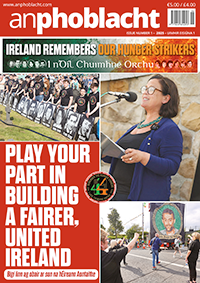
emotional week for Irish republicans. "Last Friday we marked the 25th
anniversary of the death of Bobby Sands. This Friday is the anniversary of
Francie Hughes. Their deaths and almost 50 others came during an immensely
challenging period in our history. As we remember that time and celebrate
the lives of these brave men we should also reflect on the hunger strikers
commitment to the future. That is essentially what the hunger strike was
about. That is also what we are about."
He said people should be under any illusions about the challenges and risks
facing the British and Irish governments and all of the parties in the
period ahead. Although the situation today bore little resemblance to that
of 25 years ago, there were still difficulties to be overcome. Adams said
that not least of these was the sectarianism which manifested itself in its
most brutal form last weekend with the murder of 15-year-old Michael
McIlveen. "Let us be clear and honest about this. Sectarianism is rampant in
this society. It needs to be eradicated. The peace process is consequently
the most important issue facing the people of this island today", Adams said.
The Good Friday Agreement was central to the stabilityof the process.
"Progress within the peace process will create opportunity, wealth, improve
our standard of living and contribute to further progress. It will usher in
equality and remove the causes of sectarianism. Failure will set all this
back by decades."
Adams said it was important that everyone understand that the Assembly to be
convened by Peter hain on Monday, was not the Assembly envisaged in the Good
Friday Agreement. "This is an inferior model designed by Mr. Hain. This is
the Peter Hain Assembly. While Sinn Féin understood the strategy of the two
governments and the positives involved the party was clear about its
shortcomings.
British legislation provides for an Assembly period between May 15 and the
end of June in which to form an Executive. If that does not happen, a
further period after the summer recess has been set ending on 25 November.
Adams said that although the two governments say the purpose is the
appointment of the Executive, the legislation authorises the British
Secretary of State to allow other business to be conducted. Assembly rules
have also been changed. "Sinn Féin will not acquiesce to this. Our singular
focus will be on the formation of the Executive. We will use our mandate for
this purpose and to prevent either the governments or any party here from
diverting proceedings into time wasting distractions", said Adams.
There is scpetiscism about Ian Paisley's willlingness to do business and
high hopes invested in the Assembly after the Good Friday Agreement years
ago have been eroded. But despite this Adams detected optimism that progress
could be made. "The significant moves by republicans last year emboldened
many to hope that this time it will be different - that this time real
progress can be made." There was also a feeling that the economy needed
local politicians to take charge. "If a focus could be kept on the formation
of the Executive and away from other distractions progress is possible",
said Adams.
Sinn Fein has ruled out participation in any Shadow Assembly. On recent
moves by the DUP to put forward assembly arrangements overiding the
Agreement safeguards Adams said made clear in meetings with the Taoiseach
and Tony Blair, that this was unacceptable.
Adams said it was worth noting that any initiatives had come from the
British government, mostly at the behest of Sinn Féin. In March Peter Hain
put forward a proposition that would have excluded Sinn Fein from
negotiations. Although he didn't push the issue and Sinn Féin blocked it,
what was significant was that Hain was "supported by the Minister for
Foreign Affairs Dermot Ahern. So for all these reasons there is a need for
great vigilance in the time ahead."
Adams said the Sinn Fein leadership had thoroughly examined the current
situation and its potential pitfalls. "After a thorough discussion we have
agreed very strict guidelines and conditions for our party's participation
in the Peter Hain Assembly. Consequently our focus will be on the
restoration of the institutions. So, I intend to nominate The Reverend Ian
Paisley and Martin McGuinness for the positions of First and Deputy First
Ministers. If this is unsuccessful we will seek to return to this business
at the earliest possible time', Adams said.
Sinn Féin would also participate in a Business Committee to ensure that the
election of the First and Deputy First Minster, and any business for the
urgent preparation of the restoration of government is discussed by the
Assembly.
Adams pointed out that it has been suggested that the Hain Assembly would
provide opportunity for discussion of important social and economic issues
but this would be pointless as the proposed Assembly is powerless on such
issues and would be nothing more than a talking shop. The way to tackle such
matters depended on local politicians taking up their responsibilities.
"We have an opportunity to send British Ministers home and for local
politicians, who know the issues, to take responsibility for deciding the
future direction of Health and Education, the Environment, Policing and
Justice and much more", he said.
The chances for success were too eartly to tell but Sinn Féin was there to
do business and determined to rise to the needs of the situation. "I have no
doubt that the DUP will enter into power sharing arrangements. But for
understandable reasons they want to do so on their terms. That is not
possible unless the Good Friday Agreement is torn up. The objective
therefore has to be to get Ian Paisley into the power sharing arrangements
on the terms contained in the Agreement. Until this is achieved the Assembly
should have no other role", Adams said.
While Sinn Fein is deeply opposed to the polices of the DUP it recognises
its mandate and the right of its leader to be First Minster under the terms
of the Agreement.
The DUP wants the Assembly to stay away from the formation of the Executiv
and for a shadow forum to exist, including shadow committees. Adams made
clear that Sinn Fein w not permit this.
Saying that he didn't know whether Ian paisley would be first Minister,
Adams was sure Paisley would be "conscious of the irony involved in Sinn
Féin preparing to go to Stormont to have him elected as First Minister.
"That's the politics of the peace process. Sinn Féin's resolve is to make
these politics work. If politicians fail or refuse to do this, then they
cannot with credibility condemn the politics of sectarianism or sectarian
killings like that of Michael McIlveen. Like it or not we are the role
models. Our duty is to lead by example", he said.
Articles may not be reproduced without the consent of An Phoblacht. For further information, please contact