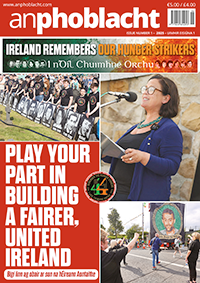
Belfast republican Bobby Sands completed his third week on hunger strike for
political status in the H-Blocks of Long Kesh on Sunday 22 March 1981. His
comrade Francis Hughes, from South Derry completed his first week on the
strike on the same day. Also on that day Sands and Hughes were joined on
their fast to the death by two other blanket men, Raymond McCreesh from
South Armagh and Patsy O'Hara from Derry City.
Bobby Sands
Bobby Sands was born in Belfast on 9 March 1954. He became involved in
active republicanism in his mid teens and when he was 18, was arrested in
Lisburn and charged with weapons possession. He was sentenced in early 1973
to five years imprisonment which he served as a political prisoner in the
cages of Long Kesh
After his release, in April 1976, Sands continued as an active republican,
and was re-arrested six months later during an IRA operation.
After 11 months on remand, Bobby Sands was sentenced to 14 years
imprisonment. When he was moved to the H-Blocks in late September 1977,
Bobby Sands refused to wear a prison uniform, and went on the blanket
protest.
Later, under the pen name Marcella, he wrote articles for Republican News.
In the H-Blocks Sands suffered the routine abuse from the prison
administration and was forcibly bathed and scrubbed down with deck brushes
on numerous occassions.
He was PRO of the Blanket men until he succeeded Brendan Hughes as OC when
Hughes went on the first hunger strike in 1980.
Sands played a major part in leading republican resistance to crimialisation
in the H-Blocks and conducted negotiations with the prison governor in
attempting to resolve the prison crisis, which foundered when the British
adopted an intransigent attitude
Francis Hughes
One of the most fearless and active young Volunteers in the armed struggle
against British occupation, 25-year-old Francis Hughes from Bellaghy in
South Derry joined the Hunger Strike on 16 March 1981.
Described Francis Hughes as "the most wanted man in the North", Hughes was
on the run for three years and despite thousands of wanted posters all over
South Derry he remained in the area, often living out in the fields and
hills while British forces scoured the countryside for him.
In March 1978 two IRA Volunteers dressed in military uniform were crossing a
field when confronted by five undercover SAS soldiers. In the shoot-out that
ensued two British soldiers were shot and the IRA Volunteers escaped the
immediate vicinity. A full-scale manhunt was mounted by hundreds of British
soldiers and RUC. Thirteen hours later Francis Hughes was found lying under
gorse bushes. He was badly wounded and had lost much blood. On his military
uniform the word 'Ireland' was emblazoned across the jacket. He was trailed
out of the gorse but refused to answer any questions.
He spent ten months in the military wing of Musgrave Park hospital, and, as
a result of his wounds, his thigh bone was operated on and reduced by
one-and-a-half inches, leaving him with a steel pin in his leg and needing
a crutch.
In August 1978 he was taken from Musgrave Park to Castlereagh interrogation
centre and for the next six days refused to answer any questions and refused
to eat or drink in case the food or water was drugged. He was charged with
organising and taking part in a number of IRA operations.
At his trial, which ended after 13 days on 18 February 1980, he was given
several lengthy sentences including life imprisonment.
When brought to the H-Blocks, Hughes immediately went on the blanket.
Ray McCreesh
Raymond McCreesh was born in the village of Camlough in South Armagh, the
second youngest in a family of four brothers and three sisters. After
leaving school he attended Newry Technical College and served an
apprenticeship as a sheet-metal worker.
At the age of 19, McCreesh was arrested after a shoot-out between the IRA
and the British army near Beleek in South Armagh in June 1976. After nine
months on remand he was sentenced in a non-jury court in March 1977.
By the time he embarked on the historic 1981 Hunger Strike, Raymond McCreesh
had spent four years on the blanket protest, and during that time forfeited
his visits rather than wear the prison uniform for the short half-hour visit
per month. He only took his first visit with his parents in 1981 to inform
them that he was going on the Hunger Strike.
Patsy O'Hara
Patrick O'Hara was born in Derry city on 11 February 1957. He was just 11
years old when, along with his parents, he took part in the big civil rights
march in Derry, on 5 October 1968, which was viciously attacked by the RUC.
A year later he again witnessed one of the milestones in the conflict when
the RUC invaded, and were defeated, during the Battle of the Bogside in
August 1969.
Patrick, known to everyone as Patsy, joined na Fianna Éireann in 1970 and,
although under-age, he joined Sinn Féin in early 1971. A few months after
the introduction of internment his eldest brother Seán was interned.
In 1974 his home was continually raided by the British army and he was
frequently harrassed and beaten up by them, before being interned in October.
After his release in April 1975, O'Hara joined the Irish Republican
Socialist Party, but within two months he was re-arrested and framed by the
British army. He spent ten months on remand before being acquitted.
The British army and RUC continued to harass the O'Hara family in 1976, and
Patsy's brother, Tony, was arrested and charged with a political offence for
which he was subsequently convicted on the basis of an alleged verbal
statement.
Patsy was arrested again in September 1976 and charged with possessing arms
and ammunition- this was really internment-by-remand and he was released
after four months when the charges were dropped.
In June 1977 he was arrested in Dublin, interrogated for seven days, and
charged with holding a Garda at gunpoint. He was released on bail six weeks
later and in January 1978 he was acquitted.
Patsy was arrested once more in May 1979. He was charged with possession of
a hand grenade and was convicted on the basis of accusations made by two
British soldiers. He was sentenced to eight years' imprisonment in January
1980 and immediately went on the blanket protest.
This week 25 years ago saw four young men, from various parts of the Six
Counties, on a hunger strike to the death in the H-Blocks of Long Kesh and
republican leadership urging the need for mobilisations and action in
support of their demands for recoignition as political prisoners.
Articles may not be reproduced without the consent of An Phoblacht. For further information, please contact