


20 March 2016
Irish reunification is an economic growth story


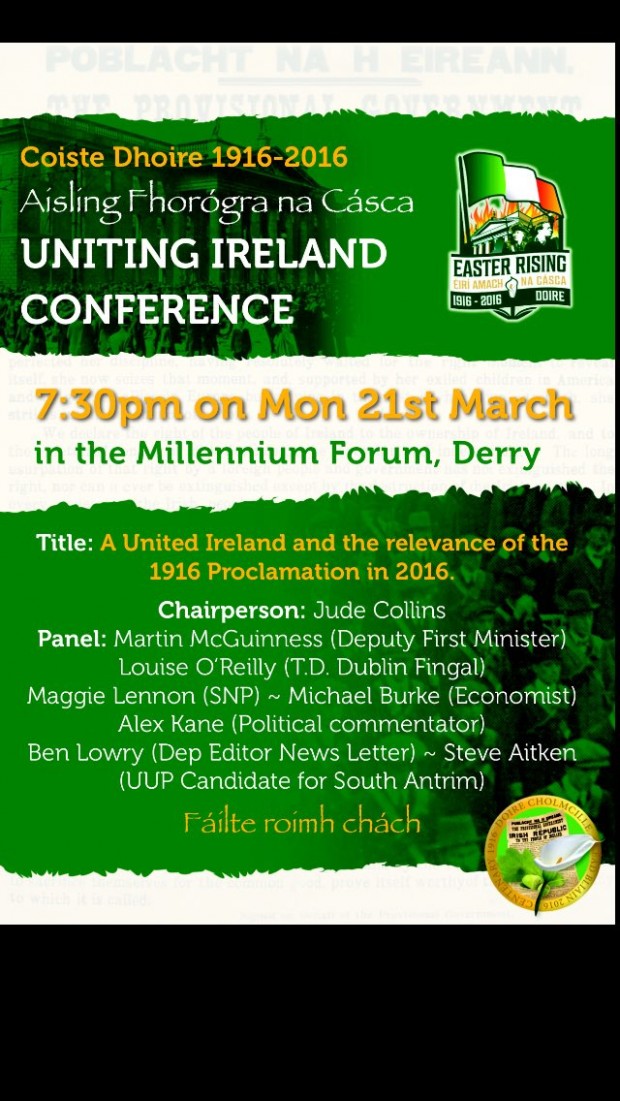
● Michael is a panellist at Monday’s ‘Uniting Ireland’ conference in Derry (details at bottom of page)
THERE ARE many and varied reasons why people taking strong opposing views on whether Ireland should be reunified. But from a strict economic perspective, the idea of reunifying the country is a no-brainer.
Average living standards would rise dramatically in a unified economy across the island. One recent academic study suggested that the economic benefits from unification would amount to more than €36billion a year within a period of less than a decade.
This means that every person – every child, woman and man – on the island would be about €6,000 a year better off from unification. That is at least £4,600 a year better off for everyone at current exchange rates.
This estimate seems entirely reasonable because Irish reunification is a growth story.
As economics plays such a little part in this ongoing debate, it is necessary to go back to first principles.
It is widely known that Adam Smith is the founder of economics as a social science. Unfortunately, he is more often (incorrectly) invoked than actually read or studied. But Smith’s genius was to correctly identify co-operative labour as the most fundamental and important factor in economics, and the single most important factor in raising living standards and productivity.
Smith called this the division of labour. But this history of Ireland and all the other colonies of the British Empire violated this most fundamental economic law. Colonies do not have their own home market in which the economic benefits of the division of labour can develop. They are also obliged to trade solely with the metropolitan centre.
This is why what is now the South of Ireland and many of the other former British colonies saw their economic fortunes completely transformed in the post-colonial period. This is also true of countries such as India and China, and even of the United States itself.
Average living standards in the South are now significantly higher than in the North – about 20% or 25% higher. Yet at the time of partition they were much lower, less than half the level in the North. This has very little to do with good or bad economic policies in Dublin or in Westminster. It reflects the different structures of the two economies.

The most important structural factor is the role of trade, which is the participation in the international division of labour. In a comparable currency, exports from the North in 2014 amounted to less than £12,000 per person; in the South, they amounted to over £40,000. Imports were comparably greater too. This means that the openness of the South’s economy is vastly greater than the North’s, both selling much more to the rest of the world and able to purchase much more from it.
This structural component of the two economies means that the economy in the South will continue to grow much more strongly over the long-term, despite how poor the economic policy choices are.
This has nothing to do with the allegedly bloated public sector in the North.
The proportions of public sector jobs in the North and in the South are 28% and 23% respectively and the discrepancy is largely accounted for by a large security service and related employment in the North. The North’s economy is not held back by having too many nurses or teachers – the North’s economy is held back because it is now an outpost of the declining British economy, which is organised around its financial sector, not manufacturing or the exports of goods. The North is not central to that, and it is largely neglected through chronic under-investment.
By contrast, unifying the Irish economy would increase the home market overnight for all enterprises, whether in the private or public sectors. This is a process that is happening naturally in any event, with the integration of health provision, the energy sector and others.
Unifying the two economies would remove the legal, political and currencies obstacles that are currently preventing Ireland reaching its full economic potential.
Follow us on Facebook
An Phoblacht on Twitter
An Phoblacht Podcast

Uncomfortable Conversations

An initiative for dialogue
for reconciliation
— — — — — — —
Contributions from key figures in the churches, academia and wider civic society as well as senior republican figures